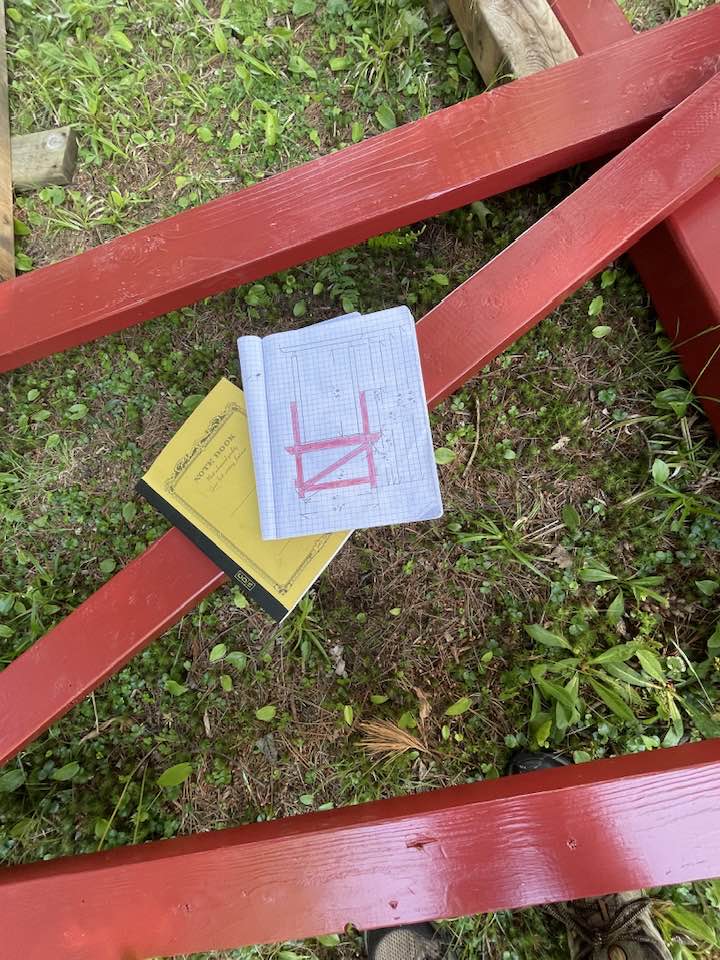
JULY 8, 2025 – I’ve written before about the “zen of cabin projects”—dock installation (and re-installation), for instance, and other endeavors involving a degree of design and engineering and requiring use of a variety of tools that can easily become dangerous if mishandled. Anyone who owns a cabin and likes DIY construction knows what I’m talking about here. Once you find your groove and develop a rhythm in project land, you discover the satisfaction that dwells in creating your own zone, which opens the door to full on Zen.
That’s where I’ve dwelt for major portions of the past few days. Three factors joined to carry me to this “happy place” up at the Red Cabin and Björnholm on Grindstone Lake in northwest Wisconsin.
The first factor was an inspiration I experienced several years ago while visiting our family place on Hamburg Cove all the way back in Connecticut. As I turned from road to driveway and slowed nearly to a stop to avoid scratching the sides of the rental car on the low-standing pillars on either side of the entrance, I looked out across the yard, past the house, past the trees and out across the cove. A gazillion times I’d cast my sight on that view “just waiting to be painted,” yet it always seemed different, dynamic, like a favorite landscape painting at the museum; a magnetic work that pulls me in no matter how many times I’ve laid eyes on it, because in the midst of familiarity is always something new and interesting about it.
But on that occasion when I turned into the entrance to Lyme Light and stopped, the “something new” was something old, something . . . missing. The missing piece (since ancient times), I thought, was a pergola of the right proportions to frame a pleasing view of the yard in the foreground and the peaceful cove in the background, with the wooded hills beyond enshrouded in a light mist. The pergola, I imagined, would have just enough embellishment to establish its originality without detracting from the masterpiece scenery that it framed. The structure would rest on the slightly mounded center of a sweeping circular driveway bordered with flowers. A flagstone walkway would meander from one side of the driveway to the pergola, then out the other side and across the opposite side of the drive, where the stone path would be bordered a short way by a low stone fence reminiscent of the signature feature of rural Connecticut (stone fences). The path would cross a stream flowing from a gurgling fountain to an elongated koi pond surrounded by an assortment of landscape grasses. The flagstones would then encircle the hammock by the oak and the hemlock before curving around to the top of the steep embankment rising above the cove.
From that day forward, each time I entered the property I added details to my imaginary landscaping project. I’m no artist, no architect, no landscaper, but I know what I like—verdancy, representing the persistence and resilience of life on planet earth; stone standing for stability, reliability, principle; flowing water as a symbol of time and connectedness; the whimsical, reflecting imagination; curves, standing for flexibility, curiosity and beauty; proportionality to project rationality—and I know what I don’t much like in design: the boring and unoriginal, the purely utilitarian without regard to aesthetics.
Anyway, because of my infrequent sojourns in Connecticut—and because I don’t have unlimited resources to deploy in the pursuit of aesthetic happiness—I haven’t converted my “pretend” world to anything tangible. On one level, this is a perfectly acceptable state of affairs. There is no cost to dreams.
The second factor underlying my current “Zen project” back in Wisconsin, is the “Björnholm tree garden” effort into which I have invested countless hours of enjoyable thought and labor. Its lacustrine location is as familiar to me as are the inside of Red Cabin and our old family cabin. Because of our proximity to Wisconsin, I have much greater access to the tree garden and spend far more time there than anywhere else beyond our primary home. I’ve long harbored “landscape” ideas for this property, but of a style driven primarily by nature’s whims, quirks and habits and far less dependent on any kind of structure that I might devise and build upon it. I envision more a well-defined trail network across interesting terrain and past notable trees and views and less a piece of architecture—last year’s “gateway” entrance being a special exception.
The third factor driving my current “Zen project” is something entirely plain, simple and lackluster: a sizable (and largely unmanageable) stock of used construction lumber—dimensional lumber stored in various corners of our garage at home, jammed under the porch, decks, nooks and crannies of the Red Cabin and before he left us, well organized by Dad in the basement of our old family cabin. Much of this wood is high grade; except for dust and cobwebs, all the lumber is “clean.”
These three factors—imagining how Lyme Light could be aesthetically enhanced; a desire to influence the shape of nature’s lines but in keeping with nature’s more “natural” state; the down-to-earth (and under the decks) challenge of diminishing the hill-billy factor by reducing the supply of usable lumber—have now finally coalesced to give me focus, give me purpose, give me inspiration, give me . . . a “Zen project.”
Stay tuned for a few mantras. (Cont.)
Subscribe to this blog and receive notifications of new posts by email.
© 2025 by Eric Nilsson

2 Comments
It’s quite wonderful to be reading your blog as I sit on your Red Cabin porch this morning! Thanks!
Cool, Chuck!