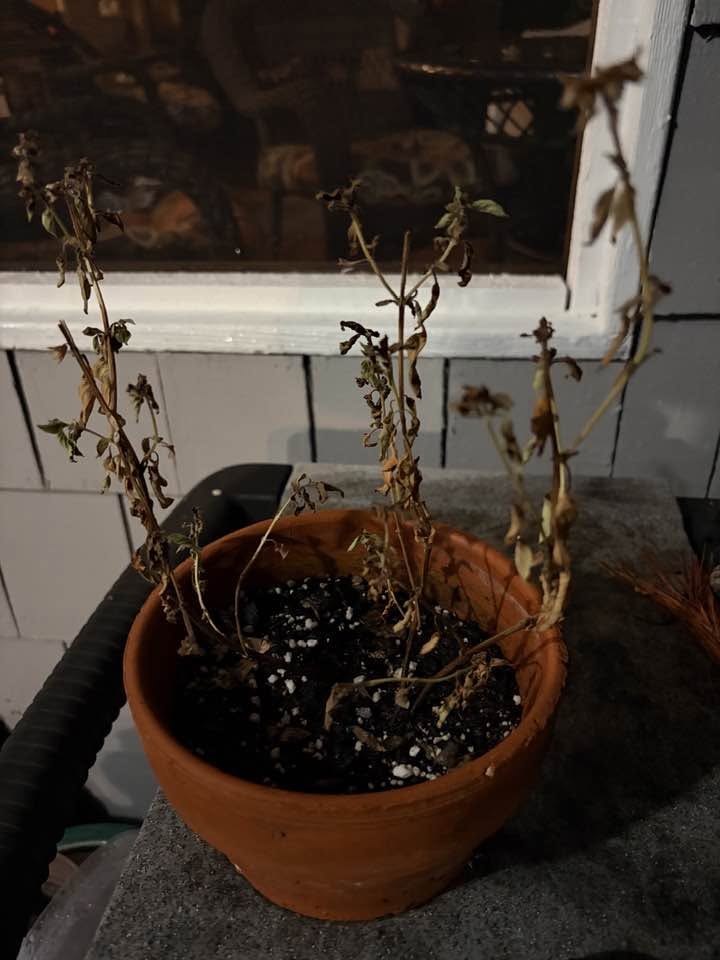
JULY 31, 2026 – When I returned home yesterday after a week’s absence, I noticed immediately the parching effect of the current drought. The lawn, front and back, was mostly yellow. Baked to a crisp, my lemon basil plant was beyond salvation, but Beth’s potted plants stood a fighting chance. I gave them a good soaking (she didn’t return from the lake until late today)—which guaranteed that today would bring a light all-day rain. A half-inch rain, however, doesn’t end a drought, and the Twin Cities, along with most of the rest of the state and region, remain in a drought.
Beth reported that rain fell up at the lake today, as well. But was it enough, I wondered, to raise the lake level enough to allow me to lower the boat into the water without having to resort to “extra engineering”? With less snowfall (and snowmelt) and less rainfall, area lakes have been adversely affected. Where will the shoreline of our lake be, I worry, by mid-century?
Today’s headline about extreme heat forecast for much of the western U.S. this weekend reminded me of other recent alarming news regarding extreme heat, drought, and ultimately, water shortages. Without digging far or long, I stumbled across a January 2026 UN report (issued before this summer’s great “bake-off”), which declared that we’ve entered an era of “global water bankruptcy.” A summary of the report provided ample bases for a reader’s distress.
Soon I was on a trail of articles citing yet more articles, all in reputable science journals and publications. I’m neither a climate scientist nor a student of the multiple scientific disciplines on which climate research, in turn, relies, but I’ve engaged in enough “informational triangulation” to believe that the global water crisis is real and headed for worse—in tandem with anthropogenic climate change. If you too want to wreck your day—rain or shine—dedicate a few minutes to reading a summary of the report, at https://unu.edu/inweh/news/world-enters-era-of-global-water-bankruptcy. Even if you’re an incorrigible skeptic living in the Land of 10,000 Lakes, statistics in the report and its dire warnings will make you very thirsty—and correspondingly appreciative of potable H2O . . . while it still flows from the tap.
As with other dire reports regarding environmental degradation of our precious planet, this UN paper on “water bankruptcy” is not without hope or direction. It urges acknowledgment that water bankruptcy is a universal issue; the report calls for the need but also points to the opportunity for cooperation among nations to address this ultra-essential issue affecting our very existence, let alone our prosperity.
But as with so many serious issues, when one wades into this matter so fundamental to our individual and collective welfare, one is immediately confronted with two related realities: First, the problem is of such gravity and complexity that it cannot be left solely to individual or market forces to be addressed effectively. The issue must be confronted by all sectors of society, ideally by public-private initiatives spearheaded by responsible and accountable governmental agencies around the world. Second, the character, competence and capacity of the current regime in the U.S. is woefully deficient to lead the world out of this era of “water bankruptcy.” Worse, however, the regime has no standing to lead, given its contemptuous disregard for all things environmental.
It’s a sad commentary on the state of our democracy that votes turn on the price of eggs (artificially inflated, as the evidence is beginning to show) or the price of gas (as opposed to the cause of the increase, namely, a war with no viable rationale or favorable outcome for our national interests). Our votes should be influenced by more central exigencies—such as “water bankruptcy”—and candidate qualifications for leading on those urgent issues.
Subscribe to this blog and received notifications of new posts by email.
© 2026 by Eric Nilsson
