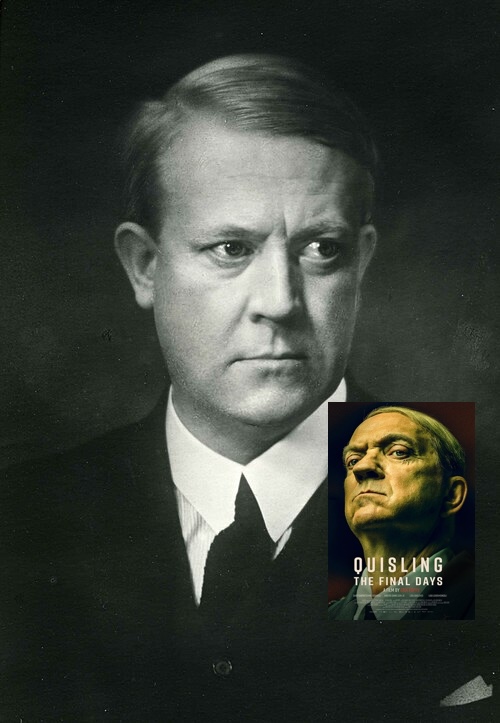
SEPTEMBER 20, 2025 – I can’t remember how old I was when I first heard the name, “Vidkun Quisling,” but it was my dad you said it. And you can bet that Dad used the word “traitor” to describe the Norwegian “Minister President” during the German occupation of Norway. So did everyone else who invoked the name “Quisling” in reference to traitorous behavior. As Dad himself quipped, “Imagine being so dishonorable that worse that Hitler or Stalin, your name becomes a word in the dictionary meaning traitor!”
Thereafter, I began noticing how “quisling” would crop up now and again to describe colluders or collaborators of one sort of another. After a time, for me Quisling the man faded into the mist of history, and eventually, upon encountering “quisling,” I heard or read “traitor” without even thinking of “Quisling.” As far as I was concerned, he was a flunkie, a nobody, a puppet, a lackey of the Nazis, and not someone that any self-respecting Norwegian, young or old, would care to remember with admiration, let alone honor. On my visits to the Museum of the Resistance in Oslo, Quisling receives treatment on a par with Benedict Arnold in American books and exhibits on the Revolution: in the case of both traitors, once we’re reminded of their turncoat status we can move on with the rest of the story of freedom, liberty and independence from foreign rule.
Recently, while scrolling through some YouTube offerings in the genre of “free movies about true stories from WW2,” I happened upon a recent Norwegian film entitled, Quisling: the Final Days. The first couple of times it appeared, I didn’t click on it. To the extent I might have any interest in Quisling whatsoever, it was in how he’d managed to weasel his way into power under the bad guys. But the “final days”? On that front I knew all I wanted or needed to know—which, is what anyone with a passing knowledge of Norway’s experience in World War II could guess: When the Nazis were defeated, Quisling’s salad days were over, and he met the same fate as Benedict Arnold. He was hanged.
But when Quisling: the Final Days popped up a third time, I decided to give it a whirl. The movie—a Norwegian production in Norwegian with English subtitles—turned out to be a superb production featuring what I found to be a fascinating and accurate portrayal of the man. I highly recommend it, not only to people with Norwegian or broader Scandinavian connections or an interest in World War II history, but anyone with an interest in the Russian Civil War (you read that correctly), ethics, morality, Norse mythology, runaway nationalism, and the conundrums of Christianity. As it turns out, the man that history uniformly despises (even Hitler and Stalin have their modern-day admirers!) was well-educated, accomplished, well regarded at home and abroad (before his fall from grace) but also . . . complicated and, of course, terribly flawed. Oh, and by the way, after a trial in August and September 1945, Quisling was sentenced to death by firing squad—not by hanging, which had been my pre-movie assumption. After an unsuccessful appeal to the Supreme Court, the execution was carried out in the early hours of October 24, 1945.
Directed by the critically acclaimed Norwegian director, Erik Poppe, the film has all the attributes of an award-winning production. The actor who portrays Quisling, the (good) Norwegian Gard Eidsvold, is nothing short of superb, and his performance is enhanced by a physiognomy that matches almost identically, photographic and video images of the historical figure.
In Part II I’ll delve more into the remarkable story that the film tells with such extraordinary effect. To check for historical accuracy, I watched a definitive documentary on the quisling . . . I mean Quisling. Few historical dramas I’ve watched can match this one for factual fidelity. (Cont.)
Subscribe to this blog and receive notifications of new posts by email.
© 2025 by Eric Nilsson

1 Comment
Very nice views – which I certainly approve by the way . My grand father Eivind Venstad ( from outside Elverum city in Norway) was imprisoned most of the war after refusing to teach students with the new Nazi books , as the local school teacher . A man of honour , he was . And – I am still proud of what he did – for everbody . Quisling on the other hand – he have a place in history – as of an example of what intelligent – but narrow minded people can do . Damage and havoc on a high scale . May Quisling not rest in peace.