SEPTEMBER 9, 2026 – Though music defines many people in our family, many are also defined by writing.
Take my parents, for example. My mother, it seemed, was always writing up a storm, and during the eight years I was away at school, she dashed off several hundred letters. Each was a mix of advice, opinion, questions, and news on multiple fronts. She maintained similar correspondence with each of my three sisters, grandparents and uncle. Her command of spelling, syntax and grammar was never shy of an A+. The salient feature of her glib writing was the underscore; so much so, she could’ve saved volumes of ink simply by using lined paper instead of unlined stationery.
Dad was also a prolific writer, but as a diarist, storyteller, memoirist, and occasional poet. After he died, I discovered a huge cache of his written work product as a court administrator—copies of memoranda and correspondence that he maintained in carefully organized files. Whether he was taking some lawyer to task . . . or telling an amusing story . . . or writing a lengthy poem on the back of the cabinet he built to house Mother’s piano music . . . or writing strictly for himself in the spiral notebooks that served as his diary, Dad was a master of form and style. Without exception his handwriting adhered to his perfectionist standards; even a list of supplies he needed at the hardware store appeared as a textbook form of penmanship. For every 100 of Mother’s letters, Dad wrote one, but it was guaranteed to be a work of art—in content, as well as appearance.
My oldest sister Kristina (“Nina”) took up the pen with as much natural ability as she picked up her violin bow. The draw of literature, not to mention debate and politics, led her to revel in language. The high-sized debate tournament trophy in the attic belonged to her; so did the school spelling bee prize. And she owns the crushing Scrabble victories recorded for posterity in the heavy three-hole Scrabble Score Notebook at Lyme Light.[1]
I’ll never forget the occasion during one of her visits to Björnholm when Jenny was also on hand, and the two were playing a game of checkers. The match was not going well for Kristina, and not liking to be bested—by her younger sibling by eight years, no less—she began to tear up as she questioned her own intelligence.
But Jenny, who will figure most prominently in this post and has always been the family’s most reliable source of moral support, knew exactly what to say: “That’s okay, Nina,” she said. “You still have your vocabulary to fall back on.”
Everyone on hand—including Nina—burst out in laughter.
Anyway, after becoming a professional violinist, Kristina became a lawyer, whose tool in trade, of course, is language, until she realized she was first a violinist and second, a lawyer. But living in a world of musical notation didn’t mean she could ever leave the world of words. On the side she became a free-lance editor, and living in Brookline and Newton Highlands, Massachusetts, each a community of academics, she had plenty of serious work cut out for her—scholarly books and papers. As a mechanical editor, she didn’t just “cut”; she ripped PhD writing to shreds.
I could relate to her clients. During our school years, we corresponded quite heavily, and there were occasions when she’d photocopy my latest letter, mark it up as none of my English teachers could, and send it back.
Her own writing, of course, is from rarified heights. I often picture her writing not with a pen or a typewriter but with a figurative super-box of Crayola-brand crayons—the one with 64, which is what Barb Johnston had in third grade and that I so desperately wanted but my mother said was too expensive. In other words, Jenny was wholly correct: if all else in life went south, Kristina would always have her enormous vocabulary, so full of colorful words the rest of us would never encounter except in Webster’s (unabridged) dictionary. She has no need for a thesaurus, on-desk or online, since planted deep inside her long-term memory somewhere is all-inclusive synonymy.
Holding her own, meanwhile, is my sister Elsa, whose handle on the mechanics of writing has always been top shelf. She saved her expressive genius (along with technical perfection), however, for the violin. The bow in her hand was like the pen of a great writer. When she dashed off a letter to me at school, however, her pen was like her bow.
But the writing didn’t end with my parents and older sisters. Jenny wound up marrying an internationally acclaimed best-selling novelist with a pile of other popular books to his name, not to mention his authorship of countless nationally syndicated columns and articles. He had the unusual style and wide respect to bend all the rules for which Kristina was a stickler. But that’s what a famous writer has full license to do: ignore the rules and chart his or her own path. Somewhat ironically, he is the only English major in the family.
The way with words continues among the next generation: my nieces, who can write like nobody’s business. The oldest, Hillary, graduated from Medill School of Journalism at Northwestern University and became a special feature writer for the AP. The next oldest is an aficionado of fountain pens and can wield them with great proficiency. The third in line is a star stand-up comedienne, who, of course, writes all her own jokes.
A Swedish second cousin, Jan Kotschalk, is a retired sports writer for a major Swedish newspaper, and has published two histories about the exploits of his famous father.
Not to be overshadowed is another writer in the family: Kerri, the wife of Russ, a very close second cousin of my sisters and me. She used to write a regular newspaper column for a regional paper in Silicon Valley, and her amusing style and complete command of technique are nothing short of “blue ribbon – special mention” quality. A while ago while we were visiting Russ and Kerri, she took a turn at marking up the essay of a student mentee of mine. When I read her detailed comments, I nearly choked—feeling as if I required mentoring.
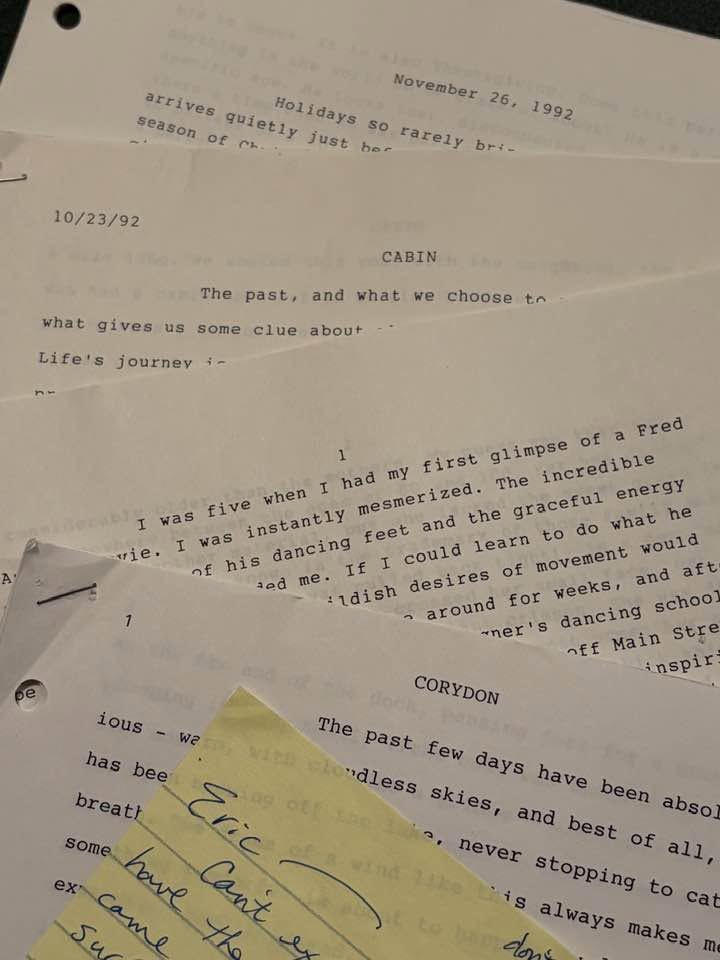
Recently, a package arrived from Kerri. She and Russ are preparing to move after 40 years in their current abode. Amidst their domestic archaeology project, she uncovered five stories hammered out on a typewriter. None bore the writer’s identity, and Kerri had no idea how they’d landed inside a box on a shelf in a closet of the archaeological dig site. She didn’t have the time to read them, but from a phrase here and there she saw that the setting for two of the stories, at least, was Björnholm—a place she and Russ and Russ’s parents, uncles and grandparents had visited many times. But who had authored the writing on paper yellowed by time?
Upon reading the first couple of sentences of the top story, I knew exactly who the writer was: the most naturally gifted writer of the family, hands down—Jenny (named after Russ’s grandmother), author of the novel (subsequently made into a Disney movie), The Sandy Bottom Orchestra. If her vocabulary isn’t a match for Kristina’s, Jenny’s free-flowing, imaginative style is to story-telling what Jenny’s namesake, the Swedish Nightingale, was to singing.
Most writers must think when writing. After all, by definition, writing is thinking—invariably at a deeper level than speaking. Jenny, on the other hand, doesn’t have to think about what words to put on the page or in what order. She has such an exceptional gift for written expression, all she needs to do is move her pen across the paper or fingers across the fingerboard. The prose magically follows in the wake of pen and fingers.
One of the stories included in the package Kerri sent was entitled “Corydon.” I remember when and where she composed it: the summer of 1991 at Grindstone Lake. Our son Cory was six years old; his brother, three. Our family was enjoying a splendid sun-filled weekend. The breeze was up, and Beth and I were sitting at the water’s edge with Cory and Byron. Undaunted by wind and waves, Jenny rowed down from Björnholm to visit, and a while later, Dad appeared, albeit by land.
When Jenny returned to the old family cabin, she sat down and dashed off a masterpiece:
The past few days have been absolutely glorious—warm with cloudless skies, and best of all, a high wind has been blowing off the lake, never stopping to catch its breath. The drama of a wind like this always makes me feel as if something wonderful is about to happen; my daydreams become more expansive, more inspired [. . .]
[. . .] The children looked so beautifully young and free with the sun shining on their soft, brown, little backs. I think we all felt invigorated sitting there in the sun, the wind coming wildly at us from the sparkling water. The white-caps, tumbling incessantly onto the shore, made the lake seem bigger than usual. Gulls circled above us. Sometimes the wind seemed to pull them backwards. Occasionally one dove for a small fish. My nephews shouted with excitement when we spotted the eagle overhead. It was magnificent—soaring on air currents; sometimes it hung almost motionless above, cautiously observing us.
My brother decided to test the elements with his sailboat; he was soon rigging the sails. My older nephew found the water irresistible. He removed his clothes and was soon at the far end of the dock, pausing just for a moment before plunging in. His small, lithe body was enchantingly radiant. At that moment he looked like a prince—his realm being the water, the wind, and the sun. he belonged to the elements far more than he belonged to us. The presence of a child is a miracle, but he is only a visitor; he will grow up, and the child I saw today will be gone, buried deep within—recognizable only to himself. I wanted to gaze at that picture of innocent freedom forever: a small boy standing alone, facing in the wind, the brilliant sunshine reflecting off his smooth skin. A boy of six is a restless creature—he jumped in. We smiled as we watched him. My sister-in-law said, “Imagine how wonderful that feels—to be naked in the water like that.”
Is there anything left in us from when we were six?
My sister-in-law got up to go inside. “Could you keep your eye on him?” She nodded toward the lake. My eyes were glued to that small creature frolicking in the waves. He looked so exuberant. I tried to imagine the energy, the lightness, within that little child. I knew he was shouting just for the sheer joy of it, but the din of the waves erased any of his sounds before they reached the shore [. . .]
[. . .] He faced the far shore, leaping like a wild dolphin into each approaching wave. His little form bobbed recklessly up and down in the water. Occasionally his dear, round, dark head would be completely submerged, only to reappear quickly with glistening jewels of liquid light covering this black hair. He was in a state of exhilaration I lost long ago. I sat watching, mesmerized by his movements. He was part of a perfect dance—his whole being was intertwined with the forces of nature. How quickly his thin arms and legs carried him away from the staid security of the land!
As I stood watching, I could neither move nor speak. Another moment passed, and then I realized our dear little boy was moving all too rapidly away from us. For just a split second I could not judge whether his movements were those of helplessness or of great harmony with the wild waters. I ran to the end of the dock, shouting his name, motioning him to come in. At first the wild creature did not hear me, but then he slowly worked his way back to shore. How I envied his childlike freedom, his fearlessness! Climbing out of the lake, he shivered slightly before wrapping himself in the soft warmth of a beach towel. As he stood there with droplets of water falling away from him, he emanated a cool, fresh energy. He snuggled against his mother, who’d returned to the dock, and said, “If I could have just one wish, just one—you know what I would wish?”
“What would you wish?” I said.
“That I could live forever.”
Subscribe to this blog and received notifications of new posts by email.
© 2026 by Eric Nilsson
[1] Our family’s retreat in Lyme, Connecticut.

1 Comment
Thanks for sharing your sister’s writing. I could feel the wind coming across the lake and the joy of watching our children play in the water. Oh, that our children can feel that same joy watching their children enjoy life! Lisa’s expecting another boy in early December; that makes 5 grandchildren for us.