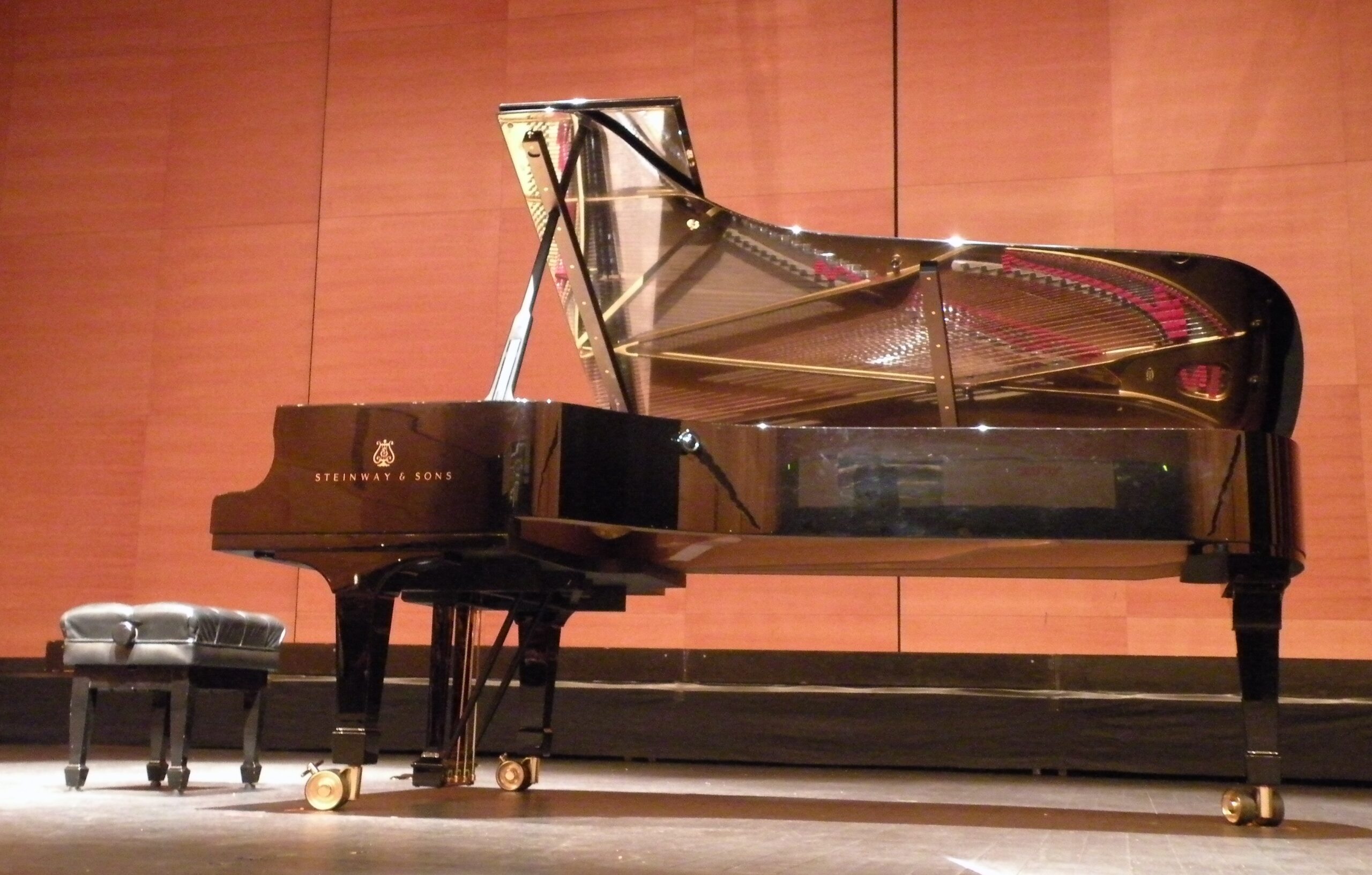
NOVEMBER 7, 2026 – Our family has strong ties to ROK—the “Republic of Korea,” commonly known as “South Korea.” There’s the adoption connection, of course, b ut another link predates it. That’s the musical bond. It’s not mine but that of my musician sisters who, from the early days their extended careers on the concert stage, have had many Korean friends and colleagues, mostly violinists. As to me, I’ve simply enjoyed the explosion of music-making by a vast number of Korean Western classical music performers, primarily violinists . . . and pianists.
Until very recently, I’d never investigated the origins of South Koreans’ abiding appreciation for Western classical music. I’d took the embrace for granted: in symphony orchestras across Europe and the United States, Korean-born musicians are so commonplace as to be unremarkable—though their musicianship is uncommonly good. Likewise, among the world’s top concertizing pianists Koreans are represented disproportionately.
Last Monday evening, to divert my anxieties about Tuesday’s election, I switched the TV from agitated political jabber to Netflix, and in scrolling through a gazillion choices, most of which were cheap hookless lures on an endless fishing line, my attention was snagged by a Korean production called, Four Hands, Two Sonatas. My curiosity was triggered by introductory frames showing a young pianist playing an allegro excerpt from a Beethoven sonata. I was suddenly “all in” when I pressed the play button and with a Woosh! was carried off to Prague—a city I’ve visited extensively multiple times—to the music of a four-hand (one piano) transcription of Danse Macabre by Camille Saint-Saëns[1].
By-passing the post mortem cablevision analyses of Tuesday’s election results, I binge-watched all 12 episodes of the Netflix series. My reaction to the production: WOW!
Having grown up in a household filled with classical music—a hefty portion of it coming from the piano—this art form was as familiar to me as major league sports were to most of my school chums. My high school years at Interlochen Arts Academy involved an even deeper immersion into music. One of my best friends during that time was Greg Schatten, something of a prodigy at the piano, whose virtuosity extended across a broad repertoire, overlapping with pieces I studied on the violin—the Franck Sonata for violin and piano, for example, which is wickedly difficult for the piano, and Mendelssohn’s Piano Trio (w/ violin and cello) in d minor.
I lost track of Greg after graduation, when he went off to Juilliard in the big city and I, to a regular liberal arts college in Maine. Although during my freshman year I took weekly lessons at New England Conservatory in Boston, my central impressions of conservatories were shaped vicariously by the experiences—and firsthand stories—of my three sisters.
During my late teens when my brain chemistry produced the occasional fantasy of pursuing a musical career, that reverie was easily vanquished when I heard my sisters or fellow students at Interlochen play.
Since then, albeit rarely, when listening to masterful performances of musical masterpieces, I’ve experienced recurrences of the musical fantasy—“If only I’d started earlier and worked much harder to the exclusion of all else . . .” I’ll think wistfully, “maybe I could’ve amounted to something.”
But what I know to be true is that a musical career would’ve led to a bad outcome. At the rarefied end of the hypothetical spectrum: first prize at prestigious international competitions—Chopin, Cliburn, Tchaikowsky, Leeds; a globe-trotting career as a sought-after “warhorse concerto” soloist, with over a million albums sold. Yet, in many respects, it wouldn’t have been an enviable life—always on the road, and outside of practice and rehearsals, no time for anything except taxi rides to and from airports, hotels and concert venues, with the risk of fame and fortune going down the drain because of disabling repetitive injuries to fingers, wrist, elbow and shoulder.
At the other end of the spectrum: one failed audition after another—mostly because of lack of talent or proficiency or on account of a bad case of nerves or behind-the-scenes politics. And upon hanging up on the music world, I’d have carried great pain, as if by the barbs and weight of unrequited love.
The best case I could’ve realistically expected would’ve been a career of mediocrity—in achievement and reward. I think of this fate of mediocrity whenever I hear my sisters talk about other musicians they’ve encountered over the long tracks of their careers. Many of their colleagues, of course, have been world class, but others are, well, not so world class. The comments about these latter musicians are what make me shudder; comments such as, “Yeah, so-and-so? Mmmm. He’s not great, but he’s an okay violinist.”
An “okay violinist”? Imagine, I’ve often pondered, being infatuated with the beauty of music, working as hard as possible to be the best I could be at polishing the double-sided coin of performance—divine at its best, but at a price of untold hours of daily toil—only to hit the cruel ceiling of mediocrity.
Against the foregoing background, the Netflix series, Four Hands, Two Sonatas, underscored my conflicted relationship with great music: I love it deeply but am equally relieved not to have married it.
The 12-episode show plunges the viewer/auditor into one of the most elite arenas within the rarified North Star region of Western classical music—venued not in the West, but in the East, namely South Korea. A serious musician or music aficionado would appreciate how very well the series is constructed; how every detail is crafted. Apart from documentaries featuring films/recordings of actual famous musicians, I’ve seen no other film production that matches the musical sophistication of Four Hands, Two Sonatas. Throughout the 12-episode series, the viewer/auditor gets to feast on extended morsels by Bach, Mozart, Beethoven, Chopin, Schubert, Schumann, Liszt, Saint-Saëns, and Shin You-Jin—not as “background” soundtrack pieces, but as integral elements of the story, performed by top-drawer musicians. Moreover, the series draws the audience/spectators into the broader world of classical music production, promotion, business, and above all, competition, which, in Korea, is taken to an extreme level.
Using this extraordinary art form as a vehicle, the series explores aspects of the human condition that transcend the music world. It is this feature that I think gives the work universal appeal—even among folks with very little or no background in classical music.
The story spins around two fiercely competitive pianists from contrasting backgrounds. One, Kang Bio, hails from a wealthy and musically prominent family. His grandfather is a world-renowned conductor with standards no one can meet. Bio’s mother, a former ballerina, has devoted all her energy (accompanied by criminal machinations) into turning her son into the world’s greatest pianist. The three live under the same roof, despite monumental friction among the three.
The competing pianist, Choi Jeong-yo, grows up in hard-scrabbled circumstances after his mother dies and his father’s life, well lubricated, falls apart. At an early stage, Jeong-yo had learned to play the piano (under his mother’s auspices) and even played in a children’s competition, where he first met Kang Bio (Choi’s mother died of a heart attack during the competition, forever traumatizing him). Soon thereafter, Choi gave up the piano and swore off music altogether.
As the story develops, Choi is “discovered” and recognized as a prodigy. He’s granted a full scholarship to the prestigious Korean Arts School, where Kang is a top student. The two become friends—but also competitors—and from there the story unfolds dramatically—not only in Seoul but in Prague, Romania and Moldova, of all places.
Based on obsessive perfection, twisted expectations, erroneous perceptions, guilt and greed, and a host of other human frailties, the lives of the lead and supporting characters become intertwined in multi-dimensional conflict and tension. Despite the viewer’s hope for relief before the whole story—and its characters—streak off the cliff, the whole shebang does just that: it goes over the cliff.
And yet, all is not lost. Redemption and reconciliation occur, at least modestly, and the viewer is satisfied with the outcome.
As is the case with so many streaming series, Four Hands, Two Sonatas has a story line, casting, acting, directing, writing, and overall production values that render it worth watching. But two aspects of the series make it extraordinary. First, of course is the musical element—presented at such a high and sophisticated caliber. Second, and thought-provoking well beyond the viewing time, is the tightly wound paradox of great art: as it transcends all the dysfunctionality of our species and transmutes human intelligence, emotions, and imagination into divine expression, great art can also be the sanctuary of people with traits as despicable as exist in any other human endeavor. The series confronts this paradox but doesn’t pretend to resolve it.
In any case, the unusual musical appeal of the series stirred my curiosity: why is Western classical music so popular and successful in South Korea? Stay tuned . . . and in tune. (Cont.)
Subscribe to this blog and receive notifications of new posts by email.
© 2026 by Eric Nilsson
[1] The famous piece has undergone multiple arrangements, transcriptions and modifications, though all of these have preserved its original essence. It was originally written as an “art song,” a (Western) musical work for single voice and piano accompaniment. Saint-Saëns himself reworked the piece into a symphonic poem for orchestra and was premiered in 1875. Disturbing in its anxiety-ridden dissonance, it was not well received. Soon thereafter, Franz Liszt—a close friend of Saint-Saëns (until researching for this post, I had no idea the two famous composer/pianists were contemporaries, let alone friends!)—wrote a piano transcription. Many other piano transcriptions followed by other composers/arrangers, including one for four hands (same piano) by Ernest Guiraud (1837 (New Orleans) – 1892 (Paris)) a renowned teacher and composer famous for writing orchestral recitatives for Bizet’s Carmen and Offenbach’s The Tales of Hoffman). Saint-Saëns got back into the act with a piano transcription for four hands—two pianos, as well as another for piano and violin. Finally, along came the incomparable pianist Vladimir Horowitz, who recrafted Liszt’s version. The Horowitz arrangement is the one most often played today. Now consider yourself well-prepared for the next “Trivia Night” at your favorite micro-brewery; more specifically, the “Micro-Trivia” round.
