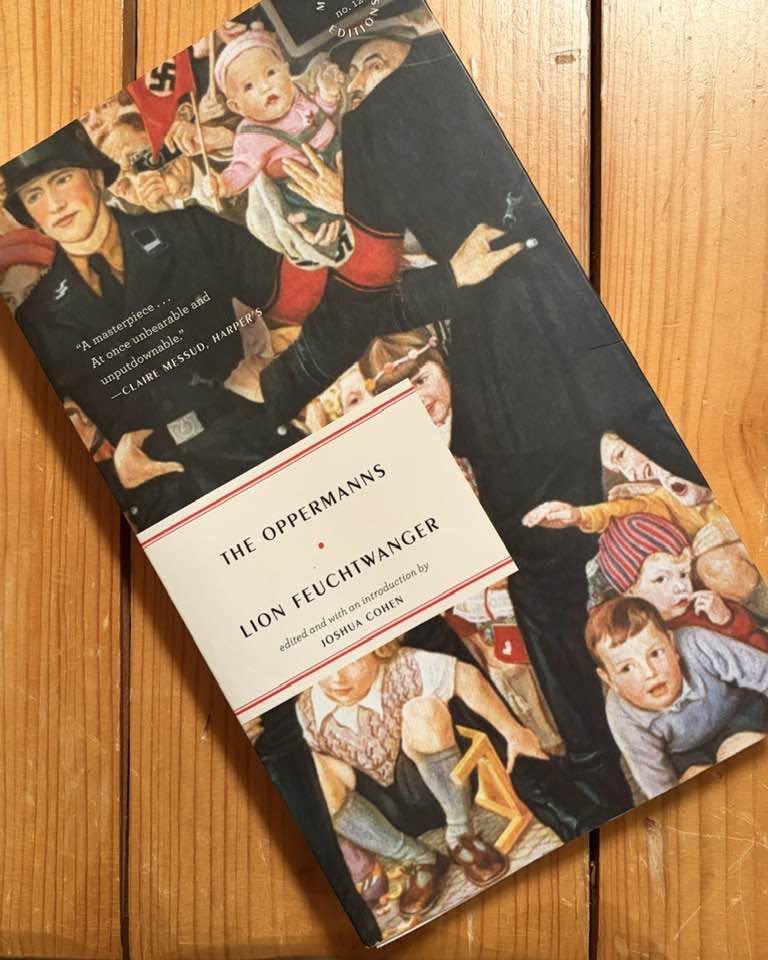
JULY 9, 2026 – (Cont.) The reasons I say The Oppermanns is “a book for our times,” are chilling against the backdrop of what we’re now witnessing in America. I don’t suggest by this that one epoch is identical to another. History doesn’t “repeat itself” as an exercise in klecksography. No inkblot on the page of history, folded in half for a Rorschach test, produces a mirror image. But let’s face it: one constant of the human story is the human condition—and its imperfections—leading with the susceptibility to all manners of nonsense that in turn, often result in disaster. That we survive repeated disasters is proof of our resilience—so far, anyway.
If you delve into Lion Feuchtwanger’s prescient novel, over the nine-month period covered by the story—beginning nearly three months before Adolf Hitler was appointed chancellor of Germany—you will be astonished by the parallels to our own times, 94 years later. Enough common touch points exist to trigger some of the loudest, most dire alarms in the lives of Baby Boomers—not to mention our elders and the “alphabet generations” that follow us.
Since we readers have a nearly century-age prism through which to consider the characters and conditions in Germany at the outset of the book—November 1932—we are like time-travelers who can enter their homes, their books, their places of business and study, their conversations, their innermost thoughts and emotions. Yet, we are helpless in winning their attention. They can’t hear us or see us, as we reach out to warn them of the storm that’s about to break, not only on their lives but on the rest of the world, claiming 60 million to 80 million, including 55 million civilians. The magnitude of the conflagration is beyond our capacity to grasp, and in this regard, Stalin was coldly correct: “One death is a tragedy. A million deaths are a statistic.” (Times 60 to 80!)
One recurring theme in Feuchtwanger’s disturbing work is the attitude that many people—including many in the Oppermann family—were “over-reacting” to the early onset of Nazi violence and encroachment of civil rights. With the ramp-up in censorship, fewer of the incidents got reported, at least in any detail, and when information did make its way around, the reaction among decent folk was often, “The majority of Germans don’t condone it and won’t stand for it.” Moreover, Germany was a modern, well-educated state with many deep intellectual and artistic traditions. The Nazi goons, by contrast, were largely losers, incompetent, uncultivated. Being in the minority, how could they possibly stay in power long enough to be a serious threat?
One hears these same reactions today. “This isn’t Nazi Germany,” people say. “Two-thirds of Americans don’t approve of Trump’s authoritarian streak,” they add with encouragement. “Besides,” it is said, “they’re so ignorant and incompetent, they’re doomed to fail—sooner, rather than later. By November, voters will lose confidence and vote the nincompoops out.”
Soon after the Nazis came to power in early March 1933, the civil service in Germany and more critically, the education system, saw the primacy of loyalty over ability, experience and competence. One’s qualifications for work, housing, and other benefits of society were measured by one’s loyalty to the main tenet of National Socialism: loyalty to National Socialism and more specifically, to “the Leader.” The central trait of the Nazi takeover—blind loyalty and sycophancy—is the core value of the Trump regime.
In Germany, loyalty over truth undermined society, just as this same phenomenon weakens America. This downgrade results from the two main forms of loyalty: one fueled by fear of loss (of position, power, and worse), the other driven by avarice, the chance to gain advantage over one’s less loyal and sycophantic peers. Furthermore, in addition to crowding out competence, abject loyalty to Trump has led to a streak of anti-expertise and anti-intellectualism: not a single member of the Trump cabinet has any background or expertise in the area of his/her purview. For the past year, the Administration has been on attack mode against education institutions. The same phenomenon prevailed in Germany, as symbolized so graphically by the mass-book burnings across the country and imposition of crass ignorance and propaganda on university curricula.
Then, of course, there were the Jews. Only the heartless and ignorant person today can deny the close parallel between the continuous pogrom against the Jews of Germany in the 1930s and the treatment of immigrants in America in 2025-26. As noted earlier, the Jewish population of Germany in 1932 was slightly more than half a million out of a population of 65 million—in other words, less than 1%. Moreover, their prowess and accomplishments in the arts, law, science, medicine, and academia were vastly greater than their numbers would suggest—to the inestimable benefit and advantage of Germany as a whole[1]. The much publicized 11 million undocumented immigrants in the United States are also fewer than 1% of the total population. Their contributions in the crop fields, in factories, in construction, in the hospitality industry and myriad other parts of American life; to the economy and the Treasury Department—are also inestimable. The “bad apples” that dishonest and disingenuous politicians and social media influencers use to create an entire scapegoat class is fundamentally no different from how the Nazis labeled and treated Jews.
In both instances—Nazi Germany and Trumpian America—“scapegoatism” fueled directly a brutally cruel campaign of arrest and maltreatment in detention centers—all beyond the attention of most Germans then and most Americans now.
Beginning last week with the irresponsible red-baiting rhetoric of Trump and Speaker Johnson, we see a redux of the same approach of the Nazis. Next to the Jews, “communists”—real and imagined—become designated “Enemies of the People” in Nazi Germany.[2]
Many other incidents—in plain sight, as well as under the surface—in The Oppermanns are stark reminders of how authoritarianism creeps before it leaps. (Feuchtwanger describes how “normal” much of life in Germany seemed to be, despite the rapid disassembly of democratic norms and institutions behind the semblance of order and prosperity.) If you find reason to fear what lies ahead for America, The Oppermanns will provide little comfort. Yet, it should motivate you to resist the trends that surround us and work to retrieve what we’ve already lost.
In any event, The Oppermanns is superbly crafted. By any measure it’s a work of great literature. Though I have other books that I’m currently reading and yet more cramming the “on deck” circle, I’ve begun my second reading of this book. With that disclosure I urge you to read it . . . at least once.
Subscribe to this blog and received notifications of new posts by email.
© 2026 by Eric Nilsson
[1] In the Great War, Jewish soldiers served in numbers and with valor in much greater proportions than was the case with the general population of Germany. Nevertheless, after the war, a propaganda campaign convinced many Germans that it was “The Jews who’d stabbed them in the back.” Nothing could be further from the truth, any more that it is true that the “rapists and other violent criminals” comprise more than a statistically insignificant number of the 11 million immigrants that today’s propagandists have targeted.
[2] In baffling irony, Feuchtwanger became enamored of Stalin and the Soviet Union, where the tactics deployed against humanity reached a scale that would eclipse the horrors unleashed by the Nazis. To reconcile Freuchtwanger’s rare insights into what was unfolding in Germany with his embrace of the USSR during the same decade, one must assume ignorance and naivete on the part of the novelist. So it was with many other liberals in the West. But Stalin’s propagandists were masterful in presenting the Soviet Union as a “workers’ paradise.”
