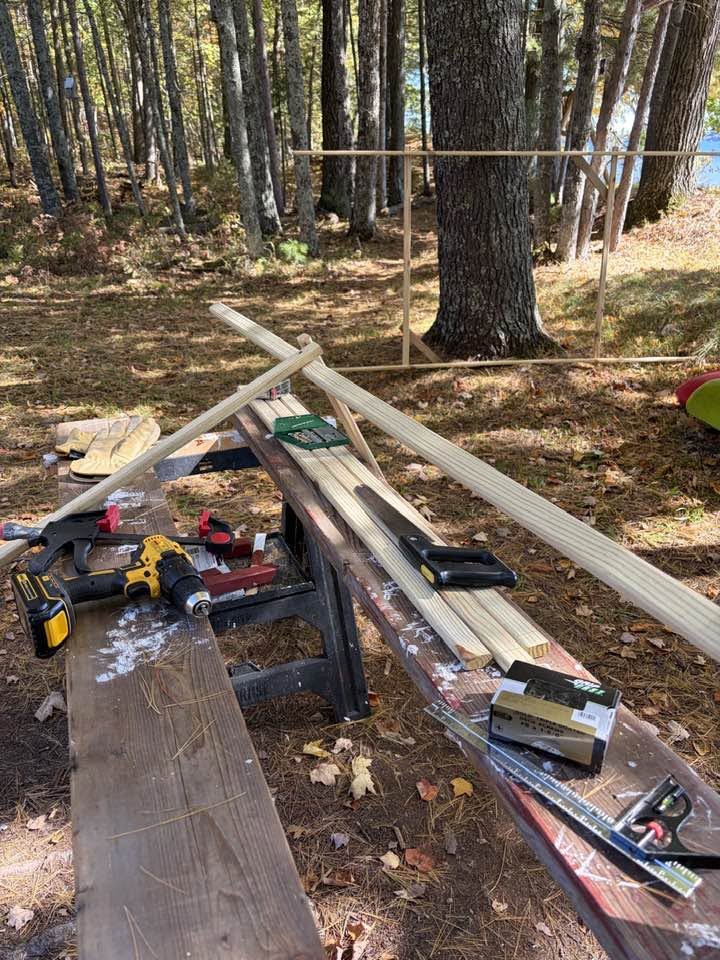
OCTOBER 2, 2026 – After dispensing with yesterday’s “reverse engineering” mission, an altogether enjoyable undertaking, today I turned to another, long-anticipated project: construction and installation of protective cages for the larger set of hemlock trees among the 30 I’ve planted over the past four years.
By way of background, I’ve always been partial to hemlocks (though the white pine will always be my favorite evergreen), and once I grew serious about fostering a tree garden within the woods of Björnholm, my vision for the project expanded to include a place for this short-needled evergreen, not to be confused with the poison hemlock plant. The principal challenge with cultivating hemlocks, in fact, is that they double as deer-candy. Whereas the white pine is also “deer-candy,” generally deer devour only the terminal shoot bud of that tree. The tree will survive, though cheated out of a year’s vertical growth until a branch in the top whorl takes over. In the case of a hemlock sapling, however, deer go ga-ga. They’ll consume every single accessible needle of the poor tree. Whereas a white pine can be adequately protected by a simple paper bud cap stapled around the top bud before winter sets in, a hemlock requires more comprehensive protection.
For weeks, I’d been researching examples of tree cages for defense against the dam_ deer. At scale, the materials were way to expensive, yet less expensive materials offered unreliable protection. Thus, I was compelled to design my own kind of housing for the hemlocks that have begun to flourish, attaining a height of five to six feet (the upper limit for browing deer) and a diameter of about four feet.
As I mentioned in Wednesday’s post, my original specifications, calling for 2 x 2s and full diagonal bracing on each side, proved to be too heavy—and in cost, approached the expense of other materials I’d found recommended online. But as I drove away from Menard’s with 1 x 2s, I wasn’t confident that the smaller size members would provide adequate stability.
This morning it was show time: I’d thought about the tree cages for all too long. Now it was time to put theory to practice—before the inevitably colder weather descended on the tree garden, followed by winter and . . . browsing deer. The weather was ideal, and once I summoned the gumption to start cutting and drilling my brand new stock of wood, I was back in “Nirvanaland” (see yesterday’s post).
The key to a building a stable cage—as with anything standing on four legs—is bracing. I realized, however, that I hadn’t bought enough 1 x 2s the other day to provide for full diagonal bracing. After scavenging for substitute lumber among my various stashes, I found just enough wood to fashion corner bracing—two braces per side of the cage. Several hours later (interrupted by client calls and emails and all-important lunch), I’d completed two halves of the 8 x 4 wood cage frame for the first hemlock. Now to transport them to the tree garden.
As I headed down the trail, I felt like one of those big wide flatbed trucks with the huge “WIDE LOAD” sign across the front bumper and the same notice on the back of the trailer, hauling some oversized clumsy piece of equipment. The four-foot cross members of each half-cage kept catching a tree branch here or a tree trunk there. Eventually, though, both halves were delivered successfully.
I hadn’t thought through adequately just how with only two arms and hands I would attach the two halves. On their own, the half-frames were unwieldy and undisciplined. Each wanted to move in the opposite direction from what I intended, and in trying to position them so that I could drill holes and attach cross-pieces with upright elements, I came very close to losing control. “No matter what you do,” I told myself, “DO NOT allow either half of your crazy cage to fall on the hemlock and snap it in half! The irony in such an outcome would be immense.”
Out of abject fear of busting the very tree I was trying to protect, I hiked back to the Red Cabin to retrieve several clamps. These were deployed successfully to allow full assembly of the case without endangering the subject tree.
Half an hour later, the beautiful hemlock was inside its “cage,” and the cage was staked to prevent it from tipping over onto the tree.
I didn’t have time to wrap my supply of green plastic snow fencing around the cage. The sun was slipping down fast, and I needed to clean up, pack up, and hit the road in time to pick up Beth at the airport later this evening as she concludes her “cousin trip” to the Maritimes.
This “special projects” stay at the Red Cabin was all too short, but so it goes with any sojourn in Nirvanaland. Let me restate that: I was blessed with two-plus days up there, and am rejuvenated by the project work, as well as by the gorgeous fall scenery. I’m left to wonder, though, if a person passing by those hemlocks 50 or 100 years from now might know that once upon a time, they were confined to winter cages.
Subscribe to this blog and received notifications of new posts by email.
© 2026 by Eric Nilsson
