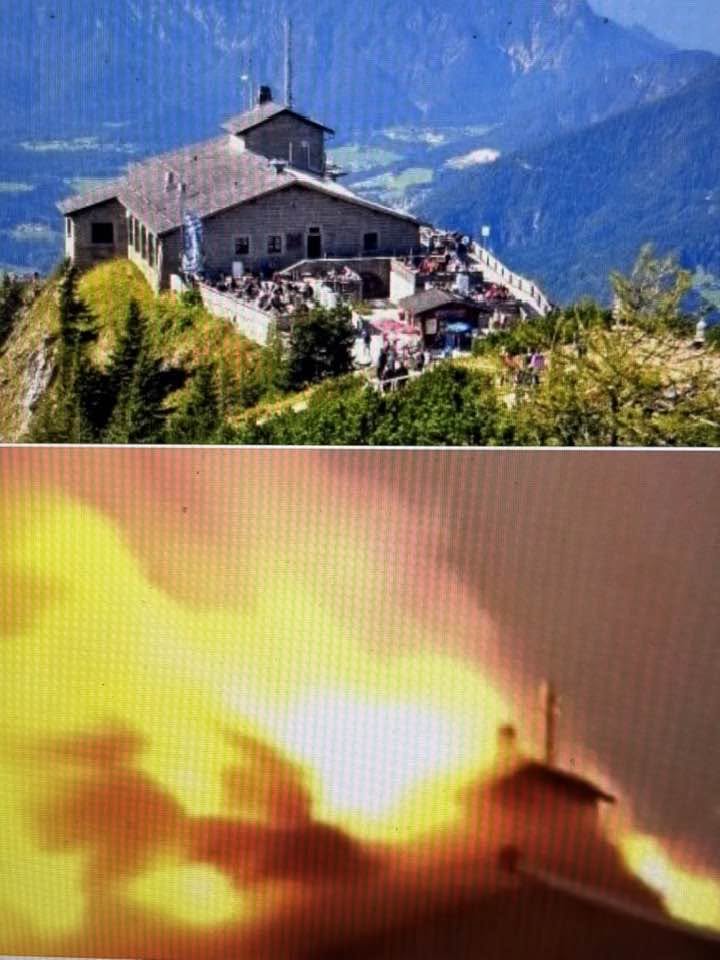
OCTOBER 25, 2026 – I must confess to my readership that occasionally I struggle to post my daily blog entry by my self-imposed deadline: midnight, UTC-6 (“Coordinated Universal Time”[1])(or UTC-5, during Daylight Savings Time). Yesterday’s effort was an example. Following a day of hard labor building mini-cages around a dozen more hemlock trees up at the lake (with two dozen more to go[2]), followed by a three-hour drive home, then an hour of legal work, I’d depleted my stores of mental energy. When at 10:00 p.m. I turned to drafting the daily post, I kept drifting off to sleep mid-sentence—then waking up with a start at the end of the sentence and finding gibberish on the screen.
Upon waking this morning, I promised myself to do better with today’s post. My initial thought was to recount the particularly bizarre dream that did the work of an alarm clock . . . er, app. In my unconscious distortion of reality, I clung to the very top of a very dead tree—two stories or thereabouts above the ground. An acquaintance hung on tight just below me. For reasons evident to no one, least of all myself, I’d decided to squeeze and squish a large cold baked potato as if it were a bar of soap. The effect of this maneuver was anything but salutary. Now my hands were covered with the slippery mushy starch of an Idaho potato, compromising the integrity of my grip high up in the hard dead remains of a tree, its top and branches pruned haphazardly, leaving stubs of varying lengths as handholds and footrests. I panicked. How would I exit my predicament?
“I’ve got to get down—now!” I said to the person below me on the tree. “I can’t hang on any longer. Sorry. You’re going to have to back down too . . . before I lose it!”
But I couldn’t navigate down. All I could do was wrap my arms and legs around the all-too-small upper trunk and wait for . . . what? I wondered. The fire department? But who would make the call? I was without a phone. Ditto the other climber. In that moment I seized on the perfect solution. I woke up.
Soon I was at the kitchen counter consuming breakfast—and the latest news. Among the stories that snagged my attention was one about yesterday’s fiery destruction of Kehlsteinhaus—better known as the “Eagle’s Nest,” the Nazi meeting and party venue perched atop Kehlstein Mountain (el. 6,017’) just outside Bechtesgaden in southeast Bavaria. According to an AP report, much more detailed than a cursory article in the Times, authorities arrested a 33-year-old man who was riding down the narrow, winding mountain road from the fire just as emergency vehicles were rushing upward.
Apart from the man’s flight from the conflagration, the story imparted no other evidence of his culpability. The authorities, however, reportedly said that “he showed signs of mental illness and was being sent to a psychiatric facility, but they also would look into the possibility of a political motive in view of the building’s history.” (Emphasis added.) Apparently, the man “had ties” to Bechtesgaden but was not currently a resident of the area.
Hmmm, I thought, as I poured my daily jolt of java. What an interesting moral dilemma—like being stuck high up in a dead tree—and good topic for today’s post. The dilemma intensified when I explored the subject further.
If, arguendo, we assume that the fire was in fact the work of an arsonist—and by extension, that the culprit and the man on the motorcycle were one and the same—what are we to make of his crime from a moralistic perspective? And if we assume further for the sake of argument that he turns out to be legally exculpated by way of his mental illness, what if any bearing would such an outcome have on the moral question raised by the destruction of the “Eagle’s Nest”? But wait: Wouldn’t the desire to blow-up a monument to Nazism be evidence of sanity?
But what, exactly is the moral question? That’s a philosophical matter.
Consider these additional facts: After World War II, the de-Nazified government of Bavaria decided to raze the subject site—a venue designed for meetings between foreign visitors and the henchmen of Mephistopheles. The post-war edict was reversed, however, when Bechtesgadenians hit upon the idea of converting the place into a tourist trap. Why not? After all, they’d wound up free to be capitalists, while the Communists reigned supreme in what would become known as “East Germany,” the DDR—Deutsche Demokratische Republik (or “GDR”—the German Democratic Republic).
In short order, the Eagle’s Nest was open for business. (Ironically, however, “socialism” took over the enterprise: today the place is owned by the state of Bavaria, which grants an operating license to a private concessionaire.) What followed were decades of tourist buses (of the capitalist variety) carrying people from hither and yon up the mountain, then up the elevators to gawk and awe at the crazy-beautiful Alpine scenery that fills the background of the blockbuster movie, Where Eagle’s Dare and Hitlerian home movies embedded in innumerable documentaries about the meteoric rise and catastrophic fall of the Third Reich. To set the record straight, however, the home movies were shot at nearby Berghof, Hitler’s private retreat, where he spent the majority of his time besides in Berlin and the Wolf’s Lair in East Prussia during the war. (He staged only 14 appearances at Kehlsteinhaus.) The movie was filmed at Festung Hohenwerfen just over the border in Werfen, Austria, near Bechtesgaden.
Now, 81 years after the end of the greatest human conflagration on planet earth, an old tourist trap oozing with evil finally joins the flames that consumed tens of millions of lives and scarred the minds and bodies of tens of millions more who survived. No one alive today is untouched by the legacy of that horrific epoch.
Given this background, what now is to be done? By the black letter of the law, if proof by applicable standards points to an identifiable culprit, we would expect such person to be convicted and sentenced as the law requires or allows. Putting ol’ Mephistopheles aside, one insurance company or another is about to suffer a financial loss, trickling down to its owners. No doubt the workers employed at the spot have lost their income, though who knows what public benefits might accrue to them, in which case the taxpayers of Bavaria and/or Germany at large will be pinched, though individually, by imperceptible amounts. Bottom line: the arsonist broke the law by torching property and caused physical destruction resulting in financial injury. It becomes an open and shut case.
But under the circumstances—destruction of the den of evil—such a textbook outcome seems unjust; doubly so, if the perpetrator is found to have been unduly influenced by mental illness. Yet, if we adjust the facts just a tad, maybe the case is more nuanced. What if it’s shown that the arsonist didn’t suffer any mental illness and in fact, didn’t give two hoots about Germany’s Nazi past or the role that the Eagle’s Nest played in facilitating the horrors of that terrible past? What if the culprit here was in charge of the tchotchke shop inside the tourist trap and held some grudge against his remote boss all the way back in Munich, who was constantly hounding the poor guy to increase sales of Nazi memorabilia made in China and pushed onto tourists made in China piling off those tourist buses, one after another? Again . . . should he be afforded any clemency given that what he managed to torch wouldn’t have been “a thing” if it hadn’t been associated with the worst kind of evil imaginable? And in fact, as noted in the AP article, the place was nearly razed in the first place right after the war. (Hitler’s retreat at nearby Berghof, bombed by Allied aircraft during the war, was purposely not restored after the war for fear it would become a shrine to neo-Nazism.)
I must confess that I was more amused by these questions than I was troubled by them. Yet, as I drained the last sip of java from my cup, amusement yielded to philosophical meandering: how does the moral question (as it were) raised by the Kehlsteinhaus fire play out when it comes to preservation of ancient monuments honoring tyrants? Or modern monuments now on the drawing boards honoring you know who? If a Romanian should attack Trajan’s Column with a sledgehammer in protest of the deaths caused by the Roman Emperor’s bloody conquest of Dacia (present day Romania), should the attacker be punished for destroying what the passage of time has transformed into a treasure of world heritage? If the day after Trump leaves office, his triumphal arch is blown to Timbuktu, should we lionize the bomber? What if the dynamite dynamo waits a year or 10 or 50?
Our country still struggles with such moral dilemmas over all things Confederate, though many people, emboldened under the current regime, grapple not. These latter folks have no compunction in restoring the names and reputations of outright traitors and disgracing the American flag by flying high the Confederate Battle Flag. They’d have no trouble climbing to the top of a tall dead tree and sliding back down again. I have a hunch too that they’d have no mercy for the arsonist of Kehlsteinhaus.
Subscribe to this blog and receive notifications of new posts by email.
© 2026 by Eric Nilsson
[1] People insistent upon relating anecdotes about French chauvinism should find humor in the tangential story behind the arrangement of the abbreviation, “UTC,” for Coordinated Universal Time. Without going too far into the historical swamp, in 1970 a subset of the International Time Union—the international body in charge of establishing standards for time nomenclature—tasked with devising acronyms for various terms, couldn’t agree on the initials for “Coordinated Universal Time.” The Anglophones insisted on “CUT.” (Duh.). The Francophones, on the other hand, would have none of it. Predictably, they wanted the exact opposite (reverse): “TUC,” standing for Temps Universel Coordonné (mais bien sûr!) Eventually, neutral middle ground was found: “UTC”—not to be confused with “Urinary Tract Conundrum.” The “-6” (and “-5” during Daylight Savings Time) designated hours behind Greenwich Mean time.
[2]I discovered that I’d undercounted. In previous posts, I’d referred to an inventory of 30. A recount identified a total of 52.
