MAY 6, 2026 – Today’s edition of The Times carried a guest essay entitled, “Give us the Aliens” by my favorite scientist, Neil deGrasse Tyson. In his usual jocular style, he poked fun at our enduring perception of aliens as very human-like in appearance—a torso to which are attached, two arms (each with a hand), two legs (each with a foot), a neck and a head with two eyes, a nose and a mouth. But given the boundless range of life forms on earth—besides us humans—as a sampler of biodiversity across the cosmos, why, asks the famous astrophysicist, do we insist on treating nearly all aliens as if they resembled us? He then turns the picture around and ponders how visiting aliens might perceive us . . . or how they, in search of life on earth might misperceive our automobiles as some kind of technologically advanced earthbound bio-form.
It seems to me that not much LSD or imagination is required to draw parallels between religious faith and a belief in aliens. Or more specifically, I see similarities between our popular culture’s image of aliens, on the one hand, and on the other, our mainstream construct of the Divine and his/her/its/their representatives—whether in the clouds, as it were, or down here among us mortals.
Often, members of Divine & Co. assume strikingly humanoid forms. Moreover, depictions in paintings and sculptures bear an uncanny likeness to the specific humanoids dominant in the sub-culture that produces the artwork. For instance, the Aramaic “look” of Jesus depicted in art of the Middle East is distinguishable from the fair-haired, northern European version of Jesus in art produced by . . . northern Europeans. One of the most recognizable versions of the “Nordic Christ,” called, “The Head of Jesus Christ,” was painted by Warner Sallman, himself a Finnish Swede. Surprise, surprise, but Sallman’s Jesus could easily pass for a Swede. Hindu deities, meanwhile, are always depicted as . . . residents of the Indian Subcontinent.
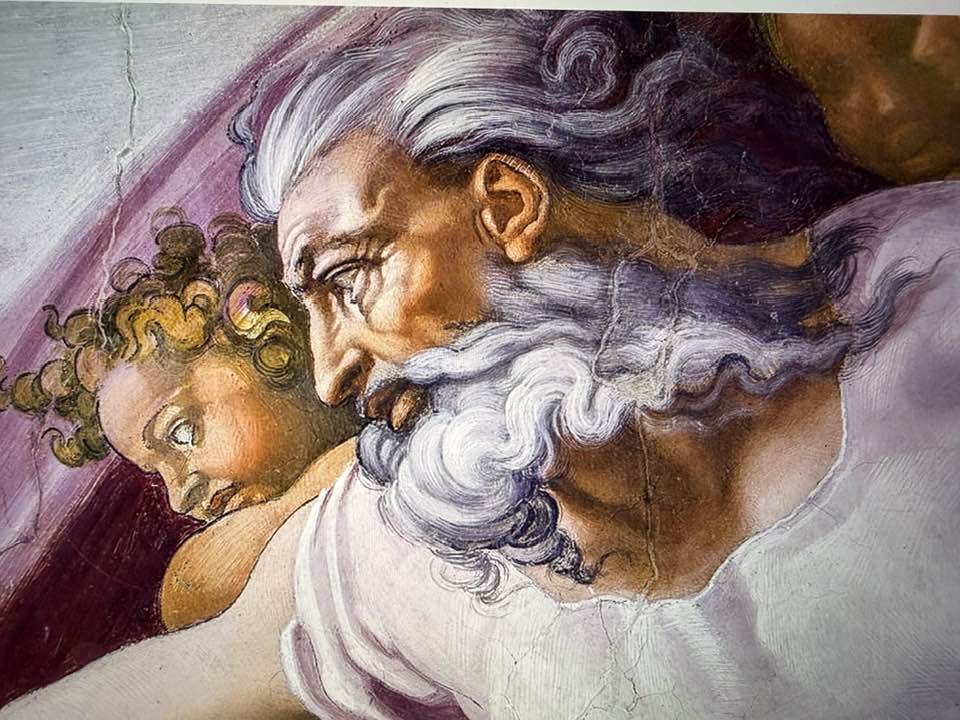
According to Scripture in the Judeo-Christian tradition, right up front God said (using the “royal we”), “Let us make mankind in our own image, in our likeness . . .” Genesis 1: 26-27. With that directive, it was no surprise that Michelangelo’s depiction of God on the ceiling of the Sistine Chapel looks exactly like a man—with impressive gravitas, of course.
I’m not sure what’s quainter—our portrayal of the Divine as humanlike or our image of aliens as anthropoidal. Despite God telling us that he made us to look like him, I have difficultly reducing the omniscient, omnipotent and omnipresent Creator down to nothing more than a man in white with a shock of gray hair and a beard to match. In the case of aliens, I have trouble speculating about their appearance when their very existence is much in doubt—at least in any meaningful proximity to our neck of the universe. In his Times essay, Dr. Tyson signals his doubts about UFOs and aliens circling or landing on earth. In The Little Book of Aliens by another astrophysicist, Adam Frank, one learns enough about the Drake Equation, the Fermi Paradox, and the Kardashev Scale to understand empirically, the infinitesimal odds of our encountering aliens.
Yet Michelangelo’s quaint representation of God and Hollywood’s simplistic portrayal of aliens serve a critical purpose. They provide tangible symbols of divinity and infinity. The human psyche, still a work-in-progress, can’t begin to grasp the full nature of “Divine” any more than our make-up allows us to understand that for all practical purposes, we are alone and will remain so to the end of time, untouched by alien influences. Until we evolve far beyond our current state, I guess it’s fine to think of God as a man (or drag king?) hanging out on the ceiling of the Sistine Chapel and aliens too as alternate versions of ourselves, or for simplicity’s sake . . . treating the Divine as alien, and the alien as Divine.
Subscribe to this blog and received notifications of new posts by email.
© 2026 by Eric Nilsson
