OCTOBER 7, 2026 – Today’s WSJ carried an interesting article about the comeback of the bunt thanks to “thinking outside the (batter’s) box” by the Tampa Bay Rays.
When I was a kid, the bunt was right up there with the sacrifice fly: if everything went according to plan, the batter was out but the base runner(s) advanced. As I recall from reviewing stats on the backs of baseball cards, debits to the batting average of a sacrificial lamb weren’t offset by credits for moving runners, unless, of course, the bunt or sacrifice fly drove in a run. Once in a great while, you’d see a bunt go down as a hit, and when this occurred, it came as a big surprise worth cheering about—if you were cheering the at-bat team.
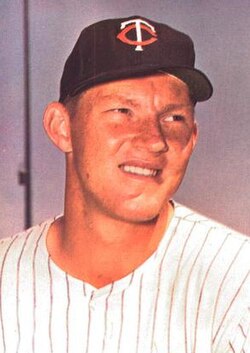
One of my favorite players on the Minnesota Twins during the team’s early golden years[1] was the 16-time winner of the Golden Glove Award and future Hall of Famer, southpaw Jim Kaat. Apart from being a leader of the “A-team” pitching staff, Kaat was the only hurler in the majors (back when pitchers batted) who also served as a pinch-hitter. Though he was a big guy—standing 6’4” and weighing 205—he didn’t swing for the fences, as did power hitter Don Mincher, the club’s more frequent pinch hitter in those days. No, Kaat was sent to the plate to . . . bunt. I wasn’t the only Twins fan who thought this was cool, given that no other pitcher in either league had the pinch hitter card in his back pocket when he wasn’t performing his regular duties on the mound.
The total Twins (player) payroll in 1965, the year they went to the seven-game World Series against the storied Dodgers, was a measly $1.5 million, with a per-player range from a low of $5,500 (Sandy Valdespino) to a high of $50,000 (Harmon Killebrew). The great Tony “O” made $20,000 that year, $7,000 less than our prized pitcher-bunter, Jim Kaat. Once the reserve clause was eliminated (1975), baseball salaries sky-rocketed like a fastball off the bat of Reggie Jackson. In time, player contracts not only cleared the centerfield fences but bounced off the scoreboards behind the fences. By 2002, the Yankees payroll topped $125 million.
Then along came the Oakland A’s, who made it to the playoffs with a payroll of only $44 million. The club’s success was explained in Moneyball by Michael Lewis, published in 2003. Instead of negotiating a player’s contract on the basis of batting average, hits, home runs, RBIs and other statistics, the A’s used a method called “sabermetrics” to examine in-game performance stats, such as how often the player smacked the ball to deep right field (and was caught for an out) or how often the guy got on base, whether by a hit, a walk, or fielder’s choice. Such statistics hadn’t normally been tracked, but the A’s secret was that formerly untracked performance revealed far more about a team’s winning potential than did the standard stats. As a result, the A’s won a distinct advantage over other teams at a much lower cost.
But just as in the case of every new idea, service or product, once the competition figures out how to replicate—with a spin—the pioneer’s advantage wanes and is eventually lost.
So it was with the bunt, only in a reverse sort of way. Among the revelations of the A’s “sabermetrics” was the ineffectiveness of the bunt. The sacrifices simply weren’t worth the benefits. As this conclusion gained currency, other teams dropped the bunt as well. In time it became a rarity, and as it did, of course, so did the skill required to lay down a good bunt. Eventually, it all but disappeared from play.
Which leads us back to Tampa Bay, which in player payroll now ranks 27th out of 30 major league teams. Looking for innovative alternatives to expensive stars with big bats, the team revived the bunt. This season they turned it into a winning strategy. They managed 94 bunt hits out of 134 bunts laid down for a whopping .365 average, contributing to the team’s overall batting average of .258—best in the American League.
May the record reflect that as of the time of this sentence, Tampa Bay leads the Yankees, 4 – 3 after seven innings in game three and is 2 – 0 in the series. I’d say more but must get back to the game. You can guess on which team I’ve laid down my imaginary bunt . . . er, bet.
Subscribe to this blog and received notifications of new posts by email.
© 2026 by Eric Nilsson
[1] After Cal Griffith bought the Washington Senators and moved the franchise to Minnesota, he changed the name to the more geographically appropriate, “Twins,” to denote the “Twin Cities.”
