SEPTEMBER 3, 2026 – Over my lifetime, I’ve shaken hands with several non-famous super-geniuses, though I can’t say I seized on the opportunity to procure their autographs. Given the relative obscurity of these individuals, there’s no monetary value in their John or Johanna Hancocks. I’ve heard of a good many more super-geniuses, the names of whom are well-known. Given the fame of super-geniuses in this latter category, their autographs would sell for lots of loot, but for that very reason, I’ve had no disposition to own their signatures either.
But aside from a relatively rare score on a standardize I.Q. test, what marks objectively a super-genius? I’m not aware of a definitively objective and universal test of super-genius.
In the first place, super-genius takes many forms. Compounding the challenge is not only the nature of super-genius but its breadth. This reality raises many questions, such as: Does a savant at one narrow mental feat qualify as a super-genius or as a mere oddity? On the other hand, should Beethoven qualify as a super-genius if he was unable to multiply two numbers and instead, had to jot down in columnar fashion one number umpteen times and add them up? Is violinist who can perform the Brahms violin concerto backwards but knows absolutely nothing about baseball really a super-genius? Is a tone deaf astro-physicist breaking new ground . . . er, space . . . in understanding dark matter smarter disqualified as a super-genius?
Second, assessing qualifications for super-genius requires a certain level of knowledge on the part of the assessor. Paradoxically, though, often the ostensibly requisite knowledge is mere ignorance posing as knowledge. To the mind of a mono-lingual math major, someone who can recite long tracts of poetry by memory in three languages, might present as a super-genius—just as the physics major who can rattle off formulae explaining the origins of the universe might appear as a super-genius to the English major who (quietly) took remedial math in high school. Or . . . the co-worker (most likely an immigrant) who can speak five languages next to your English and rudimentary Spanish seems to qualify as a super-genius, as distinguished from your tour guide at the Acropolis who can just as easily talk up a storm in six languages. No super-genius that person; after all, she’s “only” a tour guide, dependent on tips to supplement her meager wages. If she were a super-genius, she’d have figured her way out of Greece. Or to put in terms of the consummate American capitalist—such as the schoolmate of mine back in the day, who defined everyone by the measure of money, “If the tour guide were really that smart, she’d be a [b]illionaire by now.” (“Millionaire” changed to “billionaire,” since millionaires are now a nickel a dozen.) As with so many assessments and judgments in life, context if everything.
Lately, I’ve been following the online presentations by the (quite possibly super-genius) harmonicist, Howard Levy, with whom I’ve shaken hands on two occasions, thanks to his appearances on A Prairie Home Companion shows I’ve attended. Howard can wail on the harmonica (as well as on the piano)—in pretty much all musical genres. If Howard is just a garden-variety genius, what he does on that instrument requires a level of refinement, sophistication, and in my estimation, genius, that can be found only places such as Buddha Garden (India), Inhotim (Brazil), Knepp or Kew Garden (England), or Tokachi Millennium Forest (Japan).
There exists no question, however, that the musicians featured in Howard Levy’s interesting series, Music Legends You Should Know, are bona fide super-geniuses. Conducted in a very accessible conversational format, Howard introduces each “legend” in such a compelling fashion, I’ve become hooked on these presentations. Many of the subject personalities are somewhat obscure, but their “super-genius” is beyond debate.
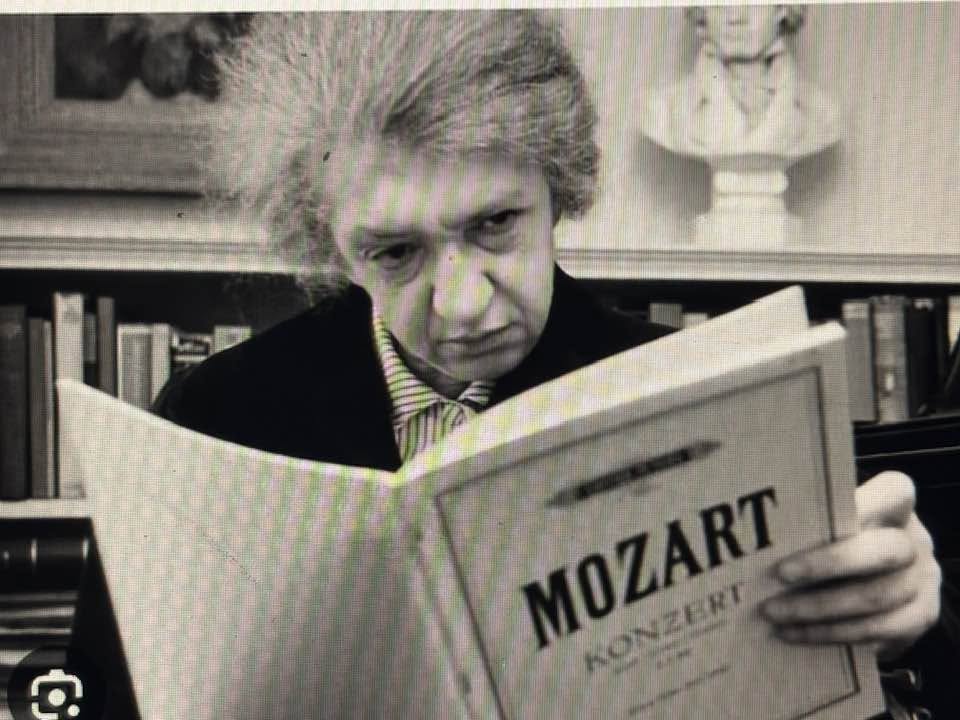
Take, for instance, Clara Haskil (1895 (the year my maternal grandfather was born) – 1960 (the year I entered first grade)), the Romanian-born pianist extraordinaire. How extraordinary? How about this: When she was just four years old, a pianist from the Bucharest Conservatory paid a visit to the family home by way of some musical connection. (Clara’s mother was a piano teacher; her two older sisters took piano lessons.) The guest pianist performed a Mozart sonata. When the performance was finished, Clara, never having had a piano lesson, sat down at the piano and played the entire work . . . by memory . . . and then transposed it into several different keys!
That “super-genius” demonstration launched what would become a stellar global career, performing with the greatest orchestras and chamber musicians of her day. Her life was marked my extreme physical hardships, however, which, with great determination, she overcame.
Of the many other examples of Clara Haskil’s “super-genius,” one transpired two years after she’d heard a composer friend of hers working on a new piece. Upon her arrival outside his London apartment, where she had arranged to practice, she lingered a while, listening to her friend at work. She then knocked and was welcomed into the apartment, where she proceeded to practice (presumably for an upcoming concert or recital in London). She did not see the friend’s manuscript of the piece-in-progress. When the two met up again two years later, she said, “Oh, I really liked the piece you were working on that day I came to practice.” She then sat down and played the first four pages of it by memory—and flawlessly—the whole of what the composer had been working on that day two years before! The composer was floored. He knew she hadn’t later bought a copy of the piece or ever seen it: the rendition she played was the version as it stood on that day he’d begun writing it, not the finished work.
Not to be outdone by herself, Clara Haskil was also a virtuoso violinist. Before going out on stage to perform (the piano), she borrowed an orchestra member’s violin and blazed away at the Mendelssohn Violin Concerto. Toward the end of her life, she toured with Arthur Grumiaux, the famous Belgian violinist. Often—get this—because Grumiaux was also an accomplished pianist, he and she would switch instruments!
Haskil was good friends with Charlie Chaplin, who called her one of the top three geniuses he’d ever met. The other two: Albert Einstein and . . . Winston Churchill.
Another “super-genius” featured by Howard Levy was Nicolas Slonimsky, a contemporary of Clara Haskil. Born in St. Petersburg in 1894, he lived to be 101. After the Bolshevik Revolution, Slonimsky became a citizen of the world but in 1923 emigrated to the U.S. and became an American. Trained as a pianist and conductor at the St. Petersburg Conservatory, he was a close friend of Serge Koussevitsky, the fellow Russian-born conductor of the Boston Symphony Orchestra and became Koussevitsky’s conducting accompanist. Slonimsky embarked on his own prestigious conducting career, but his embrace of avant-garde music became controversial.
Unperturbed, he plunged into writing about music, and this is where his “super-genius” blossomed. (The fact he could speak a bunch of languages was noteworthy, but this lingual prowess put him in a league no more remarkable than the hypothetical guide at the Acropolis.) Of the many books and articles to his credit, the most spectacular was the Thesaurus of Scales and Melodic Patterns, published in 1947. Howard Levy said that when he’d gotten his hands on a copy, he tried to study it, but it was so incredibly dense and analytical, he had to put it aside. But then he discovered that John Coltrane owned a copy and referred to it so often, the book was as dog-eared as a train conductor’s shirt-pocket timetable—except the Thesaurus is no shirt-pocket book. It’s music theory bible for geniuses.
Slonimsky also had a wonderful sense of humor. Another book he wrote was the Lexicon of Musical Invective: Critical Assaults on Composers since Beethoven’s Time. It’s a collection of negative reviews of the premieres of what later became the bedrock compositions of the canon of Western Classical Music. He was a hilarious guest on Johnny Carson’s Tonight Show.
By way of his affinity for contemporary music, Slonimsky became friends with another super-genius featured by Howard Levy, none other than Frank Zappa, who, by the way, was a student of Slonimsky’s Thesaurus.
I found all this quite fascinating, especially in light of my recent appointment with my dermatologist. I’ve been under his care for eons, and on each encounter, we talk music, because in a prior life, my good doctor, whose name is Goodman, was well on his way to becoming a concert pianist. Earlier this week I learned that he’d won first prize in a prestigious piano competition, and when I mentioned that earlier in the day I’d watched an old video of Vladimir Horowitz performing “Rach 3” (Rachmaninoff’s (impossible) Piano Concerto No. 3) with the New York Phil under the direction of Zubin Mehta, and then asked if he, Dr. Goodman had ever studied the piece, he replied that yes, he’d performed it! But apropos of Howard Levy’s series, when I expressed amazement about “all the musical genius afoot in the world,” Dr. Goodman was quick to affirm, adding, “And it’s not limited to the classical genre. Take jazz, for instance, and even other popular music—there are many geniuses out there outside the classical world.”
And in dermatology clinics, apparently. My former dermatologist, years ago, was a French horn player—a fact I discovered when I heard him whistling Mozart’s Horn Concerto while approaching me along the clinic hallway. “Hey,” I said in surprise. “That’s Mozart’s Horn Concerto!”
“Yes! You know it!” said the doctor, just as surprised.
“It’s a great piece, but I’ve never heard it whistled. Are you a horn player?”
“Used to be all the time,” he said. Now only when I get around to it, but after studying that concerto I could never get it out of my head.”
“I’m glad,” I said.
Speaking of super-geniuses, they abound, of course, just as frequently outside the music world as within it. Take Richard Feynman, for example. If you want to visit the far side of the universe by understanding quantum physics, he’s your man. Listen to one of his riveting lectures, and you’ll think you’re traveling through a wormhole yet with astonishing survival skills, because when the lecture is over, you still exist.
But that’s for another day.
When I was young and foolish . . . Strike that. When I was young and even more foolish than I am as an old guy, I used to envy the gifts of the “super-geniuses,” as well as, of course, the talents of plain, every-day geniuses. I’ve long since learned to accept that I was born a Chevrolet Bel Aire, and no amount of envy would ever transform me into a Porsche 911 Turbo. But even that misses the point. “Super-geniuses” weren’t created to teach us “ho-hum” humans humility. They were put on this planet to enrich and edify our lives. In that regard, we Chevie Bel Aires are the lucky ones. All we need to do is to stay in tune—and enjoy the drives down extraordinary roads of a miraculous world.
Meanwhile, in a wholly separate universe reside “super-interesting” people—the subject of tomorrow’s blog post.
Subscribe to this blog and received notifications of new posts by email.
© 2026 by Eric Nilsson
