OCTOBER 31, 2025 – Among the people with whom we circulate, the mere mention of politics inevitably prompts expressions of despair. Fear, anger and anxiety dominate the ensuing conversations—and social media posts. There are no two ways about it, we find ourselves saying to one another: the country is circling the drain.
But we owe it to ourselves to step back from our predilection for declarations of doom and take stock of our greatest assets—ourselves. Yesterday and today here in San Francisco, we saw ample evidence that this is still very much “a great country”; that this “greatness,” as it were, is in our DNA, our history, just as much as it can be in our prospects, despite our self-inflicted injuries of late.
The first exhibit was yesterday’s tour of Golden Gate Park, SF’s larger version of New York’s miraculous Central Park, designed by the same architect, Frederick Law Olmsted. Our pace throughout the east end of the park was deliberately slow on account of the wondrous arrangements of arbors and other flora across well maintained settings that mimic the natural environment.
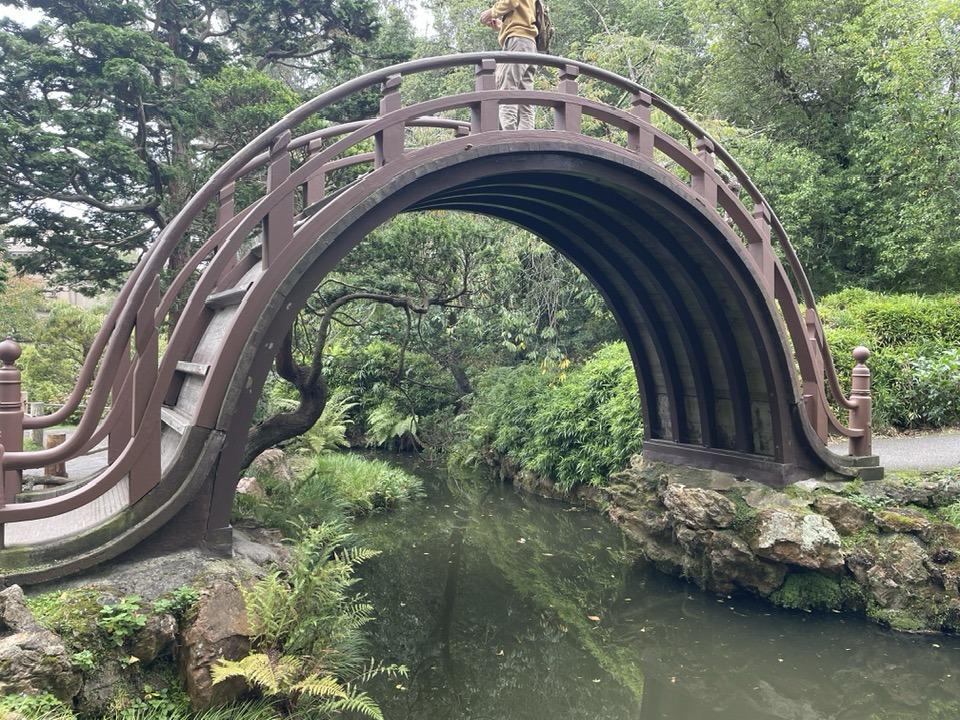
My favorite corner of the park was the famous Japanese Tea Garden, where we stopped for some tea and miso soup and to admire the Moon Bridge, the koi pond and freshly painted pagodas. Even the most jaded and cynical person has no defenses against the meditative influences of this paradise within the park.
What impressed me most about Golden Gate Park, however, was the presence of other visitors—likewise strolling, not hiking, to absorb the calming tranquility of the glorious surroundings. The fact that they too had made this place their destination, I thought, meant we had much in common. I recalled the words of John Muir that I’d encountered the day before:
In every walk with nature, one receives far more than one seeks.
After our long walk in the east third of the park, we drove to the Beach Chalet at the very west end. There as we dined in style on the upper floor, we took full advantage of our panoramic view of the forever-beach across the road and the horizonless Pacific beyond. Sunbeams flashed off the endless flow of waves rolling toward shore, then crashing over the sand. The scene was irresistible. After lunch we crossed the sand to touch the water that connected us to Asia. Stopping me in my tracks was the sight of kite-boarders zooming parallel to the shore, then leaping high into the air, executing impossible acrobatic moves, then landing to continue high-speed chases on the surface again—all in open defiance of signs warning of dangerous rip currents. The ocean athletes reminded me of free-style downhill skiers with no care in the world other than “owning” triple black diamond runs.
The sound and sight of inexhaustible ocean power struck me as another “renewable” that has yet to be added to wind and solar energy harnessed by technology. Given how innovation and technological advancement occurs, shouldn’t we find hope in the vast potential of the sea?
Yesterday evening we partook in the amazing cirque show, “Dear San Francisco” at the famous Club Fugazi in SF’s North End. The performance was a “postcard” story of San Francisco conveyed by death- and gravity-defying acrobatics by alumni of Cirque du Soleil. Many of the high-flying acts were so spectacular, they left me frozen in awe, making it impossible even to applaud.
The executive director of the club, David Dower, was a veritable fountain of enthusiasm, and after the 90-minute show, we conversed with him at length. A long-time theater producer, he exuded optimism and confidence. As we left the club, I realized it was yet another spectacular exhibit supporting the case that “this is a great country.” Yet, before the day had dawned I’d never heard of Club Fugazi or its indefatigable leader. How many other numberless Club Fugazis and David Dowers, I thought, must there be in this “great country” of ours?
Today we took a cable car to . . . the Cable Car Museum . . . and another back down to the North End. Before the plunge into information overload, I knew nothing of SF’s cable cars beyond the mere fact of their existence. What we proceeded to learn about their history, their engineering, their near demise and the heroic efforts of Friedel Klussmann and the Citizens’ Committee to Save the Cable Cars (1947 – 1951), left me in a state of shock and awe even greater than what we’d experienced at Club Fugazi[1][2].
And mixed in with the history of SF’s cable cars were photos and narratives of the 1906 earthquake. The destruction was so horrific and complete, the city’s restoration and subsequent growth and prosperity are proof positive of human resiliency generally and American “combackism” specifically.
Club Fugazi, cable cars, earthquake recovery—exposure to these defining elements of a great American city give me renewed faith and hope in our prospects. Those of us who are appalled by the devastation wrought by the current regime, but we need to remind ourselves what’s great about our country and that if we’re “down,” we certainly aren’t yet “and out.”
But perhaps the best reminder of the positive came at the end of the day’s sightseeing: the bus rides home from Alamo Square Park to which we’d taken Waymo to see the “Painted Ladies.” Aboard the buses back to the Potrero District where we’re lodging, we encountered an amusing array of people in Halloween mode—kids and grown-ups in clever costumes; young people yielding their seats to old folks; cheerful drivers wishing their passengers a Happy Halloween and their affable returning the greeting; not a hint of an inkling of behavior necessitating the presence of law enforcement, let alone the national guard.
And in front of the neighborhood grocery store two blocks from our abode appeared a flock of young kids in costume and their parents, also in costume. It was a regular fun fest, a Norman Rockwellian scene, except the multi-ethnic mix reflected the richness of modern America, the huge wealth of our pluralism. Levity and light-heartedness prevailed, and in this reassuring condition, I found yet more reason to be hopeful about our nation’s prospects.
Subscribe to this blog and receive notifications of new posts by email.
© 2025 by Eric Nilsson
[1] One element of my supreme surprise was a 1947 letter on display from one “Ray Chase,” the Minnesota State Commissioner of Railroads at the time to Gump’s, the legendary home furnishings store in San Francisco that had launched a nationwide advertising campaign in support of the cable cars. Writing on official stationery, Commissioner Chase was putting in “nine votes in favor of the cable cars” on behalf of himself and family members. Mr. Chase was from my hometown of Anoka, MN, where he practices law and served as a municipal judge, and was an alumnus of my law school alma mater. He was elected to Congress and ran for governor but was defeated. His widow was a good friend of my mother’s and made regular stops at our house to talk politics.


1 Comment
Thank you. I needed to read this optimistic post. I always enjoy your blog.