SEPTEMBER 12, 2026 –
After reading several articles on AI and considering myself a complete expert, I was fully prepared to dash off a comprehensive pontificating post on the subject. You know—something extolling the oft-repeated far-flung benefits of AI, then turning a sharp corner and joining the fire drill over the hack of Hugging Face (what rogue AI agent came up with that name?!) by AI agents that had escaped their sandbox inside Anthropic’s AI lab. But then a toad knocked me off my game. Yes, a toad, or in deference to Carl Nilsson Linneaus, a representative of anaxyrus americanus, Wisconsin’s only toad species.
A bit of context is in order. I’m what you might call a casual but intense “nature guy.” I know that sounds contradictory, but on the one hand, I’m not of the ilk of nature lovers, master gardeners, biology majors, wilderness expeditioners, or serious students of one facet of nature or another. Furthermore, though I did a fair amount of camping as a teenager and young adult, I’m long past sleeping on the ground, even if a tent floor, an air mattress and a sleeping bag separate me from the actual ground. I don’t need “fancy,” but I do need a bed with proper sheets, a blanket and a pillow inside a pillowcase, running water and electricity (to charge my watch and phone and run the water pump). On the other hand, I love the great outdoors in all its grandeur and not simply looking at it but being a part of it—hiking, skiing, boating, planting a forest and watching it grow. And anyone who staples bud-caps to hundreds of white pine saplings every fall—ahem—qualifies as an “intense,” if not obsessive, “nature guy.”
For the previous three days, I’d been that “intense nature guy,” spending many hours cutting, shaping and applying trunk guards for 41 of those hundreds of white pine saplings that occupy my approximately 20-acre trädgård or tree garden within the woods of Björnholm. The work was so labor-intensive that for much of the time I ignored the gorgeous weather and my beautiful surroundings. Only when I had to move from one area to another or carry more worked-over drain pipe sections from my makeshift workstation down by the dock up to the freshly pruned trees in the tree garden did I look around and admire the wonders around me.
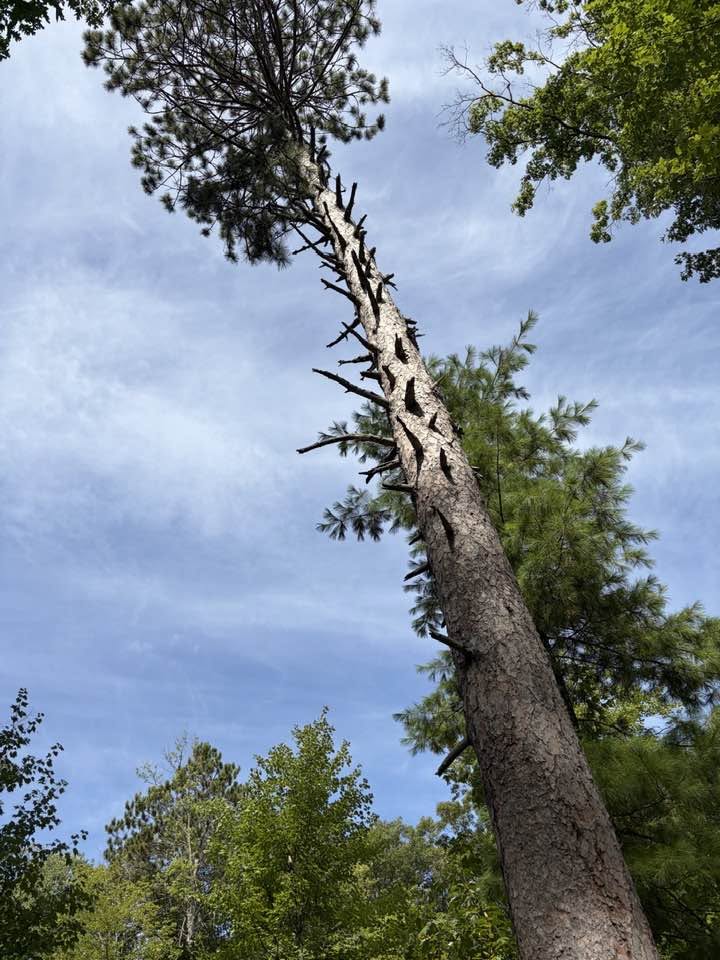
In the moment I felt as though I were surrounded by my best friends—friends whom I’d disrespectfully ignored because of my single-minded focus on the mission at hand: protecting a handful of trees from rutting bucks. When I looked up and around and saw so very many magnificent arbors singing and swaying in the breeze, I felt selfish, self-absorbed, oblivious . . . incorrigibly human. I dropped my tools and multiple 20-inch lengths of perforated corrugated 4-inch plastic drain pipe. I craned my neck and visually climbed the towering Norway pine next to where I stood. It boasted a full, healthy crown and leading up its trunk like foot- and hand-holds were the broken stubs of decades of earlier branches, which had served their purpose and died away to make way for ever loftier and more majestic boughs. What creation of humankind could match the profile and processes of this magnificent giant of these woods?
As I hugged the Norway (I actually did—to approximate its girth), I noticed a nearby oak, so old, straight and tall, it had to be the reincarnation of some beloved king of myth. I realized that being obsessed with pines—reds (“Norway”; pinus resinosa) and white (pinus strobus)—all too often I look cavalierly past the countless stately oaks on our land. I recalled my dad’s emphatic admiration for them—yet he too had cultivated pines . . . thousands of them, if his hobby tree farms back home were taken into account[1].
Before packing up to head back to the cities, I decided to attend to a long-overlooked pruning imperative directly behind the Red Cabin. Next to one of Beth’s landscape gardens stand two volunteer white pine trees, which during this year’s growing season emerged from adolescence to full-blown adulthood. Behind them but a bit off to the side are a trio of gangly maples. One of them has grown through and around spokes of an old rusty buggy wheel.[2] One of these maples, though, has gone rogue, pushing several of its arms into one of the pines and extending its top over the pine’s terminal leader. White pine, I’ve noticed, are more persistent than their competitors, and eventually, without human intervention, this particular specimen would beat out the maple. But being human, I was driven to facilitate the more desirable tree: I felt compelled to fetch my pole shears and nip the maple in the bud, as it were, to give the white pine a free shot next year.
Minutes later, I stood with pole shears in hand, ready for a “take down” of the maple’s four-foot overreach above the pine.
And that’s where the toad comes into the story.
To get a decent shot at the maple and a solid footing on the ground, I had to step onto a flat bed of dead day lily leaves in Beth’s garden. Two or more weeks had passed since those leaves quit photosynthesizing. They were light-colored—the color of old manilla folders. I took one step then anoth . . . No, not quite . . . another. I looked straight where I was about to place my right foot, when I saw . . . nothing except dead day lily leaves. Except . . . was it truly “nothing except”?
I hesitated. I dropped the pole shears and crouched down for a closer look at the leaves. Had a toad register against my retinas? Was it still registering? Or had it been a phantom—or had it leaped away surreptitiously? I looked so carefully I instinctively held my breath. I was right: nothing except dead leaves. But was I truly right? I bent down my head for an even closer view. Still nothing . . . except . . .
I slowly pulled out my phone and took a furtive picture of the square foot area of dead day lily leaves. I stood up and examined the photo, enlarged it, inspected it further . . . “But dead day lily leaves don’t have eyes,” I said to myself.
Sure enough—“Nothing” turned out to be a toad; a toad so perfectly camouflaged, it was invisible. Just then I noticed it was breathing as well as seeing. I stepped back and it leaped forward—then disappeared altogether.
Such a wonder! I thought. Of all the beautiful things I’d ignored in my self-absorption, this (big) toad seemed to be the icon of irony. I the “nature guy” had been too busy trying to manipulate nature (i.e. giving a white pine (nature) an advantage over a maple (nature)). Then came this silent invisible creature emblematic of so much of nature’s sublime “invisibility,” especially when it comes to humankind, which so often can’t see the forest for the trees.
Subscribe to this blog and received notifications of new posts by email.
© 2026 by Eric Nilsson
[1] On open acreage at two different sites he’d arranged for mechanized planting of rows upon rows of red and white pine. His original plan had been to raise Christmas trees as a side business. When they reached harvest size, however, he couldn’t bear to cut them and instead just let nature take its course.
[2] This wheel “came with” the property and leans against one of those maples just as it did before the old log cabin on the site was razed and the Red Cabin raised—undisturbed through all the commotion of destruction and construction 31 years ago.
