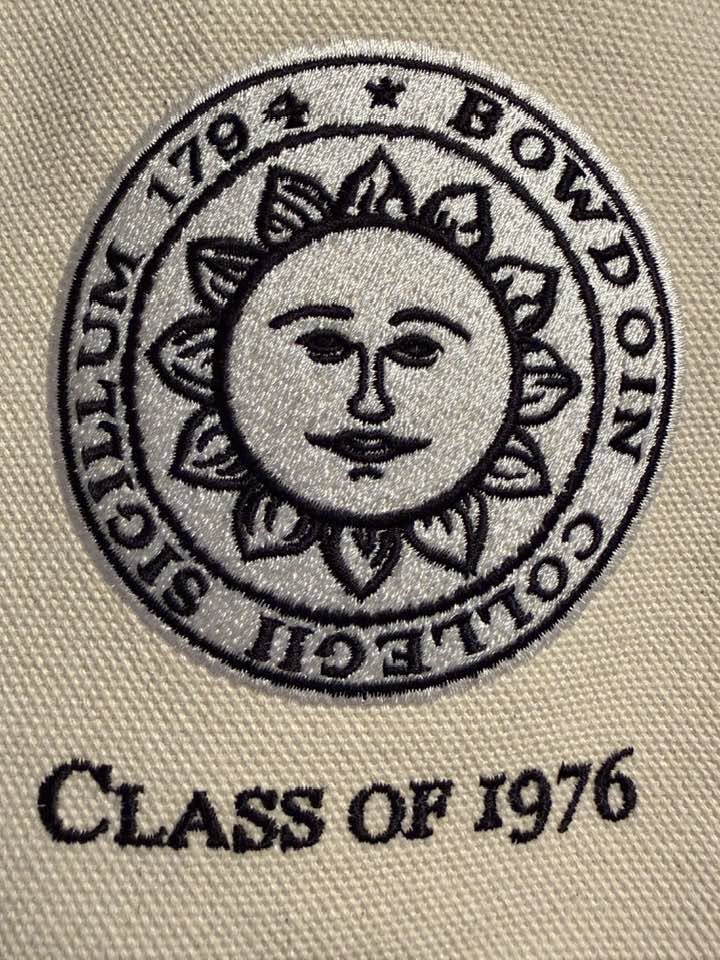
JUNE 8, 2026 – (Cont.) Out of a class of approximately 340 students at an old (est. 1794) New England liberal arts college, all of said students having passed the admission matrix established by the legendary Director of Admissions, Richard Moll, with the able assistance of his right-hand man, the inimitable Richard “Mers” Mersereau, there were bound to be a few good apples who turned out okay when baked into the great pie of life beyond Bowdoin. In fact, I think it’s safe to say that far more than a few turned out to be “good apples who turned out okay.”
Despite my brief on-campus career as the “Bowdoin Baker,” after graduation I felt increasingly outside the Bowdoin orchard. After my Grand Odyssey around the world in my mid-twenties and a few extended stints working on family “bidness” in New Jersey, I returned to my deep Upper Midwestern roots half a continent away from the rocky coast of Maine. For the first 20 to 25 years of after college, I encountered few folks back in Minnesota who’d even heard of the college[1]. For years, my connections to Bowdoin wilted.
With the approach of the 50th Reunion, however, I became more engaged with my alma mater. Or rather, the development office became more engaged with me. Based on my own fund-raising efforts on behalf of a slug of non-profit organizations—including the Minnesota Association of Private Colleges—I understood the effort required to sustain any kind of civic, educational, religious, conservation, artistic or charitable organization dependent exclusively or primarily on private funding. By seizing the fund-raising opportunity of the 50th class reunion, Bowdoin was simply following the standard rule of college fund-raising: solicit alumni tirelessly, especially older ones; most particularly alumni hurtling toward the big 5-OH! in years-since-college. To do otherwise, no matter how large the institution’s endowment, would be fund-raising malpractice on the part of the college.
Of course, the alumni fund-raising angle relies heavily on an appeal to alumni nostalgia and sentimentalism, which, in turn, are grounded in the emotional affinity for one’s vanished and irretrievable youth. This attraction to the past, however rose-tinted when viewed through the lens of time, is enhanced by the unsettling effect of rapid change in the present and the specter of demise in the no longer distant future. My own susceptibility to the “Good Ol’ Days Syndrome” was as strong as that experienced by any of the other 129 – 50th reunion attendees—a Bowdoin record for attendance (on a percentage basis, I believe) at a 50th reunion. To the credit of the development staff, that record translated to another class record: $24 million in giving and a record in class participation toward that figure (76%, coinciding poetically with “Class of ’76,” to the extent there’s anything poetic about the hard reality of fund-raising).
Many of us who’d strayed were now back in the fold, at least for Reunion Weekend. For me a salient feature of this gathering was learning of the considerable accomplishments of my classmates—all those “good apples” in life’s big pie. By “accomplishments,” I don’t mean only what typically appear in Curricula Vitae. I mean the striking quality of character that my classmates projected. What I discerned was a direct relationship between character and accomplishment—the latter including the mending of bodies as well as of souls; upholding the rule of law in the course of advocacy; the works of writers, thinkers, artists, musicians, and spiritual guides who’d contributed so much to the boundless and timeless intangible wealth of the nation; the inestimable devotion of heart, mind and soul to family, livelihood, and community in a thousand ways, thus ensuring brighter prospects for the whole of humanity. In the light of the impressive character and considerable accomplishments of my classmates I was not made to feel insecure or inferior or insignificant, as certain gauges might have reflected (and plagued me) in earlier stages of life. Instead, I felt grateful for these people and for my acquaintance with their exemplary lives. I departed the reunion confident in the much needed stone and mortar that my Bowdoin colleagues had added to our societal foundations.
Several classmates were formally and appropriately singled out:
David Dickson, II, recipient of the 2026 Alumni Service Award for “all that he has done to constructively[2] encourage Bowdoin and the College community to represent values of inclusivity, reflection, and intellectual rigor.” If I’d had any say in such matters, before David retired from a distinguished career in academia, I would’ve campaigned for his appointment as president of the college. But quite possibly his positive influence on matters both inside and outside Bowdoin has been greater because he wasn’t president and subject to the inherent strictures of that position.
Phil Gregory, Julie Johnson and Ellen Shuman, for their contributions to “sustainability”; in the case of Phil, for his pro bono legal work and seminal role in the mission of Our Children’s Trust, an organization that represents children in cases seeking injunctive relief against governments based on claims of environmental degradation; Julie Johnson, a renowned wine-maker and owner of Tres Sabores in Napa Valley, for her role in advancing regenerative farming and other environmentally sustainable agricultural practices in California wine country; Ellen Shuman, for her tireless work in the world of higher education fund development generally, and on behalf of Bowdoin, specifically, and the attendant financial sustainability of Bowdoin’s mission;
Douglas Kennedy, a prolific best-selling novelist, whose 2004 book, A Special Relationship, formed the basis of the screenplay he co-wrote, Une Relation Dangereuse. The resulting film was shown at the reunion.
Many others could’ve shared the stage and limelight with the aforementioned individuals. As I told classmate Mark Levine—whose signature (faux) scowl and sharp tongue of a partisan (should’ve been) sportscaster barely camouflage his deep affinity for humanity—he and the cause he champions are every bit as deserving of public acclaim as the people and missions that rightfully received it[3]. Mark is joined by countless other unsung heroes among our classmates.
What is next for all these achievers? Much more time in the sun—the ever-shining emblem of Bowdoin—I trust; as well as continuing health and inspiration to engage in more “stone and mortar” missions. The world needs my classmates as never before. (Cont.)
Subscribe to this blog and received notifications of new posts by email.
© 2026 by Eric Nilsson
[1]This began to change several years into the new century, when I began seeing an occasional “Bowdoin” car window sticker in the Twin Cities. More recently, however, I stumbled across a most surprising Bowdoin connection right in my own neighborhood. On my return from my daily walk in a nearby regional park, I encountered a new neighbor out raking leaves in his yard. I stopped to chat, to welcome him to the neighborhood. We easily discovered common interests and outlooks. A long conversation ensued, and in the course of it I learned that decades ago, he’d played college hockey. “Where ’bouts?” I asked.
“Oh, a little school out East that you’ve never hear of, I’m sure.”
“Go ahead, tell me.”
“Bowdoin College in Maine.”
He was a member of the Class of ’80, which meant he matriculated the same year the Class of ’76 graduated. There was substantial overlap of our Bowdoin circles. Sid Watson had recruited him off Minnesota ice.
[2] Sic (split infinitive).
[3] Mark hosts the podcast series, Hope and Help Happen Here, devoted to giving voice to all the people affected by pediatric cancer. No small undertaking, to date Mark has hosted over 500 podcasts. His interviews—of children, parents, caregivers, researchers, oncologists, social workers, activists—are nothing short of brilliantly inspirational.

2 Comments
Eric: Thank you for your very nice comments on my Podcast I will have to contemplate my scowl.😂To continue the stories about our reunion, it must be pointed out the more than excellent performance by one Eric Nilsson who managed to mesmerize all of us that attended the Memorial Service in memory of our 47 classmates who have passed away, with his virtuoso mastering of the Violin. Not a peep was heard during Eric’s 3 minute highlight reel of classical brilliance which will not soon be forgotten.
Wow, Mark. Very kind words. It was quite a memorable experience for all of us who attended.
Eric