JUNE 4, 2026 – (Cont.) Ever since high school I’d been a fan of Camus, which rendered me curious about Algeria, which is why I was drawn to the acclaimed documentary La Bataille d’Alger (The Battle of Algiers) when it was showing at Bowdoin our sophomore year. The film was about the Arab urban guerrilla campaign waged against the French in Algiers from the end of September 1956 through September 1957. At the time I didn’t realize that the award-winning black and white documentary imparted essential information that would undergird the “Reign of Terror” that Jeff Oppenheim, my reliable frère d’armes, and I would organize on campus the following year.
The “terror” was a classic case of “getting too much of what you ask for.” In the subject case, “you” was the college president.
The genesis of the Olympian-scale campus mischief was a specially scheduled convocation announced out of the blue by the president’s office. By way of background, with the exception of an occasional caper[1], Bowdoin hockey, and Saturday night “open house” frat parties, Bowdoin was a relatively quiet campus. Students of that era were intensely serious about the mainstay of the college: its academic offerings. No student or faculty member, however, was more bookish than the eminently professorial, tweed-jacketed, pipe-packing President Roger Howell, Jr., himself a Bowdoin alumnus with a perfect academic record and a PhD in history from Oxford. It took just such a savant to recognize that all work and no play could make us dullards. At the convocation he gently lectured to his audience of academic over-achievers that “college was about more than pure academics.” Ironically, I missed the “lecture,” because I was holed up in my usual corner of the library basement, working on a paper notable in retrospect as a work of under-achievement.
In response to the president’s appeal, a group of wags at the Psi Upsilon (co-ed) fraternity[2] predictably rose to the occasion. “Psi-U” was known as the “creative house,” and the reputation was well-deserved. The cranks included women, who prevailed with the idea of a Psi-U-sponsored, campus-wide prank contest.
In response to “Psi-U’s” response to President Howell’s appeal, Jeff and I (we were both “independent” of the fraternity system) hatched the pie-throwing idea as an entry in the prank contest. He’d heard about a pie-throwing incident at Oberlin College—some student or prof getting pied in the face as part of a publicity stunt. To that basic idea, I added a touch of organizational inspiration I’d derived from La Bataille d’Alger, namely preserving anonymity by no member of the resistance knowing the identity of more than two other members. Our plan was well baked by the end of the two-hour drive to campus from Logan Airport, where Jeff had picked me up at the end of spring break. Upon arriving back on campus, we hit the ground running.
The “terrorist/freedom fighter” (depending on your point of view) model featured in the documentary was tailor-made for the “B.P.T.O.”, our acronym for “The Bowdoin Pie Throwers Organization.” The success of our operations would depend on anonymity among members of the B.P.T.O. Leadership anonymity was preserved by reference to the “Bowdoin Baker.” Initially, at least, this proved to be an essential ingredient in our operations.
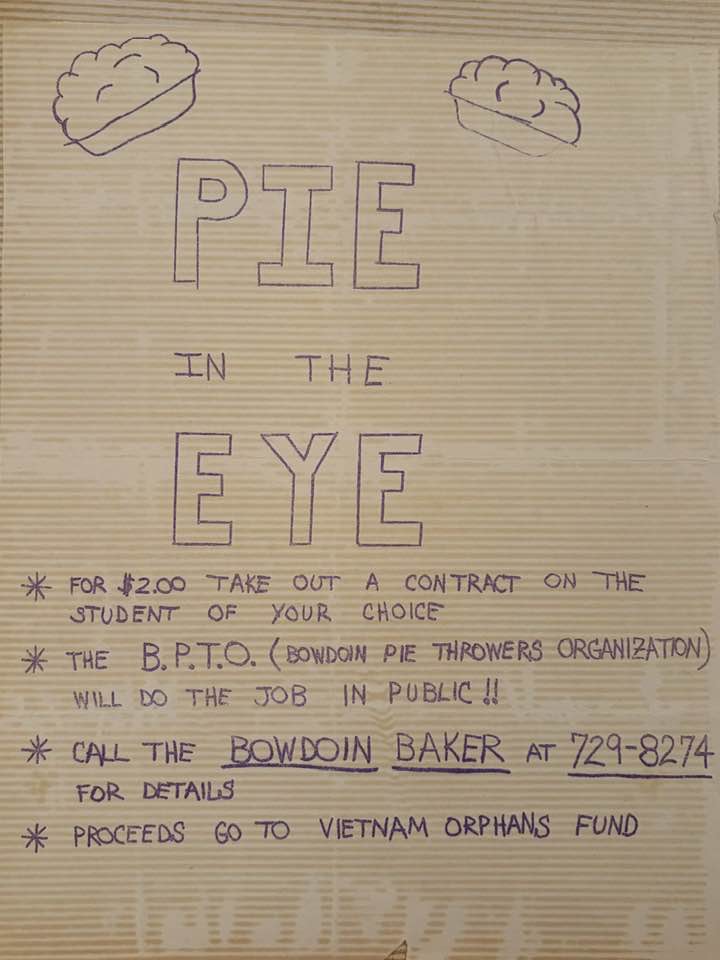
Jeff and I first arranged to borrow the phone number of an off-campus friend. We than ran a batch of advertisements bearing the caption, “PIE IN THE EYE” and posted them clandestinely across campus. The proposition was simple:
*FOR $2 TAKE OUT A CONTRACT ON THE STUDENT OF YOUR CHOICE.
*THE B.P.T.O. (BOWDOIN PIE THROWERS ORGANIZATION) WILL DO THE JOB IN PUBLIC!!
*CALL THE BOWDOIN BAKER AT 9-8274 FOR DETAILS.
*PROCEEDS GO TO VIETNAM ORPHANS FUND.
The idea was for people to call our anonymous off-campus friend and provide the specs on the intended target—physical appearance; place of residence; location of their meal service; class schedule; the preferred site of the hit, etc. Jeff or I would then talk to our contact for an information “download” by way of a pencil and a 3 x 5 “intake card,” from our inventory of such notecards that we used in research for our academic papers. Once the contractor remitted two bucks to a P.O. box, I’d collect, activate the “hit account” and assign the job to one of our lieutenants, who then re-assigned to a growing list of (anonymous) “hitmen,” who in disguise would execute the contract using a canister of whipped cream (on the spot), sprayed liberally onto a paper plate, with the inscription, “Proceeds donated to the Vietnam Orphans Fund”[3] scrawled on the bottom to discourage tort lawsuits by over-eager pre-law students.
We soon had more business than Jeff and I and two or three other initial lieutenants and hitmen could handle. Largely anonymously, Jeff and I recruited more hitmen and arranged for a meeting of the now larger group with strict instructions to attend in disguise. In my nearly three years (at that point) at Bowdoin, I’d never seen anything quite so ridiculous as 20 respectable members of the Bowdoin student body wearing ski masks and seated inside a meeting room on campus. I could barely contain my laughter. In any event, it was an efficient way to assign “hits,” which were then executed so effectively, mostly at dinnertime, that fewer and fewer students took their evening meal, at least where that repast was normally enjoyed. We’d achieved the equivalent of a state of terror across campus. (Cont.)
Subscribe to this blog and received notifications of new posts by email.
© 2026 by Eric Nilsson
[1] The “Dorm War” between Hyde and Coleman featured in an earlier post was by this time in the distant (two-years) past.
[2] From the date of its founding in 1794 all the way to start of fall semester in 1970, Bowdoin had been an all-male college. Fraternities had been around for generations, but with the dawn of coeducation at the college overall, these institutions likewise went coed. Nevertheless, they retained the male label, “fraternity.” In 1997 the Board of Trustees voted to abolish fraternities over a three-year period. By the turn of the century, Bowdoin was fraternity-free. The chapter houses were acquired by the college.
[3] Our “Reign of Terror” coincided with the fall of Saigon in April, 1975. Receiving abundant news coverage in the U.S. were the flights of Vietnamese orphans out of South Vietnam, to be resettled under the auspices of American charitable organizations. At the end of the “Terror,” after a full and accurate accounting of revenues and expenses, I sent a check for the net proceeds (several hundred dollars) to the Society of Friends (Quakers) in Philadelphia.
