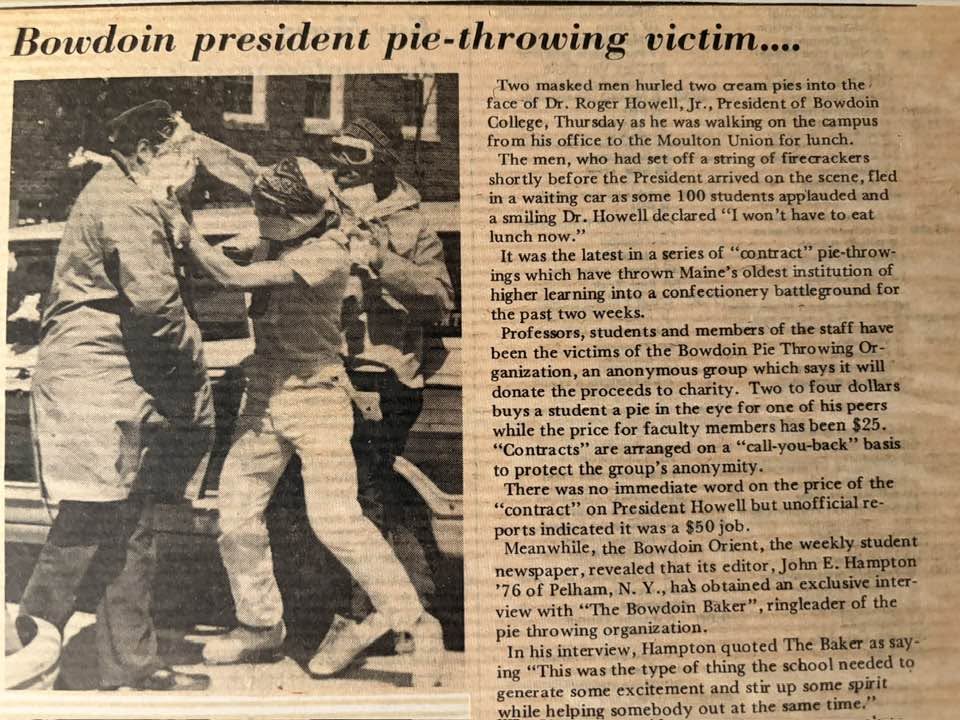
JUNE 6, 2026 – (Cont.) Our Phase II success made us think even bigger, as in . . . A whale. Why not strike at the very top of the Bowdoin College food chain? Why not hit the good-natured president of the college, “Jolly Roger Howell,” whose appeal to supplement academic over-achievement had inspired the prank contest that had given birth to the B.P.T.O. and its “Reign of Terror”? Why not?
The planning was meticulous—even with the “victim’s” foreknowledge of the inevitably and good sportsmanship. (It was during our junior year, and I was less dumb than in the last week of my senior year (See my 6/3/26 post)). Jeff and I were acquainted with President Howell well enough (in our freshman year we’d taken a two-semester course co-led by him and the college Dean) to know he’d be a good sport, but we didn’t want to overtax his good nature. Besides, the best litigation strategy always is to prevent litigation—a notion that we both carried into our respective law practices over the next five decades. (Note, however, that we avoided tort law altogether.) In short, we gave him notice that a hit contract on him had been “activated,”and for the sake of charity, we requested his cooperation. For complete success from a PR perspective, every frame of the operation required precision timing. This was no mean challenge, given that our three-man hit squad would have to unpack from the two-door getaway car (with a trunk), sprint an estimated 10 yards to the target, make a coordinated strike, then fold ourselves back into the (slowly moving) car, all within a span of 10 to 12 seconds. There would be no margin for error.
I was the lead hitman, which meant that after leaping out of the front passenger seat, I would land the first strike with a fully loaded pie—fruit-filled whipped cream. The second hitman, holding an enormous pile of unadulterated whipped cream on a paper plate, would exit the back seat of the “delivery and get-away” car and be right on my heels. The third hitman, hiding in the trunk with the lid pulled down but not latched, would pop out with another whipped cream pie, circle around the car and land the third hit. After the strikes, there could be no lingering. We’d have to dive back into the car, whereupon the driver would have to turn on the burners yet without mowing anyone over.
A few minutes before noon we pulled into the parking lot adjacent to the African American House[1] on College Street, which afforded us a narrow view between the library and Hyde Hall past which the Jolly Roger would walk on his way to Campus Drive before turning at the Moulton Union and proceeding up the drive to his home for lunch. It was the same route he followed every weekday, just after noon. Once he appeared, we pulled inconspicuously out of the parking lot and rolled quietly along College Street the short distance to Campus Drive, where our driver turned ever so carefully—as if all the lug nuts were missing from the wheels—whereupon . . . through the windshield we beheld the enormous crowd that was milling about in the target area.
Our pre-hit propaganda campaign had worked perfectly. Too perfectly, almost. Over the previous 24 hours, we’d enlisted unwitting surrogates to spread the rumor that “Around noon tomorrow in front of the Moulton Union, something big is going down; something that has never happened at Bowdoin College; something you definitely will not want to miss; something you’ll want to tell your friends that they too won’t want to miss.” In addition, as leaked in my 6/3/26 post, the day before the “big hit,” I’d issued a “propaganda plug” to local news media.
In life we experience events, incidents, and encounters beyond count and therefore, beyond memory. Salient ones, yes—the first meeting of a sweetheart; the arrival of one’s firstborn; the departure of one’s parent; and in my case, the rush of a city bus I didn’t see when I stepped into within half a shoe of its path and had the pen sucked out of my shirt pocket. But the overwhelming majority of our experiences retreat to the more obscure recesses of our memory banks. Still hanging prominently in the front lobby of my memory bank, however, is the sight (with sound accompaniment) of my pie smashing into the face of Bowdoin College President Roger Howell, Jr.
Our driver had maneuvered deftly through the crowd and stopped at the bottom of the staircase leading up to the entrance of the Moulton Union. Our target, at that point, was about to step off the opposite curb on the walkway that had led him between Hyde Hall and Maine Hall. In perfect synchronization, I leaped from the car, allowing the backseat hitman to climb out straight behind me, just as the trunk lid of the old car nearly sprang off its hinges and the jack-in-the-box hitman popped out of his hiding place. The three of us then dashed around the front of the vehicle, nearly trampling a photo-journalist (from the Portland CBS affiliate, I noticed). Jolly Rodger had barely stepped onto Campus Drive when I launched the lead pie.
In the instant before I completely buried his face in heavy whipped cream, I noticed that despite the nice warm sunny day, he’d wisely chosen to wear a beige dry-cleanable raincoat buttoned all the way to the top and over his Adam’s apple. When looking into his face, no more than 18 inches from my ski googles, my brain reflexively snapped a mental photograph and stored it straight to my long-term memory. His hands jammed into his coat pockets and his dark eyes fixed on the pie in my hands signaled resignation, not fear, and his facial skin, I noticed, appeared unusually soft for a former rugby player[2]. I worried about his nose, which looked eminently breakable. In the moment I realized I hadn’t given the possibility any thought. As a super fan of the ultimate contact sport, however, surely he’d take a broken nose . . . for the team.
Because we struck at such close quarters, the Bowdoin Pie Throwers Organization didn’t actually throw pies. We pushed them (except in the case of Professor Dane, in which case the pie was pulled). The hit technique applied to Howell was no different from our routine strikes, but what distinguished the assault on the college prexy was the size and weight of the pie. Just as I’ll never forget the visual image of President Howell’s face turning in an instant from a normal face to a huge dripping whipped cream blob, I will never forget the sound produced by the hit: like a large ripe watermelon hitting the pavement when dropped from a height of six feet.
Like a special ops team on the run after scoring a bullseye, my fellow hitmen and I dove back into the car on the fly, as our driver leaned on the horn and the crowd parted to let us through. The trunk lid, I noticed, hadn’t been closed, so it bounced up and down erratically behind us. I pictured the rear of the car as a face, its round taillights serving as smiling eyes and the trunk as a huge open-and-closing mouth laughing hysterically at the scene in our wake.
Not only had the B.P.T.O. Ministry of Propaganda succeeded in drawing a crowd—and the media; by sheer serendipity, we’d made our big hit on an otherwise quiet news day in the world beyond our cloistered campus. At the end of his newscast that evening, Walter Cronkite gave us (anonymous) hitmen our just under 15 seconds of fame by way of a corresponding amount of airtime devoted to the Bowdoin Cream Pie story. The backdrop was a still-shot of President Howell wiping the whipped cream off his smiling face.
Tom DeMaria, our classmate with a camera, took additional professional quality shots of the hit, and one found its way onto the front page of “All the News That’s Fit to Print.” At the reunion, Tom said that within his extended family, the “biggest hit of them all” had given him his 15 minutes of fame. “The New York Times made a lot of money that day,” he said with his customary good cheer. “My family went out and bought up all the copies they could find—not because they knew or cared anything about what had gone on at Bowdoin College in Maine, a million miles from Queens, but because ‘their Tommy’ had gotten one of his photographs on the front page of the Times.” When asked about royalties, Tom said with his ever endearing soft-spoken modesty that he hadn’t received a dime—nor had he expected any recompense[3].
Who knows, but if he’d been paid for that photo, maybe he would’ve pursued photo-journalism as a career, become a war correspondent in the Balkans and been killed in action—instead of raising a family, enjoying a distinguished legal career back in New York, and in retirement . . . attending his 50th college class reunion. (Cont.)
Subscribe to this blog and received notifications of new posts by email.
© 2026 by Eric Nilsson
[1] Now the “Russwurm African American Center,” named after John Russwurm, Bowdoin Class of 1826, and the first African American to graduate from Bowdoin; only the third to graduate from any American college. Before Bowdoin is hailed for this distinction, it should be noted that another 84 years would have to pass before the second African American, Herman Dreer, would graduate from the college. In my four years at Bowdoin, I never set foot inside the Center—much to my later regret. How I might have helped (but didn’t) the tiny minority of Black students of my era feel more welcome, accepted and respected at Bowdoin haunts me to this day.
[2]While a student at Oxford, Howell had become an intense fan of rugby. After his installation as president of Bowdoin, he founded the Bowdoin College Men’s Rugby Team and served in a side gig capacity as both coach and team manager.
[3]When Tom DeMaria matriculated at Bowdoin he expected to star in football. His plans were soon shattered by injury. If he was down, however, he was not out. The following spring he joined the lacrosse team—despite not knowing a thing about the sport (“What did I know about lacrosse?” he told me. “I grew up in Queens!”). On account of physical limitations imposed by his football injury, he was made a defenseman. “I didn’t have to move around as much as the guys playing offense,” he said. “I had a long [defenseman’s] stick and could stand there and jab the end of it into the ribs of attackers.” I thought of Tom as a Greek hoplite armed with a spear, following Alexander the Great into the Battle of Gaugamela (331 B.C.E.) against the forces of the Great King (Darius III of Persia). As soft spoken and good natured as a koala bear, Tom had been a formidable adversary on the gridiron—and an unrelenting soldier stopping adversaries on the lacrosse field of battle. He would’ve made an excellent Secretary of Defense.
