APRIL 25, 2026 – If for no reason but to keep tally of the latest assaults on American interests by . . . the American presidency in league with House and Senate enablers . . . today I’d intended to write about those offenses. Random material, however, disrupted my plan unexpectedly.
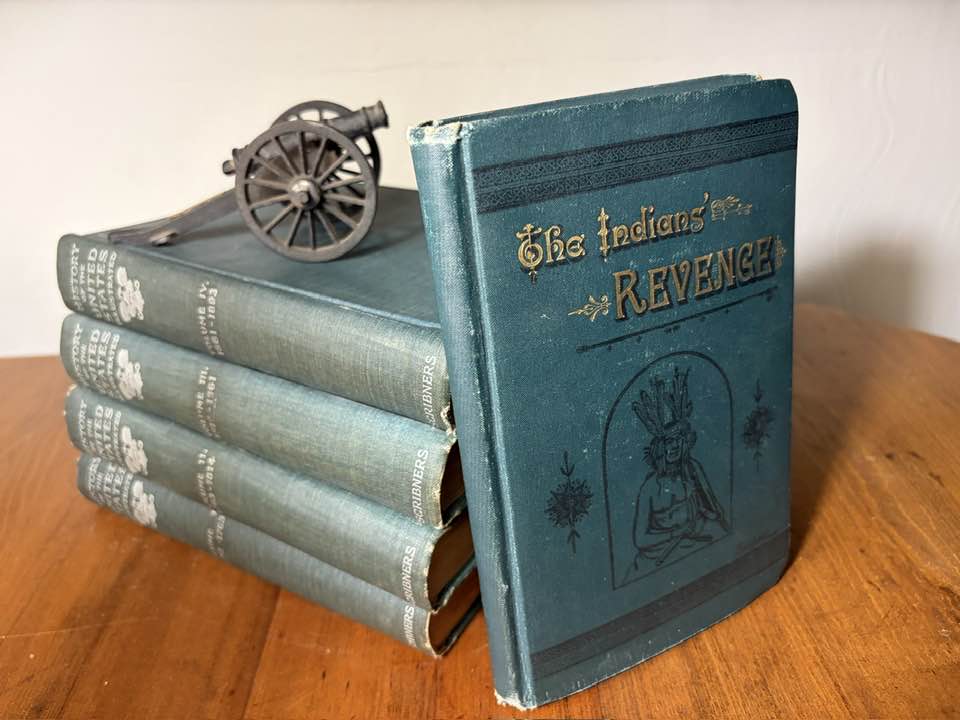
The diversion occurred as I was committing another couple of recently read books to the shelf that runs the length of the room above the doorways. Said shelf now harbors 112 volumes of various sizes and subjects, with space for another 30 or so books. In the dwindling leasable end of the shelf are a model Viking ship that I built during a snow day in fifth grade and a miniature Civil War cannon my parents bought me in a souvenir shop on our family road trip “Down South” when I was in kindergarten. On top of the trail[1] is a thin narrow label with raised lettering that reveals the cannon’s origin: “Vicksburg, Miss.” The cannon sits on top of a compact four-volume “History of the United States” stacked vertically. Published in 1895, the history belonged to Grandpa Nilsson, who one day when I was in seventh grade, handed the books to me, saying, “Here. You can have these.” I’d pored over them but never read them. Too old and therefore irrelevant, I thought. But they made an attractive pedestal for the cannon, though not till now did I see the irony of placing a symbol of the “Lost Cause” on top of a triumphal history of (a united) America.
In Part II of this series I’ll return to that four-volume history, but for now, I must introduce the reader to the mainstay of this post: a small dark blue book leaning against the “stack of history” and entitled, The Indians’ Revenge, in decorative gold lettering.
By pure coincidence one of the recently read books that had brought me in contact with The Indian’s Revenge was Ned Blackhawk’s monumental work, The Rediscovery of America: Native People’s Unmaking of U.S. History. To make room on the shelf for the latter book, I had to gently shove the former book and its prop—the four-volume history guarded by the cannon on top—down a foot or so. That simple act is what triggered the chain reaction that led to this post.
Though I was the only person who would’ve placed The Indians’ Revenge aboard the shelf, I had no immediate memory of having done so. It felt as though I was laying sight on the book for the first time. Given its old age, it appeared a bit fragile, so I removed it carefully and stepped down from the footstool I’d used to access the shelf. With the little treasure in hand, I sat down to inspect it. Inside the front cover I found two names: “Frank J. Hoeschler” above “LaCrosse, Wis.” all ink-stamped, and below it, written with a fine-pointed pen in polished cursive, “Mary Hoeschler,” also above “LaCross, Wis.,” ever so faintly inscribed.
Instantly, I remembered: Just over two years ago, my good friend Linda Lovas Hoeschler had invited me to pull from her late husband Jack’s library, whatever books I cared to have. If our own house hadn’t already been a book warehouse, thanks in large part to Beth’s thriving online book selling enterprise, I would’ve rented a U-Haul and taken custody of the entire history section of Jack’s formidable collection. Instead, I had to settle for several shopping bags’ worth of books. The Indians’ Revenge was an “impulse take”; a book that had flopped down on its back when I’d removed the three books that had supported it. I picked it up, and without even considering its contents, I added it to one of the shopping bags.
Not until this morning did my curiosity lead me to explore the contents of the book . . .
An hour later, I emerged from a most remarkable story, leaving a placeholder at the start of Chapter Three. What lies ahead is a detailed account of the Dakota War of 1862, based in large part on extensive interviews with eyewitnesses to the conflict. Every Minnesotan in the know has heard of this tragic five-week conflict that burned across the prairie just four years after statehood. Precipitated by the familiar story of white settler encroachment on Native hunting grounds and depletion of food sources, broken treaties, and desperate living circumstances, all aggravated by the diversion of the Civil War, the Dakota had had enough. Four warriors went on a rampage, killing five settlers. This set off a conflagration that would lead to the deaths of hundreds and displacement of thousands more among the settlers. When the full force of the U.S. Government was unleashed against the Indigenous bands, the Dakota were defeated and forcibly removed from their homeland. The following December brought more sorrow, when in Mankato 38 Dakota fighters were hanged en masse, the largest single execution event in American history.
The author of this gem of a book was Rev. Alexander Berghold, a Catholic priest born in Austria in 1838. His autograph appears below his photograph facing the title page. As a theology student, Berghold was recruited in 1864 by a fellow Austrian, Father Francis Pierz, who’d become a central figure among German Catholics in St. Cloud, Minnesota, north of the Twin Cities. In 1872, Berghold found his way to New Ulm[2], Minnesota, which had been at the vortex of the Dakota War of 1862.
I would up researching this extraordinary person, Father Berghold, and stumbled across a scholarly paper written by Professor La Vern Rippley, who’d died in 2022 and retired five years earlier after serving for half a century as a member and chairman of the Department of German at St. Olaf College in Northfield, MN, an hour and a half drive due east of New Ulm. Rippley’s paper, “Alexander Berghold, Pioneer Priest and Prairie Poet” published in The Report: A Journal of German-American History (1978) Vol. 37, pp. 43 – 56, gave the dedicated and enlightened priest highly complimentary treatment. Father Berghold was a veritable tour de force in New Ulm and environs, where he took charge of building churches, ecumenical schools and a hospital, and ministered to the totality of immigrant needs.
Later in his career he tangled with the Archbishop John Ireland, the legendary prelate of the Archdiocese, who ruled from his ecclesiastical throne in St. Paul[3]. An outspoken advocate of temperance, Ireland was also a proponent of full “Americanization” of immigrants. He opposed Berghold’s efforts to uphold German culture and language among German parishioners. Eventually, Berghold was forced to resign, whereupon he assumed a post at a Benedictine Abbey in Oregon. In a farewell column in the New Ulm Post, the editor—an admirer of the departing priest; no friend of the Archbishop—wrote,
We have read these letters [between Ireland and Berghold] and have discovered such uncouth expressions that we were compelled to ask how in the world the writer of the same could be an archbishop. Judging on the basis of these letters, we consider Mr. Ireland to be totally unworthy of his high clerical office.
Professor Rippley also praised Berghold’s literary career (books and poems), but on my own I’d already discovered the priest’s supreme command of literary English (he knew eight languages) as demonstrated so beautifully in the first 37 pages of The Indians’ Revenge.
What drew me to read well into the book (now hooked, I’ll continue to the end) was the good Father’s introduction, which at the very outset revealed his sympathy for the Dakota[4]:
“Indian Horrors,” “Indian Massacres,” “Indian Cruelties”—these are among the titles of the sensational works written for the sole purpose of catching the eye of the public, and of filling the empty pockets of their authors. These lurid descriptions are now means to obtain that end without containing anything worth reading. The Indians’ Revenge, p. 3
He then proceeded to refute a popular claim against the Dakota:
A false statement in reference to a supposed outrage committed by some infidels at New Ulm is hereby corrected. Reports have been published and speeches have been made that a crucifix was publicly burned by the “infidels” of that city. After full investigation by the author of this work, nothing could be found to corroborate this base calumny. All that can be said with regard to this matter is, briefly, that after the siege of New Ulm, a half-burnt crucifix was found on the prairie in the vicinity of the Evangelical church. The crucifix was undoubtedly purloined from one of the numerous Catholic houses and was lost or thrown away in the prairie. Other report to the contrary are untrue, and may be set down as a vile slander. Ibid. p. 5
To bring my “random material” full circle . . . after coming up for air from my deep dive into the Dakota War of 1862, I called Linda to ask her to identify Frank and Mary Hoeschler’s relationship to Jack. Frank was Jack’s great uncle. Jack’s great grandfather, I then learned—Jacob John Hoescheler (later changed to “Hoeschler”)—had fought in the conflict. Born in Austria in 1841, his family had come to America when he was 11. On August 16, 1862, Jacob enlisted in Company K, 6th Minnesota Volunteer Infantry in Brownsville. Three days later, he found himself smack dab in the middle of the Dakota War. He survived and was then shipped off to fight in the Civil War. His route of entry? Down the Mississippi River right past Vicksburg—the origin of my miniature Civil War cannon atop the stack of volumes of United States History, the prop for The Indians’ Revenge. (Cont.)
Subscribe to this blog and receive notifications of new posts by email.
© 2026 by Eric Nilsson
[1]The part of a field cannon that rests on the ground and is used to pull the armament.
[2] A town in southwestern Minnesota with a population today of 14,000, New Ulm was named after Ulm in the southern German state of Baden-Württemberg, which, in turn, as Father Berghold explained in The Indians’ Revenge, is the combination of initials of the old Roman map legend, ultra limites militares, meaning “beyond the military lines”—the Roman description of territory adjoining their distant possessions.
[3] Ireland insisted that the grand Beaux-Arts/Neo-Classical St. Paul Cathedral, designed by Emmanuel Louis Masqueray and Whitney Warren and completed in 1906, be sited on a hill looking down on the state Capitol, designed by Cass Gilbert and completed in 1905.
[4] No doubt he was influenced by the sentiments of his recruiter-mentor, Father Pierz, whom Rippley reports, “. . . was a staunch protector of Indian rights and consequently he was opposed to the advent of white settlers. But once he realized that the tide was irreversible, Pierz worked zealously to bring German Catholics to Minnesota as well as German-speaking clergymen to minister to them. Rippley, L.V. (1978). “Alexander Berghold, Pioneer Priest and Prairie Poet. The Report: A Journal of German-American History, vol. 37, pp. 43-56.
