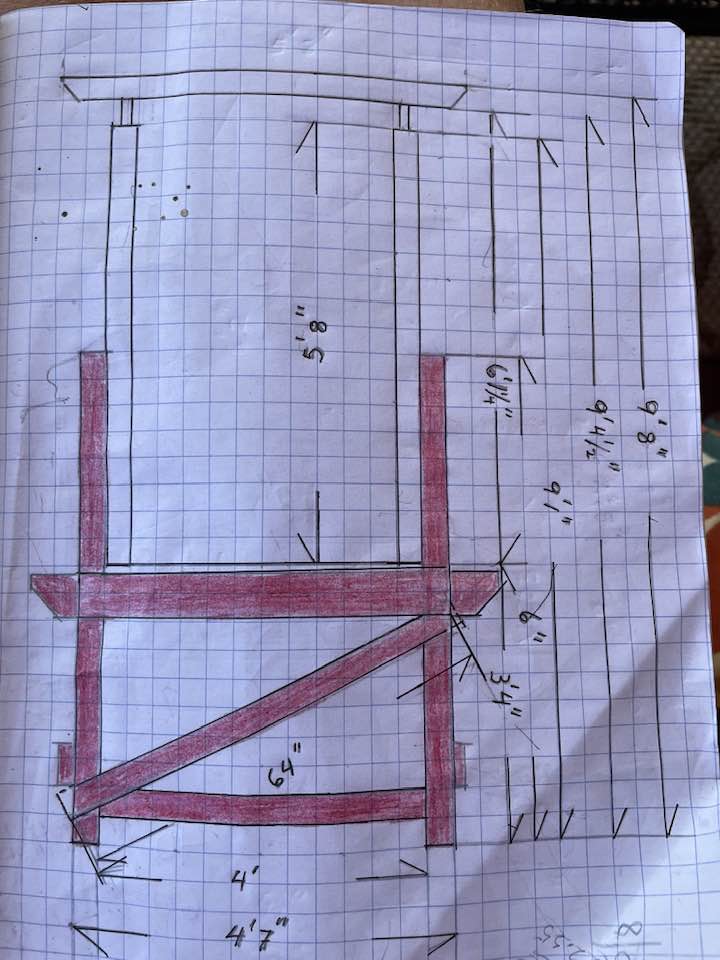
JULY 11, 2025 – (Cont.) I’ve always had a fondness for graph paper. It invites a disciplined approach to the transition between conceptualization and materialization of a building project. It fills gaps in mental images, drawing the possible from the improbable. In the case of Project Zen, graph paper captures with precision, proportions imposed by my odd-length 2 x 4s—assuming no or limited cutting and waste. Moreover, the graph paper presents a basic test of stability: Does this structure appear to be solid and stable or should I worry about it toppling over in a stiff wind?
The beauty of combining graph paper with a pencil and eraser is that I can easily raise, lower, widen, render narrower and make other adjustments without the aid of a saw or hammer and nails and quaintly, without the aid of a cursor and computer screen. I think of it as kayaking, rather than steering a large power boat, in and around a compact archipelago. Slipping through the waters by your own means is more gratifying than relying on technology. What appeals to me is the tactile experience of holding a pencil against the edge of a ruler and watching a line form across a series of squares on the page of a notebook as I blaze a graphite trail.
I’ve lost track of the number of iterations of my structure. And—you might ask—what, exactly, is that structure? Thus far I’ve used the words “pergola” and “viewing stand” to describe it, but these terms require some assembly for the reader to picture what has thus far appeared only on graph paper.
Ever since my initial conceptualization of the “trädgård,” or tree garden, I visualized some kind of marker at the “summit” of the roughly 20-acre portion of our lacustrine woods that I call the garden.. This peak, so-called, is not so much a mountain top as it is high ground shoved up by the Wisconsin glacier during the latest Ice Age. It is the most elevated real estate within sight from our pontoon boat when anchored in the geographic center of our roughly oval-shaped lake with a surface area of 3,111 acres (dimensionally, two miles by four miles). Over time, my idea of a “marker” morphed into a monument of some kind; amorphously defined in my mind, but bearing the elevation above sea level (about 1,300 – to be refined in accordance to a U.S.G.S. topo-map) and above lake level (about 100 feet, also to be calibrated accurately). I’ve also assigned thought to a name, such as “Mt. Raymond[1]” in honor of our dad, who, more than any other person on earth besides the writer, spent time walking the subject woods.
After this portion of our woods was harvested in 2016, I’ve worked on blazing and maintaining a trail network throughout the tree garden. One of the primary trails branches off from a woodland path 75 feet inland from and parallel to the lakeshore. This trail meanders around a bit until it leads up the slope to the “summit,” then drops down over the other side, continuing northward to a powerline easement that borders the north side of the tree garden[2].
The exact location of Project Zen will be astride this trail as it crosses the high ground. It’s an improbable site for what is a major construction effort—for me, anyway. I figure that left to my own devices, lugging all the lumber, fasteners, tools and assembly accessories will require no fewer than 30 round trips up and back down the trail with a linear distance of a third of a mile and rising in elevation that is the equivalent of a 10-story building.
The laborious task of hauling supplies (including bug repellant) and materials sounds ridiculous to the firm of mind, but that’s exactly part of the allure of Project Zen. I envision that intrepid people who want to be close to nature, close to the land, close to creation, will be drawn to the tree garden someday in the not so distant future. With sturdy hiking sticks and sturdier shoes, these intrepid visitors will climb the trail, admiring the tall white pine along the way; trees that I planted “way back” in 2017 and bud-capped against the browsing deer each fall thereafter until the royalty of the forest were beyond the reach of the “arbivores.” As these hikers reach the top of their climb, they will lay eyes on a surprising sight: lined up with the narrow trail, a set of steps leading up to a dark red platform 40 inches off the ground and supporting a classic-style white pergola reaching over six feet above the platform. The colors will match the colors scheme of the Red Cabin, which, in turn, mimics the traditional colors of “stugarna” (Swedish for “the cottages”) of Småland, the province in southern Sweden from which 80% of Swedish immigrants, including my family’s forebears) called home).
A painted sign—yet to be designed—will proclaim, Ave Arbores, Latin for “Hail the Trees.” And as the heartbeats slow—having hastened during the ascent—one of the walkers will say, “What in the world . . . ?” To aid in their cardio-pulmonary recovery (but not so long that the mosquitoes discover new blood), the hikers can access via a QR code and GPS, their exact location and its local significance geologically, geographically and historically.
As my dad once said about his Shangri-La, which by his caring stewardship he left intact for his progeny, “Just knowing this place is here gives me great contentment, even when I’m not present.” So will I say of Project Zen in the time that fate and fortune allot me.
If, after my having explained all this, the reader is further convinced of my mental maladjustment bordering on separation from reality, know that I’m fully aware of the weakness of an underlying premise: that Project Zen has features of permanence. It most surely does not. Recently, I scoped out the contemplated location with closer attention than I had before. I took note of the nearby mature oaks that survived the harvest; trees that tower above the site and well within a radius far exceeding their height. Storm, disease or inevitably . . . the sheer rerum de natura will one day fell these now sturdy giants. Will they succumb to an infestation that lays waste to their foliage? Will lightning strike next month? Next year? Will fire wipe out the entire landscape? Will the increase in violent storms wrench the roots of these stalwarts from the ground and topple the trunks down upon Project Zen, converting it in an instant into the likes of a disorganized yard of a Soviet-era toothpick factory in Siberia? Only time—the supreme mystery of physics—knows but will not tell until the future becomes the past.
But so it is of all human endeavors. Against the inexorable ticking of the universal clock, even our works of granite must one day crack and crumble. (Cont.)
Subscribe to this blog and receive notifications of new posts by email.
© 2025 by Eric Nilsson
[1]Which appears on a crude trail map that I’d drawn several years ago and rediscovered recently while thumbing through one of my sketch books.
[2] The easement is 30 feet wide and was clear cut about 20 years ago. Since then hundreds of volunteer red (Norway) and white pine have settled in the territory. The power company, a co-op has launched a project to put most local powerlines underground to minimize power disruptions. Although construction will wipe out some of the trees, many will survive, and in time the easement will be heavily forested with the original indigenous and dominant arboreal species—red and white pine.
