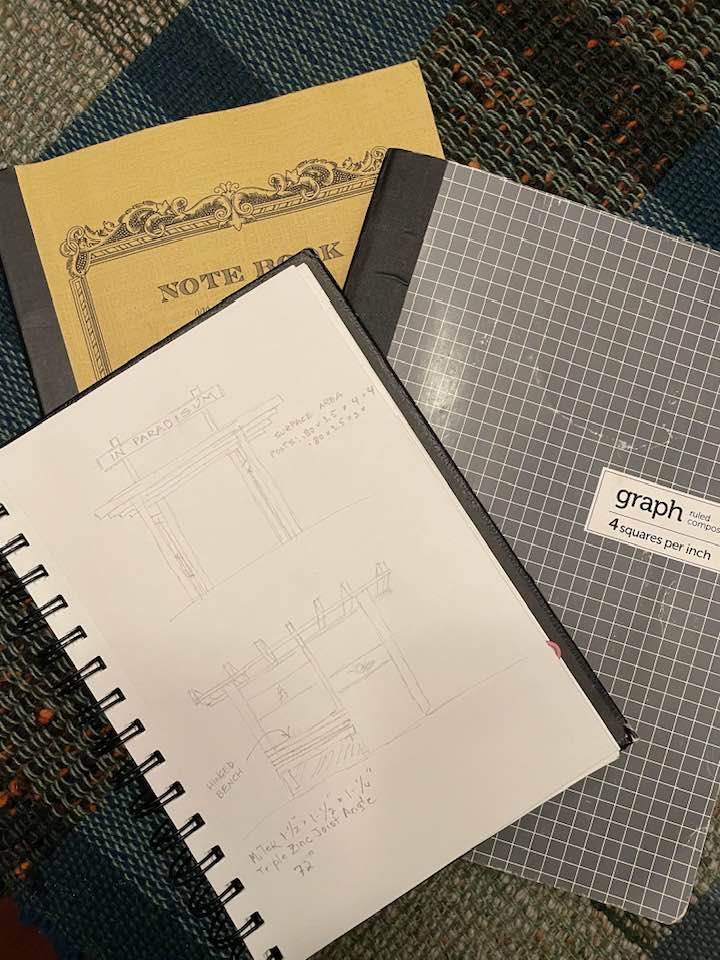
JULY 10, 2025 – (Cont.) Most building projects, whether large or small, follow a logical sequence. You start with an objective, be it a new house or a recycling box to be placed outside the new—or old—house. Next, plans are drawn up (in the case of the house) or sketched out (depicting the recycling box). Based on the plans, the builder who will construct the house—or you or your capable in-law, in the instance of the recycling box—will spec out the materials. Once the lumber, fasteners and other construction items are procured, they’re assembled in the fashion specified by the plans. It’s all rather straight forward, unless . . . it’s a “Project Zen.”
To optimize the Zen effect associated with building something, you’ve got to throw some paint around. In my current project, this meant reversing the first three steps outlined above. Instead of following the sequence of objective-plans-spec-procure-build, I decided to spec out the project (that is, take inventory of my sizable stock of lumber and fasteners), then figure out how they could be assembled into something that was more functional than a straight-up sculpture and more interesting than a purely functional box or shed.
This is no way for a builder to operate, of course, but might it be how a painter sometimes approaches the canvas? I’m no artist, and being odd, quirky or altogether nuts doesn’t render me “artistic,” but I imagine that perhaps Vincent and his ilk didn’t always follow norms and conventions in creating many works that now grace museum walls. But apart from throwing paint at the wall to see if it turns into “art,” practical method underlies my madness.
First, my lumber inventory comprises many “two-by’s” of uniform but non-standard length. For example, I have many 2 x 4s that are 56 inches long and a bunch that are 67-1/2 inches, but few that are 96 inches (eight feet), which is a standard dimension for say, stud walls. Generally, structures and spaces within them have lengths and widths that are divisible by four, since most lumber is stocked in such dimensions. To minimize waste, you want to avoid plans that provide for a room frame that’s say, nine feet by 13 feet. If my current project were to require buying additional lumber (ironically) to supplement the lumber stash I’m trying to diminish, I’d have no choice but to buy “divisible by four.” But then I’d have a a mismatch between standard and irregular length lumber, and this would lead to lots of cutting and waste.
Second, my lumber stock includes treated and untreated pine and untreated cedar. Treated pine isn’t the most environmentally friendly material to be working with, but over the years I’ve accumulated a fair amount of it, and exposed to the elements it will last forever, particularly if it’s mostly off the ground. Untreated cedar is far more rot-resistant than untreated pine (micro-organisms don’t like the tannin in cedar), but prolonged exposure to moisture will eventually compromise the cedar. Untreated pine exposed to the elements—especially at ground level—is not long for the world. Within a few short years—sometimes less, depending on conditions—untreated pine will rot away. To some extent the life of untreated pine can be extended by the application of (environmentally friendly) preservatives or lathered with two coats of a high quality, semi- or high-gloss paint (with primer). Since Project Zen will necessarily require placement outdoors and thus, exposure to sun, rain, ice and snow, and since most of my lumber is untreated pine, I know that paint or preservative will play a critical role in Project Zen.
Third, I will be working alone on my project. This means that whatever I build, I’d have to manage all physical demands—lifting, carrying, climbing—primarily by engineering, not by brawn or four hands. Having developed heightened respect for ladders, especially after last summer when I encountered a wasp nest embedded in a gutter I was cleaning, my project height will be limited by the safety principle that my feet go no higher than a safe jumping-off distance to the ground[1].
Subject to these three considerations, I focused in earnest on Project Zen—a combination pergola/viewing stand sited on the highest elevation in the tree garden. With a good mental grasp of my lumber inventory, I sat down with a sketchbook and brought the structure into view—at least on paper. Make that on numerous pages. I kept on drawing elevations until I settled on something I liked. I was not yet in Zen mode, but I was moving closer.
The next step was to turn to a notebook of graph paper that heretofore I’ve used primarily for scale drawings of potential gnome homes. These were their own form of Zen, and I remember the groove I found while immersed in that long-term project. Having arrived at a general concept for a “real” structure—the pergola on top of a viewing stand—I was now ready to prepare scale elevations. At this stage I took a step back from pure design and concentrated on engineering challenges: how do I make the structure “wobble” free? How do I ensure it won’t tip over or fall apart? How do I build something that is at once rock solid but movable if need be? (It is unfeasible to anchor the structure to the ground, that is, to pillars of poured concrete extending below the 48-inch frost line.) More specifically, how do I determine the CG (center of gravity)? What are the physics of triangulation? Et cetera.
I was now well into Project (Engineering) Zen and having a blast. If I’m no artist, I’m certainly no structural engineer, but in considering basic questions such as, “What makes for a stable table?” I found gratification of a sort similar to what I’ve felt in studying a piece of art or music. (Cont.)
Subscribe to this blog and receive notifications of new posts by email.
[1] Even that principle has to be qualified: Twenty-five years ago while building our shed, I was not more than three feet off the ground when I attempted to hoist a 4 x 8 sheet of OSB onto the side rafters of the gambrel roof. In so doing I violated a principle of ladder safety—at all times keeping at least one hand on a ladder rung. As I held the OSB sheet, I nearly lost my balance going backwards. Had I not caught myself, the result would’ve been very bad news, given all the lumber, bundles of shingles, wheelbarrow, sawhorse and miscellaneous tools that lay at the foot of the ladder.
