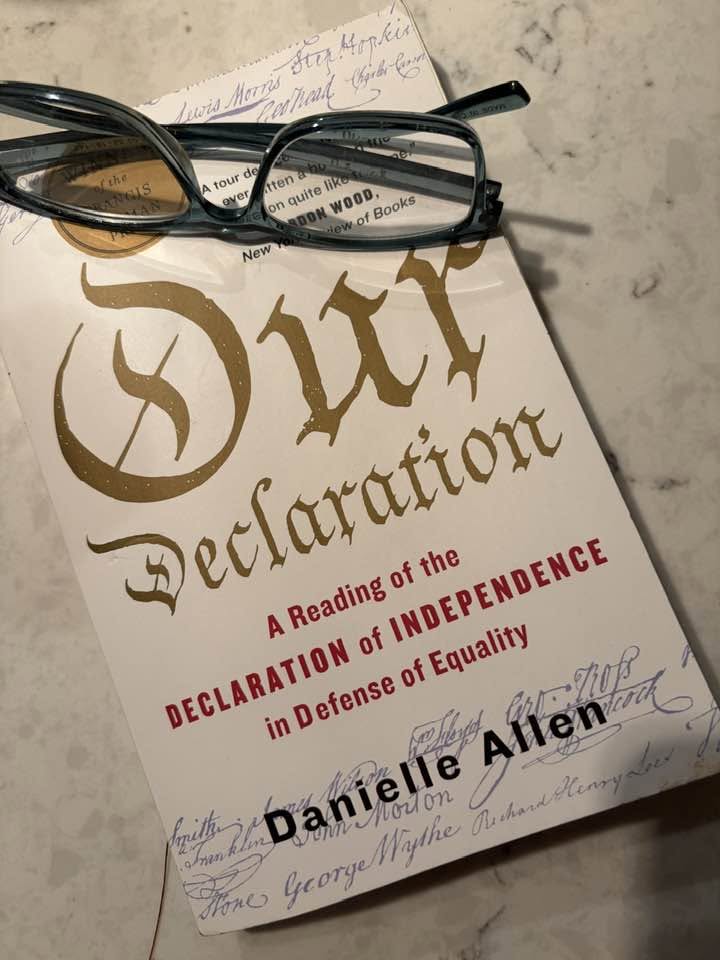
AUGUST 2, 2026 – In a previous post, I misstated (2015) by one year, the pub date (2014) of the book I just now finished, Our Declaration / A Reading of the DECLARATION of INDEPENDENCE [sic] in Defense of Equality by Danielle Allen (Harvard University). The significance of this error is that as it turns out, this remarkably anticipatory work pre-dated the presidential campaign of the Naked Emperor. If the book was in the “highly recommended” category back in 2014, it merits inclusion on the “required reading” list today.
Allen describes the Declaration as a syllogism, containing a statement of principles, a summary of facts (in the form of “grievances”), and a conclusion—declaration of independence from Great Britain. Presented this way, the Declaration becomes not only the convincing prescription for independence from tyranny, but a guidepost for people of any time and any place, who struggle with the conditions of their polity.
Our Declaration leads the reader not only through a meticulous examination of the 1,337 words of our country’s foundational document but on a journey through the political philosophy enshrined in this remarkable cornerstone of our history. I experienced a tripartite reaction to this work of scholarship and analysis: 1. Amidst the fog and clutter of current political commentary, this book serves as a beacon; 2. Why didn’t my high school, college or law school curricula include a course on the Declaration of Independence as probative and discerning as this book? 2. If more people would read and digest Our Declaration, the effect on our body politic would be transformational.
In just 282 pages, plus notes, Professor Allen covers lots of both contextual and philosophical ground. Her arguments are well-organized and well-articulated (albeit in places overly sanguine), but I acknowledge that my pre-disposition—my bias—was very receptive to her thesis: The Declaration of Independence is as much about political equality as it is about “freedom,” contrary to the libertarian interpretation that has gained increasing ascendancy in the first quarter of the 21st century.
She states the problem as follows:
Political philosophers have generated the view that equality and freedom are necessarily in tension with each other. As a public, we have swallowed this argument whole. We think we [have] to choose between equality and freedom. Our choice in recent years has tipped toward freedom. Under the general influence of libertarianism, both parties have abandoned our Declaration; they have scorned our patrimony.
Such a choice is dangerous. If we abandon equality, we lose the single bond that makes us a community, that makes us a people with the capacity to be free collectively and individually in the first place.
Professor Allen argues that the authors of the Declaration of Independence did not share this current view that equality and freedom are in conflict and that freedom must prevail over equality[1].
Notice, I wrote “authors”—plural. Although Thomas Jefferson took the first whack at drafting the Declaration, the Continental Congress had delegated responsibility to five delegates (formally called, the “Committee of Five”)—Jefferson (Virginia), John Adams (Massachusetts), Benjamin Franklin (Pennsylvania), Roger Sherman (Connecticut), and Robert Livingston (New York). Jefferson did not create that first draft out of whole cloth. He relied on a preamble written earlier by John Adams and a Virginia Declaration of Rights drafted by George Mason up the resolution of a Virginia Convention in May of 1776. Moreover, these writings incorporated input from numerous sources, and Jefferson’s initial draft was itself put through the sausage maker—that is, the grind of editing by the Continental Congress. According to Allen’s count, consensus had to be reached among more than 50 individuals. Of additional consequence were the further editing that occurred on the part of the copiers and printers of the “final” approved version of the document.
Allen folds this drafting background into her thesis regarding “equality.” She calls it “democratic writing,” otherwise known as “drafting by committee.” Anyone who’s been through the exercise of drafting a letter or document in conjunction with other people knows what an arduous and frustrating task this can be, but Allen argues effectively, I think, that out of “democratic writing,” comes a stronger, more effective consensus. As an aside, before reading Our Declaration, I’d always referred to Jefferson as the author—singular. (Cont.)
Subscribe to this blog and received notifications of new posts by email.
© 2026 by Eric Nilsson
[1] In the current phase of the Trump Era, a further tension exists between (a) what I call “laissez-faire freedom”—the freedom of the super-wealthy to use outsized campaign contributions to influence elected officials, to run roughshod over the environment, to force policy decisions to the detriment of disadvantaged sectors of society, and to operate free from government interference and regulation; and (b) the expansion of authoritarian rule by the executive branch of government, abetted by the abject servitude of Republican-controlled House and Senate, and all too often, granted sanction by SCOTUS.
