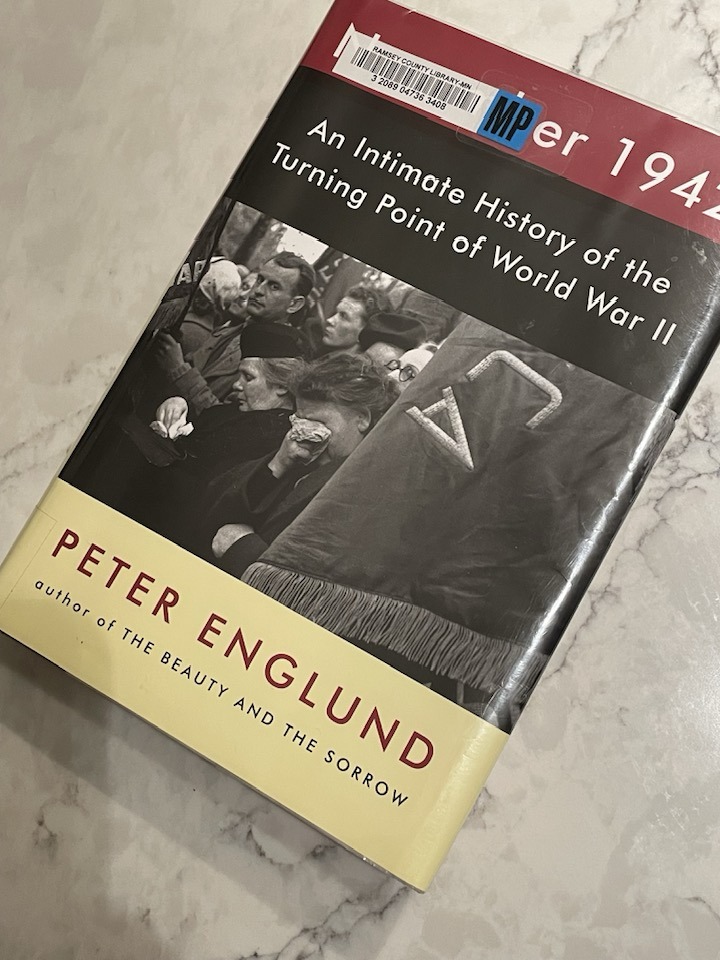
NOVEMBER 19, 2025 – Today I raced to the last page of, November 1942 – An Intimate History of the Turning Point of World War II by the Swedish historian and journalist, Peter Englund. As the last words reverberated inside my head, I closed the book, rose out of my chair, and peered out the window. I needed time and space to catch my breath. The book tracks the challenges faced by 39 people—all sides—during that critical month of the greatest conflagration the world has ever seen. Nothing of the large volume of history I’ve read about WW II has affected me as deeply as November 1942. Even if that conflict specifically or history generally doesn’t occupy the forefront of your interests, you should read this book for insights into the human condition, including prominent elements playing out in our world today.
The book can be a springboard for discussion about myriad facets of war and peace; suffering and redemption. What stood out for me were five features:
FIRST: All-out war, conducted in tandem with the harshest conditions of nature, produces the deepest, broadest, and cruelest forms of suffering, which have no floor. Not only does war bring direct crushing devastation from bombs and bullets, which destroy property, limbs and lives. It also unleashes disease, starvation, and exposure to the elements at their extreme. The diaries, memoirs, other writings, and oral histories that form the factual bases of November 1942 reveal horrors unimaginable without the narratives of participants: starving, freezing, and itching madly head to toe from lice, for example, while avoiding being machine-gunned in fighting the Battle of Stalingrad; or as a malnourished POW suffering from yellow fever and dysentery while being driven along the rain-soaked mud of New Guinea in sweltering heat; or wearing the compulsory Yellow Star of David and carrying an infant, being followed by an SS officer in Poland who is closing in for the arrest (and deportment and death), and with no time to deliberate, handing off the infant to a total stranger approaching from the opposite direction. One story after another as riveting as these for over 440 pages leave the reader gasping for oxygen.
SECOND: Everyone has a breaking point, and the effect of unspeakable suffering can demolish the heart, mind, and soul of the sufferer. The accounts presented by the author underscore the psychological toll of endless and abject fear, disease, violence, hopelessness, and starvation. These factors, in turn, have direct and profoundly detrimental effects on the viability of combatants.
In one especially memorable passage the author writes:
Different people react in different ways to mortal danger and extreme stress. Some go to pieces at the mere thought that they could be injured or die. Some, on the other hand, appear to be perked up by danger—at least initially. Most people seem able to deal with it, able to bring themselves to face up to it, at least for a time. The absolutely unshakeable rule, however, is that everyone has a limit. And the question at the present is whether the men in McEniry’s [U.S. Marines] dive-bomber squadron, VMSB-132, are approaching that limit.
It’s noted that a leading indicator that someone is about to crack is the manner in which they hold a coffee cup: one hand, still okay; two hands, keep an eye out; no longer able to hold the cup at all—it’s too late. In November 1942, the author reports, pilot McEniry and most of his colleagues stationed at Henderson Airfield in the South Pacific were using two hands to hold their coffee cups.
Coupled with the notion that “everyone has a limit” is the impression that in many instances, combatants on the ground, in the mud, suffering mightily and endlessly—on all sides—lose all connection to casus belli to the extent any existed in the first place, other than a fantasy hatched from a megalomaniac’s fanaticism. In the absence of rationality, combatants are focused on the most elementary feature of existence: survival.
THIRD: Some people will drink the Kool-Aid even after it’s proven to be toxic. Many of us who abhor the current regime keep asking, “What will it take for MAGA to realize their very interests, let alone those of the nation as a whole, are directly threatened by the current regime?” An analogy, one would think, would be Germans in November 1942 vis-à-vis the Führer—still insisting that the Battle of Stalingrad can be won and that full victory over the Allies is “around the corner.” Despite seeing, feeling (painfully) a wholly contrary reality, soldiers in the field and people at home still believe in the infallibility of der Führer. Some Germans never saw reality, even in the ruins and rubble of Hanover, Hamburg, Essen, and Berlin. And what of the Japanese, who would rather commit group suicide than accept defeat at the hands of enemies who are so dishonorable they—the Americans—would not commit suicide to “save their honor”?
FOURTH: In a brief passage, the author mentions that the Nazis loved classical music. And they did, especially the works of Wagner and Beethoven, Carl Orff and Paul Höller, and Sibelius. Nazis loved this music (not to mention trainloads of great (stolen) art). Was it even possible that the worst of evil hearts could embrace the pinnacle of artistic beauty? . . . unless one accepts the belief that aesthetics can be divorced from morality.
FIFTH: The biggest impact of November 1942 on my perception of reality 83 years later, is this: despite the comprehensive evil of WW II and the destruction of the human soul, we as a species didn’t collapse into cold dark caves. We rebounded remarkably fast, albeit with permanent scars. We proved that we are nothing if not resilient, despite our penchant for self-inflicted mayhem. The ultimate irony is how our resilience had previously played out after the Great War of 1914-1918.
Is that resilience part of an inexorable cycle driven by destruction? And are we on the cusp (or already past the threshold) of . . . the next phase of that cycle?
Subscribe to this blog and receive notifications of new posts by email.
© 2025 by Eric Nilsson

1 Comment
This is brilliant, thank you.