MAY 19, 2026 – Today at high noon I joined two other lawyers with whom I’d teamed up in a contested real estate matter for the past two years. What had started out as the prospective sale of farmland turned into a full-blown lawsuit, including a protracted appeal, followed ultimately, by a closing on a sale of the subject property. Dickens, chronicler of the classic lawsuit of fiction, Bleakhouse, would’ve had a field day—or better stated, a day in the field.
Anyway, with the closing behind us and the sale proceeds in our clients’ pockets, it was time for the lawyers, at least, to celebrate. We did so over modest fare at a comfortable restaurant around the corner from the building where my office used to be in downtown Minneapolis. Not to get too carried away, for liquid refreshment we settled on . . . water.
Though less than a minute late, I was the third of our crowd to arrive. On impulse, after shaking hands, I decided to kill two birds with one stone. No, not two lawyers; two birds, to-wit: 1. Jump-starting a scintillating conversation; and 2. Finding an answer to a somewhat arcane legal question. I would’ve arrived with time to spare had I not been grappling with said question over the phone with a bank client a half hour earlier. Said client is a lending officer closing on loans to a large church, and the title company involved requires a current “certificate of good standing” for the church entity. This is a standard request that ordinarily can be easily satisfied. In the case at hand, however, there exists no standard; no statutorily prescribed method of procuring a “certificate of good standing” for the kind of entity involved. Ironically, the title company’s own examiner couldn’t explain how to fulfill the requirement.
Save the foregoing paragraph for your next bout of insomnia.
When I asked my two colleagues—both highly experienced in real estate and attendant corporate law—thought of the situation, neither had a clue, but each revealed his self-confidence by admitting such. I described my proposed jerry-rigged solution, to which I received friendly nods of approval, along with two wide yawns.
One bird down—kinda, sorta.
Now back to the first bird; the hoped-for scintillating conversation. For this, the “bird of legal arcana” served as a convenient springboard.
“So . . .” I continued. “Here we are, three lawyers addressing a legal minutia. No one besides us—and bank auditors and title company examiners—cares one whit about it. Yet, in the legal framework of modern society, the question at hand concerns an important nut and bolt. If too many nuts and bolts are defective or missing, eventually the entire legal structure on which society depends is compromised until the structure faces collapse. Once it does, it’s too late for nuts and bolts.
“Now, I ask you,” I said, “when in our careers did we ever wonder or worry about the integrity of the system or question our roles? When did we not work off checklists, just as pilots do, making sure all the legal T’s are crossed and I’s are dotted? And why did we do that? To uphold a system of logic, verifiability, predictability, and stability; to make sure every party to a transaction knew what the rules of the road were, and that if they weren’t followed, what the remedies would be and how they’d be pursued.
“But now, against the backdrop of the current regime’s open and active contempt for the law; its abuse of the legal system to extract retribution against political enemies; its arbitrary and capricious approach to governance . . . we have to wonder, how long before crossing the T’s and dotting the I’s won’t matter, won’t count for beans, because raw power and the threat of its unbridled assertion overwhelms the system?”
With unaccustomed spontaneity, my colleagues plunged into what soon proved to be . . . a scintillating conversation; “grossly disturbing,” to be more accurate. As we shared our shock and dismay over the war, the grift, the corruption, the degenerate DOJ, the campaign to redistrict; the parallel campaigns to suppress voting and cast a cloud of suspicion over the electoral process . . . and so on and so forth until our soup, salads and sandwiches were afterthoughts. By the time our dishes were cleared, we found ourselves sinking into the political tar pit that will be the legacy of our generation.
I know these gentlemen well; I know myself fairly well. None of us is customarily morose or ill-tempered. Each of us thrives on humor and making the most of life. Yet there we were, out of sorts over all the wrong turns our country has taken since Election Day 2024.
In the end, we agreed: we shouldn’t talk this way around our kids and grandkids. They’re the ones who must inherit the long-term damage wrought by the current generation.
The wisest thing said during our two-hour lunch came right at the end. “It’s important to vent,” said one of my friends, “because all is lost if all these nefarious actions by the administration become normalized.” In fact, many of them already have.
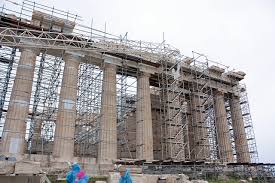
From this encounter I returned to the business of tightening the nuts and bolts of another development financing transaction. In one regard, it was mundane work; in another, however, it was essential to the legal scaffolding required for a just and well-ordered society. That scaffolding is in serious danger—and thus too is a just and well-ordered society.
Subscribe to this blog and received notifications of new post by email.
© 2026 by Eric Nilsson
