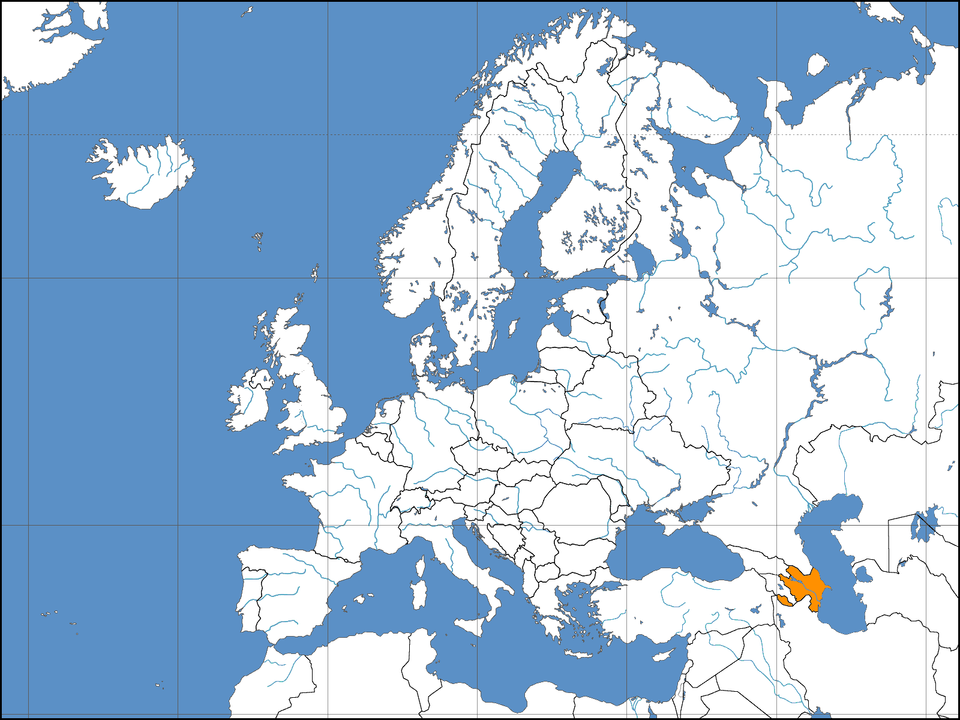
JULY 9, 2025 – A few days ago our clothes dryer quit drying. The machine was old enough that it didn’t owe us much, but before we leaped at the chance to replace it with a costly new machine, my spouse did the sensible thing and arranged for a $99 service call to obtain a diagnosis and repair estimate. I was still up at the cabin through all the excitement, but after the estimate was in hand, Beth called me. “For less than half the cost of a new dryer—including the service charge,” she said, “the guy can fix it, and it should last for another five years.”
“That’s a no brainer,” I said.
“The guy talked with an accent that I couldn’t place,” said Beth. “He said he was from—I’m not sure . . . Arb-something . . . somewhere close to Russia.”
“Azerbaijan?”
“Yeah, that’s it—what you just said. I told him ‘I know my husband would be very interested in meeting you,’”
“You’re right about that,” I said.
This afternoon while I was working on “Project Zen” in our backyard (I’d brought major sections home with me from the cabin yesterday evening), Beth, who was out and about on book business, called to let me know that the “dryer guy” was on his way and to ask if I would be home to let him in. I gave the right answer, then posted a note on our front door: “Dryer Repairman: please go around back.” Below an arrow pointing to the left passage, I wrote “Thanks!”
Minutes later from around the corner of our back porch appeared . . . a compact 50-ish-year-old man with a shaved pate, intelligent hazel eyes behind a pair of smart-looking eye-glasses, a thin gold necklace exposed by the open collar of his royal blue knit shirt, and a big black case full of tools. He could’ve said, “I’m here to tune your piano,” and I would’ve believed him.
He set down the case and said, “Way too heavy,” and brushed the back of his hand across his sweating brow. We then greeted each other, and he established that he was in fact the dryer repairman, not a piano tuner.
“Before you get to work . . .” I said “. . . my wife tells me that you’re originally from Azerbaijan.”
“Yes, yes, yes,” he said. “She told me you’d be interested in knowing that.”
“You’re absolutely right,” I said. “I mean, how often do I get to meet someone in Minnesota who’s come here all the way from Azerbaijan?”[1]
With that we plunged into a delightful conversation throughout which I peppered this outgoing, interesting man—Mukhtar—with questions driven by curiosity. What was his mother tongue? (Azerbaijani) Was that related to Farsi? (Yes, and Turkish, but when he was growing up, everyone learned Russian; today, people in Azerbaijan don’t learn Russian; they learn English) How long had he been in the U.S.? (Sixteen years; Mukhtar and his family followed the oldest son, who joined the U.S. military; retired, then worked for Hennepin County Sheriff’s office before retiring from that) How long had he been repairing appliances? (For a long time he ran a car repair business, but it became too demanding and he grew too old; before the collapse of the Soviet Union, Mukhtar had earned a degree in engineering in Moscow, then returned to Azerbaijan to get a second degree in economics[2]. Modern appliances are all about electronics—you must be somewhat of an electrical engineer to fix washers, dryers, dishwashers, refrigerators.) Now that he’d been here for a long time[3], what did he think of his adopted home? (It’s a wonderful country; not as wonderful as it was when his family arrived, he said, but still wonderful). Et cetera ad infinitum.
We covered lots of historical and political territory. Mukhtar’s insight into Putin’s modus operandi: take advantage of “differences” among peoples of the former Soviet states and transmute them into “conflicts”—to the strategic advantage of Russia and Putin.
We could well have talked till the sun went down, but when the Director of Repairs and Maintenance pulled into the driveway, we knew the conversation would have to be continued at a later date. I led my new friend through the back doorway and down to the basement where last week he had left the dryer disassembled.
Mukhtar had the machine fully repaired and running again in no time flat. When Beth got out her checkbook to remit payment, I said to her, “I’ll explain later, but add 50 bucks to the amount.”
“What for—conversation time?”
“No. While we were talking,” I said, “I had him look at my Skilsaw. The safety brake stopped working yesterday, and he fixed it.” In fact the dryer repairman had, in no more than five minutes, after I’d spent half an hour yesterday examining the darned thing and trying to figure out (in vain) what was haywire and how I might fix it.
“No, no, no, no,” Mukhtar said. “It was nothing, and I enjoyed our conversation very much.”
“Well, at the very least,” I said, “I need to get your email address to we can stay in touch.”
“Yes, yes, of course,” he said, shaking my hand with both of his.
With the check in his pocket, Mukhtar asked if we wanted him to go out the back way. “No, no,” Beth and I said simultaneously. Surprised by his question, I wanted to say, “And why would you even think you needed to ask? You, my friend, are definitely a ‘front door,’ ‘top drawer’ sort of individual.” But instead, I said simply, “You can certainly go out the front entrance. It’s shorter, since you’re parked out front.”
As he departed, I marveled at the life that man has lived—and at how a man like that and his entire family have contributed to the vitality and betterment of this country. I thought back to a conversation I had had earlier today with a client on a new matter—another person who started off life in another far off land (from Minnesota) and who by his hard work, heart and brains has also enriched the life of this country.
Accordingly, more on the “immigration problem” in a near-term future post. (Stay tuned.)
Subscribe to this blog and receive notifications of new posts by email.
© 2025 by Eric Nilsson
[1] Later in our conversation I told him about my encounter with the Azerbaijani couple whom I’d given a ride to their English class after I’d seen them miss their bus. (See 5/7/2025 post)
[2] I knew this meant “accounting.” When I was traveling in the USSR 44 years ago, it seemed that every other person I met was “an economist.” I later figured out that that meant, something akin to “bookkeeper” or “accounting” but never “economics,” as that term is generally understood in the West.
[3] He mentioned at one point that his family had achieved green card status years ago; I didn’t get a chance to inquire about his reaction to the whole ICE-capades

1 Comment
Wonderful, endearing story, Eric. You do know how to find them!
Erik Hansen