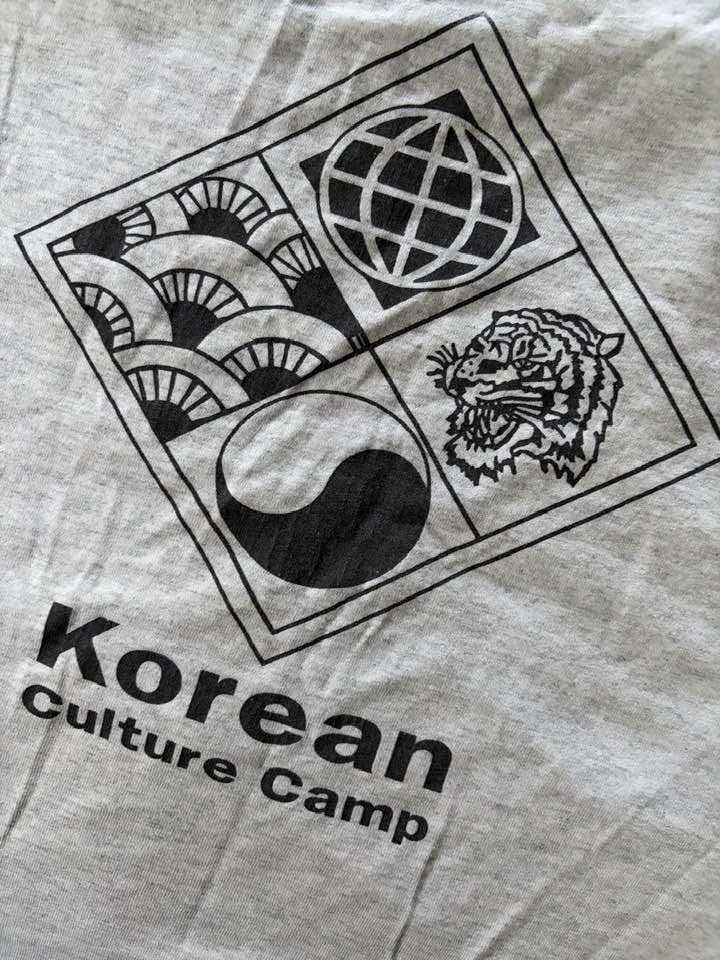
JULY 18, 2026 – Yesterday we attended the closing program of this summer’s daytime Korean Culture Camp, or “KCC,” which our granddaughter attended. She’s half-Korean—given that her father, our oldest son, is “100% Korean.” But what does that mean, exactly—“100% Korean”? He would have much to say about that. He and his brother, also “100% Korean,” attended summer KCC throughout their elementary school years. Now 40 and 37, respectively, they were among the wave of Korean adoptees who landed in Minnesota. That wave had gained momentum in the years following the Korean War and crested about a decade after our sons arrived in the second half of the 1980s. KCC has continued all this time and reflected both crest and decline of the “wave”: there are fewer campers now, and many of them are “half Korean”—children of our sons’ generation.
At yesterday’s event we met people from the distant past—Gene and Deb and one of their three Korean-born daughters, all of whom were among our group of Korean-adoptive families that traveled to Korean in the fall of 2000; Scott and Sheri and their two Korean-born sons, Dan and Zach, who, along with their younger Korean-born sister, Leah, were one of the early families at Master Lee’s Taekwondo, where Byron was so heavily engaged, and where we fraternized closely with the other Korean-adoptive families. Dan wound up studying Korean in college and afterward, lived and taught (English) in Korea, where he met his future wife. Now their kids are KCC campers.
To close the loop on a very small world, after the program, we were visiting with the Korean mother of Illiana’s new friend; the mother being a professor of Korean at the University of Minnesota. Born, reared and educated in Korea, she landed a job at the University of Iowa before “transferring” to the University of Minnesota 15 years ago. As we were visiting, the aforementioned “Dan” walked past—then slammed on the brakes and did a double-take. While a student at the University, he’d studied with the professor! Ever the clever one, Dan kept us all laughing with his witticisms, as he engaged his former teacher in a quick “catch-up” conversation (in English). From this exchange we could see that Dan had been an earnest student and the professor, great at establishing rapport with her learners. I recalled with amusement, my impressions of Dan when he was a rascally kid. Neither his wit nor his smile had faded. And Zach, who idolized and emulated Byron at every turn (kick and punch), had grown into a full scale, self-assured, cheerful, engaging man, married, with two young kids in his arms. Back in the day, I thought he’d be forever a shy, short, skinny kid, hardly of the sort to cast an opponent onto the mat—or off it altogether. No shrinking violet did he turn out to be.
During the program, Master Lee, whom we hadn’t seen in eons, directed his latest crop of charges to throw air kicks and punches and break balsawood boards, which those of us in the know, anyway, pretended were concrete blocks. As I watched the familiar demonstration, I silently reminisced about all the hours we’d spent ferrying Byron to and from the dojang, watching him take instruction and later, giving instruction, first to young kids, then kids his own age and eventually to adults, local law enforcement officers included. I also recalled all the times we parents found ourselves in the “free labor camp” directed by Master Lee and Mrs. Lee, who knew how to impose the “Law of the Dragon.” The taekwondo experience had been good for Byron, though despite Master Lee’s advertising claims, I suspect that the “leadership skills” Byron developed during those years were more innate than they were learned.
Then one Saturday at a competition in the dead of winter, who should show up on the floor of the high-school gymnasium where the event was staged, but my old law school torts professor, Michael Steenson. I sought him out and joked that he’d found an appropriate hobby for a torts professor—a pastime that involved the classic combined tort of “assault and battery,” at least in any setting other than the taped-off contest areas on the tournament tatami. As he laughed, I could see he was trying hard to remember exactly who I was, despite my having introduced myself by name and era. Memories fade as time flies.
But back to the program . . . each of the upper three grades presented something they’d worked on over the week (besides classroom instruction various aspects of Korean culture)—the famous “fan dance”; a K-Pop dance; several of the many traditional forms of drum music. In Cory and Byron’s day, similar performances were presented, but instead of wearing their grade-coded colored KKC T-shirts, participants wore traditional Korean clothes. At the end of yesterday’s program, an experienced performer entertained us with an extended solo pangmul (dance while drumming an hourglass-shaped janggu and wearing a sangmo—a traditional Korean hat with a long ribbon “spinner” attached to the top that with fast head movements the wearer can spin the ribbon into dizzying circles).
The program was held inside the gymnasium of Minnehaha Academy in the tony neighborhood on the West River Road in Minneapolis. Parents and grandparents and other guests filled the bleachers on one side, and the KKC campers sat on the other side. We ran into Cory just before the program began. As he peered across at the kids, looking for and finding Illiana, I imagined him seeing his past. As I so often do, I imagined climbing inside his head and looking out through his eyes.
Over the years, we’ve talked much about what he sees; how he feels. I used to try to alter his viewpoint and feelings; or worse, naively, I attempted to convince him that what he saw and felt wasn’t how he should see things or react to them. Over time he helped me understand that my approach wasn’t helpful because it wasn’t accurate. Now I know it was bound to fail: I was attempting to impose my will on his reality; my expectations on his aspirations. The result was the same that you get when pouring olive oil into a pot of water. Even the highest-grade oil won’t mix with the water; at best, the blobs of oil float randomly, bumping into each other and merging, becoming bigger blobs—or not—depending on the state of the water.
While Byron embraced his “Koreanness” through Taekwondo, cuisine, and language, and hanging out with other Korean-born adoptees, Cory struggled with his ethnic identity. On the one hand, he felt only limited connection with his place of origin. Moreover, as much as he wanted to understand his origins and the story surrounding his adoption, he was also fearful of it. Though of course he was “loved and embraced” by his adoptive family, both immediate and extended, he wrestled constantly with his perception of the family’s expectations; with his insecurity about who he was—“I’m not Korean,” he’d say. “I don’t speak the language, I don’t like the food, I don’t know the culture.” Yet at the same time he’d declare (understandably), “I’m not white either, despite having a white family, living in an all-white neighborhood, and going to a nearly all-white school.” Aggravating this lifelong struggle between “not being Korean” and “not being white,” was the added insecurity arising out of adoption, the double-whammy of questioning why he was placed for adoption in the first place and feeling that he was his adoptive family’s “second choice,” no matter what was said or done to obviate that sense. Then, just a couple of years ago, came revelations about widespread irregularities, even fraud, associated with Korean adoptions back in the 1980s; how the government incentivized foreign adoptions, often by deceit upon the biological mothers, to lower social-welfare outlays for their babies and young children. This news had a devastating effect on many Korean-born adoptees[1].
In Cory’s case especially, I wondered how he was reacting on this occasion, with the program’ highlights of traditional Korean culture—the dances, the drumming, even the Taekwondo. Were these all reminders of that at the same time he’s “100% Korean,” he’s not? It’s for my next conversation with him—and soon.
What I know with 100% certainty are three things: First, Cory means everything to us, just as his daughter means everything to him (and to us). Second, whether at a 100%, 50% or an undeterminable percent level, Cory’s “Koreanness” and thus, Illiana’s, is as real—and edifying—as their “Americanness.” Third, despite his own struggles over his “Koreanness,” Cory was genuinely glad to see his daughter enrolled at KCC and enjoying the week as much as she did. Beth knew implicitly that Illiana would benefit from camp and had ensured that the going-to-be-fifth-grader would have the opportunity to attend again this year.
In any event, yesterday’s glimpse of KCC and our interactions with people provided ample support for the notion that . . . “It takes a village . . .” We should be so lucky and grateful to be a part of that village!
Subscribe to this blog and received notifications of new posts by email.
© 2026 by Eric Nilsson
[1] In a recent address, South Korean President Lee Jae Myung acknowledged the adoption misdeeds on the part of the South Korean government and spoke of the need to make concrete amends.
