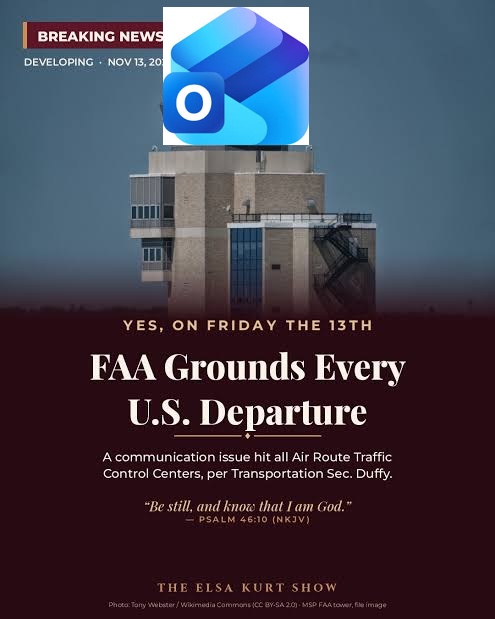
NOVEMBER 13, 2026 – If you’re a triskaidekaphobe, you can’t avoid the connection between today’s news flashes to today’s date: Nationwide aviation ground stop; the collision of an out-of-control tanker with a Mississippi riverboat with 180 passengers aboard; crazy weather rampaging over the Northeast, producing tornados and hailstones the size of golf balls. All of this, of course, was on the heels of Microsoft Outlook (et cetera) “going dark” for close to 24 hours. Surely these troubling events transcend superstition.
The good news, of course, is that despite the extreme danger inherent in each of listed occurrences, miraculously no one was killed. Moreover, we are told that based on preliminary information, none of the scares was the result of a cyberattack or other nefarious scheme. That should be a huge relief, especially in the case of the adverse weather. When an E-5 tornado, a golf-ball hailstorm or a blizzard in August is traced to a lone wolf kid living in his mom’s basement and releasing agents from his self-programmed AI app (with the aid of AI), the event will most properly be cast as “unprecedented,” ushering in a whole new “Era of Worry.”
We’ve also been told that the Outlook outage and the aviation communications trouble aren’t related. But they are. Both involved sophisticated technology beyond the grasp of people dependent on it. Both failures had material widespread impact. Both revealed our extreme vulnerability—the flip side of our extraordinary advantages—tied to advanced technology.
Thankfully, I wasn’t among the approximately 1.5 million air travelers affected by the ground stop. I was, however, among the estimated 430 million users of Outlook stymied by the Microsoft snafu. I was miffed, to be sure, given that I was having an unusually crowded work-day heavily reliant on sending and receiving email. After resorting to the inconvenience of alternative email accounts to inform clients and other parties of “my problem,” I soon discovered that “my problem” was also their problem. Good thing the cell towers of America weren’t part of Rogue Tech Day. And of course, throughout yesterday afternoon and into the evening, I wasted considerable time checking the status of the Outlook outage. When I extrapolated my lost time across the entire Outlook universe, I figured the interruption in service probably cost the global economy a cool few billion U$D. A mere hiccup in the grand financial scheme of things.
Yet, in our Internet Of Things Era, one doesn’t need to think fast or long about how wires crossing here or a system overload there could overwhelm redundancies and shut down life as we know it. We were reminded of this regularly at the Red Cabin before our power lines were buried a year ago. Before then, whenever the wind blew, it seemed, we lost power. Most of the time it was a matter of limited inconvenience, but the episodic losses of power were a reminder of our vulnerability: What if the whole grid came down, either by cyberattack or breakdown of the system in serious need of upgrades? How long before the plumbing would freeze in winter (most heating sources entail some measure of electricity—fan- and blower-motors; condensation reservoir pumps; etc.)? How would we boil/filter lake water (the pump that draws water from our well is powered by electricity)? Sure, we could install a generator, but that would require fuel, which would eventually run out.
Plus, we’d have to eat, and once the cupboards ran bare . . .
I gave this “doomsday” scenario about 10 seconds of thought yesterday—and another 15 seconds today—but then in keeping with the shutdown of plans and email, I shut down my catastrophe thinking. All it would accomplish in the short run would be heightened anxiety atop all the other things we have to worry about in the long run—such as AI and climate change. As Friday the 13th draws to a close, I’d rather not focus on what could happen and instead, celebrate over what didn’t happen. Besides, with Thanksgiving around the corner, it’s about time to assemble a list of all for which thanks is to be given, not fears that are to be conjured.
Subscribe to this blog and receive notifications of new posts by email.
© 2026 by Eric Nilsson
