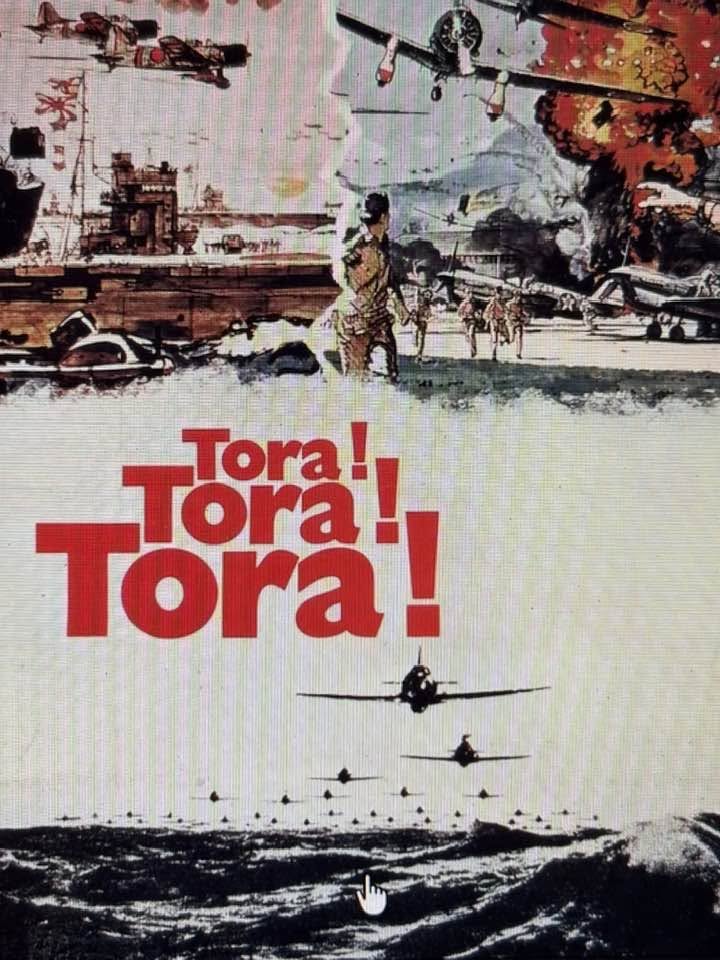
JULY 22, 2026 – In the final scene of the 1970 movie, Tora! Tora! Tora!, after the successful surprise attack on Pearl Harbor, a sober Admiral Yamamoto turns to his elated staff aboard the flagship of the Japanese fleet and says, “I fear all we have done is awaken a sleeping giant and fill him with a terrible resolve.” Yamamoto had studied in the U.S. and knew America’s inner, as well as outer, strengths. He was expressly incensed that his country’s official declaration of war hadn’t been delivered until after the attack had commenced. He knew that this sequence would fuel America’s “terrible resolve.”
The rest is history, as it is said. Japan’s Navy chief was correct. If Japan had scored a “win” in the opening round, it would suffer disastrous defeat by September 8, six years later, when the papers of unconditional surrender were signed aboard the U.S.S. Missouri in Tokyo Bay. Wholly unprepared for war back on December 7, 1941, the United States had had to transform itself from full-scale isolationism to an “all hands on deck” war footing overnight.
The Herculean effort required a long string of nights, actually—and days. Meanwhile, however, FDR wasted no time in ordering a retaliatory strike for the main purpose of showing our “terrible resolve.” After cramming complex logistical planning, resource marshalling and air crew training into the span of just four months after Pearl Harbor, Lt. Colonel Jimmy Doolittle would lead a desperate, one-way bombing mission over Tokyo and other major cities on the home islands of Japan. The land-based B-25 “Mitchell” planes were loaded onto an aircraft carrier, which, with a carrier group, set out across the Pacific. The plan was for the task force to steam as close to Japan as possible: Since they could take off from but not land on the carrier deck, after dropping their payloads the flight crews would have to fly on to allied bases in China. The scheduled launch, however, suddenly had to be moved up—and the flight time extended—when a Japanese fishing trawler spotted the force. To a man, the crews agreed to the change, despite that now the high-risk mission would be all but a suicide run.[1]
Though the physical damage from the raid was minimal, the psychological impact on the Japanese—and Americans—was profound. The sleeping giant had indeed “been awakened and filled with a terrible resolve.”
That courageous mission catapulted American confidence to the front lines and led to our essential contribution to the defeat of fascism and naked aggression among nations.
Yet here we are, less than a century later—veterans (civilian and military) of that episode still among us—living with homegrown “fascism and naked aggression [against other nations[2]].”
As I ponder the contrast between America’s reaction to the attack on Pearl Harbor and our response to the initially insidious, now open and deliberate attacks by “us” against “us,” I’m left to wonder . . . Are we again a sleeping giant about to wake up “with terrible resolve,” or are we a moribund shadow of our former selves?
If in 1941 it took a surprise attack by Japanese torpedo planes and bombers leaving 2,403 Americans dead, 1,178 wounded, and our primary Pacific naval base in shambles to awake us from our naïve generation-long isolationism, what will it take today to disturb us enough to reverse course before the Great American Experiment goes “Poof!” (or explodes!) in the lab of history?
Yesterday I wrote about losing our national soul over our cruel and inhumane treatment of ICE detainees. Today, I’m thinking again (it being Wednesday—the day I reserve for catching up on the latest news whiplash from the Strait of Hormuz) about the fiasco we’ve created in Iran. When I hear the (mostly) lame questioning of Hegseth and others appearing before Congress and the combative, non-responsive, hubris-laden, just plain “How stupid do you think we are?!”-filled responses by arrogant and incompetent representatives of the current regime, I’m forced to wonder, if not fear . . . What has become of us?
When I pull into the hopper, the exhaustive and therefore exhausting list of contemptuous attacks on . . .
our decency,
our environment,
our defenses against threats to public health,
our medical research,
our scientific advances,
our higher learning in general,
our freedom of expression and opposition without fear of retribution,
our freedom of worship, as well as our freedom from religion,
our relations with our allies and trading partners,
our bulwarks against adversaries,
our heretofore well-grounded confidence in election integrity,
our national security and economic security by leading us into a war without a consistent objective, without an exit strategy, and without a rational means of financing the many tens of billions in war costs . . .
. . . When I consider all these attacks, I wonder, I fear, “When”?! When will we become so outraged by what has been done by “us” to “us” that Trump’s approval rating drops to “fringe” territory—5% to 10%—and Republicans lose House and Senate by enormous majorities? When will it occur to us that we’re bleeding to death by a million cuts, as the enemy from within wields a club over our heads? When will we be disturbed from our slumber—or is it from our distracted existence in which our immediate demands and distresses consume our capacity for responsible and informed self-governance?
What followed the surprise attack on Pearl Harbor were perhaps America’s finest years. For once we were united in purpose and process. The effort continued until the crisis had passed definitively. Where we find ourselves now is under a long-in-coming, long-foreseeable crisis of our national soul. The necessary response this time around isn’t converting low-production car plants into highly efficient factories and turning out tanks and aircraft 24/7. The imperative we now face is to transform our failing experiment into a successful venture, not just for the billionaire campaign contributors, the religious zealots, the fraudsters, and “#MeNow!” constituencies, but for the welfare and prosperity of all comers to what ought to be viewed as a joint venture of open-sky opportunity and above all, open-ended hope.
Subscribe to this blog and received notifications of new posts by email.
© 2026 by Eric Nilsson
[1] Despite the adjusted time/distance parameters and increased risk, all but seven of the 80 men involved (five men per crew times 16 aircraft) survived bailouts, crash landings, and capture (in the case of four men out of eight apprehended by the Japanese in occupied China). Because they’d had to launch early and farther out at sea, the planes didn’t carry sufficient fuel to make their way to allied air bases. Instead, they flew as far as they could until they ran out of fuel, then bailed out or attempted crash landings.
[2] The current regime argues that its unprovoked attack against Iran was in fact, “pre-emptive” to prevent Iran from developing deliverable nuclear weapons; a retaliatory strike in response to Iran’s “waging war against us” for the past 40 years. This purported reasoning is substantively indistinguishable from Japan’s rationale for the attack on Pearl Harbor. Far from being an act of “naked aggression,” it was in retaliation against attempts by the U.S. to choke off Japanese imports of oil, rubber and scrap metal. In the minds of Japanese leaders, it was a pre-emptive attack to allow freedom of movement, commerce, etc. in the Pacific.
