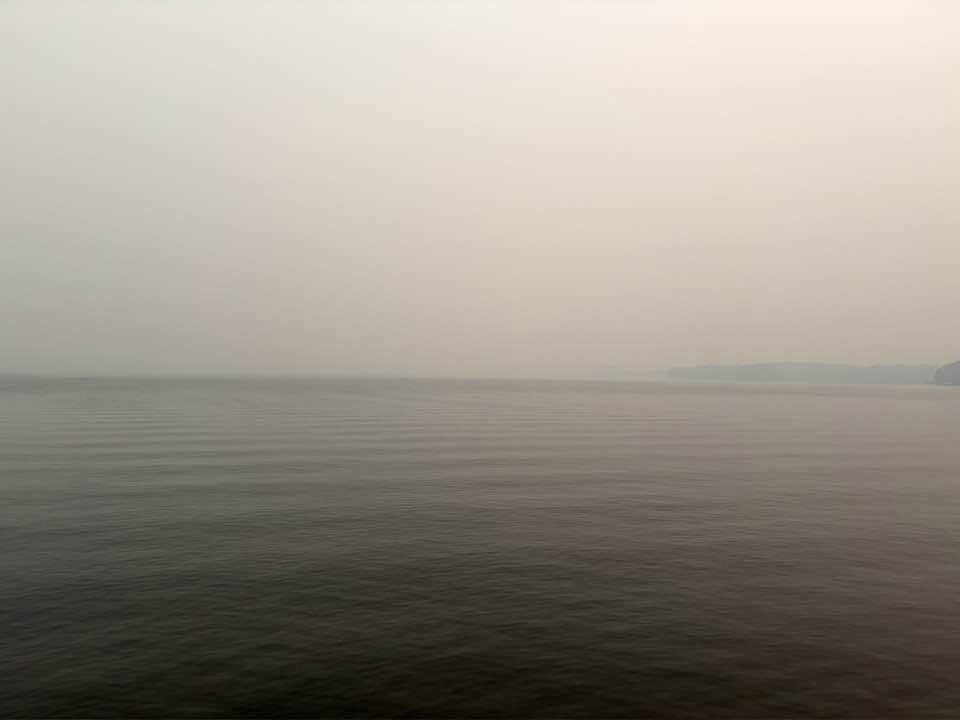
JULY 15, 2026 – This morning I awoke, looked out the front windows at the lake—but saw no lake and certainly no opposite shore. Even the trees that guard the berm along the shore were more in the nature of smudges than familiar well-defined objects. One breath of not-so-fresh air confirmed my initial impression: smoke from the wildfires hundreds of miles to the northwest of here descended upon our neck of the woods. It was a thick dry haze of the kind that rises from a campfire started by amateurs, fueled with green aspen and birchwood, and obscuring from view, everything on the other side of the campfire.
The eerie scene presented some interesting photo ops, but I took only a handful of pics. Something didn’t seem right about extracting aesthetically pleasing images from an entirely displeasing atmospheric condition. Adding to my unsettled feeling was the peculiar lighting that developed as the sun peered tentatively through the smoke. The rays seemed filter through thick amber, casting an unnatural orange glow throughout my woodland surroundings, though scattered randomly were concentrations of brighter light, as if to seduce the onlooker into thinking it was all a beautiful sight to behold. I wasn’t fooled. Each breath felt like an ill-advised intake of particulates associated with a particularly dirty fire. The air was heavy with the smell of smoke, the taste of smoke and the appearance of smoke. Had I not heard about the northern fires, I would’ve had reason to worry about a fire much closer to home. As our well-informed neighbor told me not so long ago in recounting a recent conversation he’d had with a wildfire management expert, a “scorched-earth” wildfire in our immediate region (and so many others like it in the U.S.) is not a question of “if,” but a matter of “when.”
The upside—if that’s an accurate characterization—to this current condition is that it’s moderated the temperature from the extreme high that had been forecast. But that’s a bit like saying the upside to a volcanic eruption in an inhabited area in the tropics is that the huge plume of volcanic ash cooled the folks by blocking out the sun. That’s also a theory as to what led to the extinction of the dinosaurs.
A little knowledge and a lot of imagination can drive a person to anxiety. Over the past several years, it seems that wildfires have grown more numerous and more extreme. Curious about the actual data, I Googled “Are wildfires around the world on the increase?” The most comprehensive response was comprised by a June 1 article in the U.S. edition of The Guardian. The simple answer to the basic question posed is that the answer isn’t simple—except to say, conditions for extreme fires once they get started are on the increase, as are the human and economic costs, even though the aggregate area measured globally has reduced somewhat, due largely to improved agricultural methods in Africa, of all places. Conditions for extreme fires elsewhere, however, have been exacerbated by global warming.
The worry, of course, is that like the frogs in the pot of water over the stove burner, we’re having too much fun in what we think is a jacuzzi to peek out under the lid to see and acknowledge that we’re in a kitchen, not at a spa; that if we insist on a leap of faith that “all will be fine,” we’ll soon miss our chance to leap out of the pot.
All this roiled my thoughts as I reduced my physical activity to a minimum. Later in the day, I also donned a face mask. This reduced the smoky odor, at least. Additional measures could be taken: (1) I could pack up and head home where according to my wife, it’s still hotter than Treachery—the ninth and very bottom circle of hell, according to Dante—on the back porch, but perfectly cool inside (much of) the air-conditioned house, or (2) I could hold my breath until the smoke abates.
Meanwhile, work continues on “the fleet” of model sailboats—slow, meticulous effort that imposes no cardiovascular burden on the boat maker. Photos to follow. As I focus on this cabin project, though, I wonder about the future of the planet. As time progresses will more humans face more often, the inhibiting conditions that I’m now experiencing? Will the conditions themselves worsen at an accelerating rate? What future environmental reality will confront us if we don’t face voluntarily, the known environmental realities of today? If we hang our hopes on the work of outliers—oil-industry-funded researchers and non-peer-reviewed papers, let alone politicians and “influencers” gorging themselves on junk science—will we one day be forced to acknowledge that yes, the resort “whirlpool” was in fact, a cooking pot on a stove burner?
Subscribe to this blog and received notifications of new posts by email.
© 2026 by Eric Nilsson

1 Comment
I just wondered the same, my friend. I could have WRITTEN this post. I came very close to donning a mask myself while running the myriad of errands I had to today. It seems to be abating here in the Metro. What was HEAVY haze this morning is not nearly as bad this afternoon, and I do believe they will lift the air quality alert late morning on Friday. Please stay safe. As one of my very favorite humans on the planet (you and Chad are first in my book), I want you to stay safe. Sending blessings of safety and breaths of fresh air, literally, to you today!!