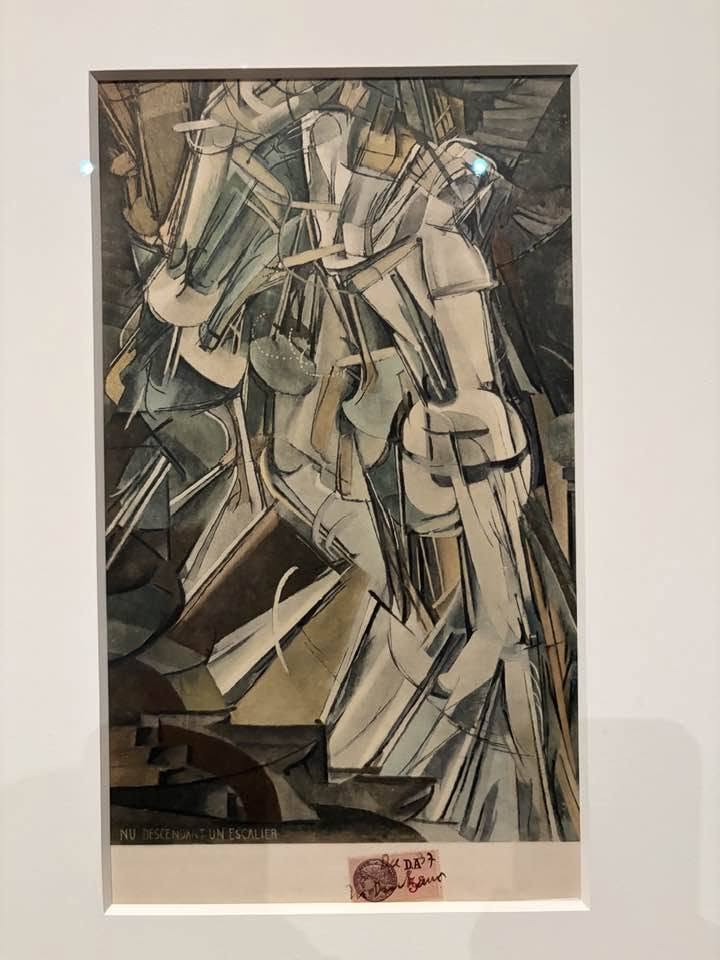
JUNE 16, 2026 – Today we sojourners followed our guides at a leisurely pace to bustling Midtown. I never tire of going there and watching the swarming tourists, businesspeople, shop workers, shop patrons, delivery persons, traffic and traffic police—all participants in the wondrous interchange of goods and services that make up . . . the economy. Our destination, however, wasn’t a shop or store or business office but MoMA, the Museum of Modern Art. Our objective at MoMA was the exhibition of works by the incomparable Marcel Duchamp.
Two and a half years ago I posted here an account of a friendly family argument over the definition of art. It got so passionate you’d have thought the subject was politics. What had triggered the discussion was a shovel. Yes, a shovel that Duchamp had purchased at a hardware store, suspended from the ceiling of an exhibition room and called the tool “art.” Our son Byron dissented strongly from the majority opinion that yes, a hanging shovel can be “art,” depending on who hangs it and where. When I, a Minnesotan, hangs a shovel from our garage, there’s nothing artistic about me or the shovel. But if your name is already associated with art-making and you hang a shovel from the ceiling of the Yale University Art Gallery (where the shovel that had sparked the debate had been observed), Voila! You have yourself un oject d’art.
At the time of the debate, I wasn’t focused on the “shovel man” himself, Marcel Duchamp. Today, of course, the story was quite different. The whacky genius of this most remarkable character was on full display, and I, for one, couldn’t get enough of it. His mind worked overtime in creative overdrive and in multiple directions simultaneously. Moreover, he injected much of his work with a prankish sense of humor. In fact, often he shoveled the humor in.
My favorite example, however, wasn’t the shovel. It was the proposed design for a book jacket solicited by the publisher Alfred A. Knopf for Modern Art USA: Men, Rebellion, Conquest, 1900-1956 by Rudi Blesh. Duchamp’s submittal was a scale model of a man’s tailcoat—a Jaquette—front and back, thus making a pun of a book’s “jacket.” Humorless Knopf shot down Duchamp’s cheeky idea, but the jokester artist got the last laugh. In the book proper, Blesh gave Duchamp prime attention. In the acknowledgments, Blesh went further and expressed thanks not only to Marcel Duchamp but to the artist’s two wholly made-up alter egos, “Richard Mutt” and “Rrose Sélavy” [“C’est la vie.”]
My introduction to Duchamp had occurred my freshman year of college. On the cover of one of the books assigned in our Western Civilization course—the volume covering “1890 to the Present”—was the image of Duchamp’s famous cubist “Nude Descending Staircase.” I was impressed by the painting, but it hadn’t moved me to investigate any of the rest of the artist’s work. Today was catch-up day, and I found pure delight in the process.
Our artist-granddaughter discovered delight in Duchamp’s quirky art, as well. Again, as she did yesterday at the Met, Illiana took lots of photos—which gave me equal opportunity to take pictures of her taking pictures of pictures.
We also toured a much smaller but still rewarding display of works by Frida Kahlo and Diego Rivera. Illiana had asked to see these, and I understood why. But the experience was all too brief. I want to see and understand more of their art.
From MoMA we went farther downtown to K-Town, which, again, at Illiana’s request, we visit each June, mainly to eat a sumptuous meal and secondarily, to go in and out of the shops as if we were in Seoul.
Given Korea’s proximity to Japan, we next visited Kinokuniya, a large, multi-stage store on Sixth Avenue (Avenue of the Americas) directly across from Bryant Park. The establishment is devoted to things Japanese. While our guides and Beth and Illiana browsed up and down aisles filled with all trinkets and accessories, I slipped away for a time to the book section to scan the expansive selections of Japanese fiction and history, as well as volumes about current events. I could’ve spent the rest of the day and evening skimming, reading and losing all track of time, before walking zombielike out of the store with a whole book bag filled with purchases. Instead, I took comprehensive photos for later review—and a more rational approach to acquisitions.
After clearing out of Kinokuniya, we cross back over to Bryant Park an onward to Fifth Avenue. While the others waited, I led Illiana up the steps of the New York Public Library and inside to check out this magnificent landmark. I’d wanted her to see the central reading room, but it had already closed for study only. Nevertheless, on the second floor, we happened upon two large photographs of that grand space. Illiana was duly impressed. She saw enough of the interior to walk out with the realization that the library was like none she’d ever seen. For good measure, I snapped a photo of her standing below one of the two famous lions that guard the front of the building.
Next was more of Japan, this time in the Uni Qlo store that we patronize on each visit to New York. Today’s mission involved the acquisition of a new broadcloth shirt for Byron, the family’s biggest Uni Qlo fan.
By the time we’d bagged the shirt—and inevitably, another for Illiana—we’d been on our feet for hours and moving slowly, that is arduously. This results in “slowpoke fatigue,” and dragging ourselves, we made it to the 45th Street location of Fabrique Artisan Bakery. Despite the word “Fabrique” in its name, this source of high-end Swedish cardamom buns originated in Stockholm. Inside we loaded up on goodies washed down with an iced latté, iced chai, and a bottle of carbonated mineral water. Why not when you’re on vacation in The City of cities?
At the end of our refreshment break, I split company with the rest of the expeditionary crew and walked north to 90th while the rest of the group took the subway. By now it was rush hour; plus World Cup visitors are in town, adding to the crush of people, both above and below ground. I made good progress, however, enjoying the wide diversity of the crowd—people from all places, speaking all tongues.
Whenever I’m in such a crowd, I experience the same reaction that occurs when I’m up at the lake hearing loon calls and enjoying nature displaying its boundless beauty: Where else in the cosmos does such a wonderful place exist, filled with endless diversity?! Nowhere, I answer; nowhere except here on this amazing planet we call earth, which rhymes with “precious home.”
Subscribe to this blog and received notifications of new posts by email.
© 2026 by Eric Nilsson

1 Comment
I’m arriving tomorrow (your today) and appreciate the suggestions you include here. Happy trails!