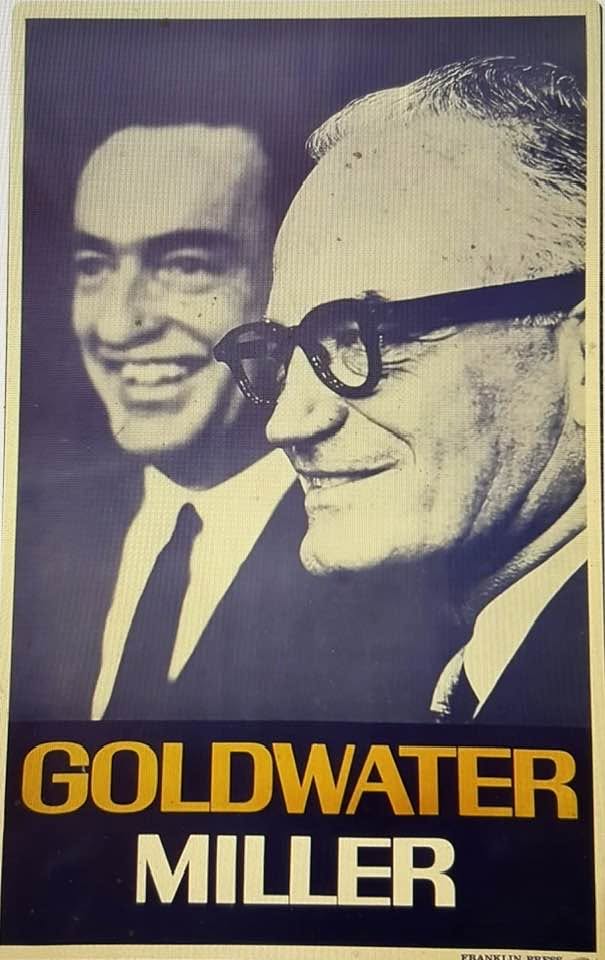
OCTOBER 29, 2026 – This afternoon on the ride to our house for an after-school online art class, our fifth-grader granddaughter listed all the main Minnesota gubernatorial and U.S. senatorial candidates. I was pleased by her political awareness. Though she picks up a lot from discussions she hears around us, Illiana disclosed that the current campaign has also been discussed in class at school.
“There’s a boy in my class who knows everything about it,” she said. “He’s a Trump supporter because his parents are Trump supporters, which is strange since they’re Black and immigrants.” This surprised me, as well, but I’ve also learned that iron-clad assumptions can often face surprising exceptions. It seemed that Illiana was now learning the same lesson.
My first lesson in the unreliability of an “iron-clad assumption” came when I was exactly Illiana’s age and in fifth grade. The year was 1964, and LBJ was running for election on his own (after having succeeded JFK after the latter’s assassination) against Barry Goldwater. I was heavily into politics—as heavily as a 10-year-old kid could be. I was the counterpart to the boy in Illiana’s class who “knew everything about the election”—at least comparatively speaking, given that no one else in my class was much interested in the 1964 election. Of course, I was under the total spell of my parents and oldest sister, a high school sophomore, who was by then a certifiable political junkie and one of Republican persuasion—our parents’ “political brand.”
We didn’t have a television, but I read all the political news[1] that appeared in the daily issue of The Minneapolis Star, which arrived at our doorstep soon after I got home from school. One memorable issue in the last weeks of the campaign announced that Barry Goldwater would be appearing at a rally in Minneapolis. Eagerly, I asked Dad if we could attend. “Just think, Dad,” I remember saying, “if Goldwater wins, we can say we saw the president in person.”
Dad didn’t have to deliberate before saying no. His response surprised me, given how outspoken he was in favor of the Republican candidate. In truth, despite his abiding interest in the campaign, he probably didn’t relish driving all the way down to Minneapolis after work, searching for a parking spot within reasonable walking distance of the old Minneapolis Auditorium, where Goldwater was scheduled to appear—then having to drive all the way back to Anoka. (As I reflect on this, Minnesota’s favorite son, Hubert H. Humphrey was on the ticket that year as vice president, and the state’s 10 electoral votes were a sure-bet for the Democrats. Trump’s recent appearance in ruby-red Kansas was reminiscent of Goldwater’s appearance in Minnesota.) When a large front-page photo of the Goldwater rally appeared in the next day’s issue of The Star, I showed it to Dad and said, “See? We coulda been there.” Dad shrugged it off.
Meanwhile, though, I noticed lots of GOLDWATER/MILLER yard signs around, starting with the Moore’s across the street, who had two signs, one on each side of the long sidewalk that bisected the wide lawn in front of their house on the Mississippi River. Where I saw the most signs was along the Mississippi West River Road, which we always took to Minneapolis on our Saturday rides to violin lessons and our Sunday trips to our grandparents’ house. The route was semi-rural, with an occasional farm and large residential lots along the river. In almost every other yard, it seemed, was a GOLDWATER/MILLER sign. I never saw (anywhere) a single LBJ/HHH sign. From my limited perspective, I assumed that Goldwater would win by a landslide.
Shortly before Election Day, the regular political conversation around the dinner table turned to the likely outcome of the election. When I chimed in and said, “I think Goldwater’s gonna win,” everyone else around the table except my younger sister Jenny jumped on my statement with such swift rejection, I thought they’d gone full-on Democratic. “But what about all the Goldwater signs on the way to Minneapolis?” I asked—not to mention the ones in our neighborhood, I thought, and the apparent total non-existence of any LBJ signs.
Again, everyone practically sat on me. My oldest sister, Kristina, led the attack, followed closely by my next oldest sister, Elsa. Between the two of them, they told me—scolded me, it seemed—that although yes, there were lots of Goldwater signs along that particular roadway, on a national scale, LBJ would be clobbering Goldwater. Nothing like having your tightly formed assumption being attacked by your two older (and far smarter) sisters. To bury my assumption altogether, Mother and Dad affirmed my sisters’ prognostication.
“There’s really no realistic way for Goldwater to win,” said Dad with a tone of resignation. I was disappointed in my family. How could they be so hopeless, so negative, so resigned? But then they referred to the Harris and Gallop Polls, the national scale of the election, and how LBJ had a convincing lead in every state outside of the Deep South and Goldwater’s home state of Arizona.
In the event, of course, LBJ won over 60% of the popular vote and 90% of the electoral vote. And I learned a lesson in the risk of exceptions to “solid” assumptions.
Subscribe to this blog and receive notifications of new posts by email.
© 2026 by Eric Nilsson
[1]Apparently, though, I overlooked the periodic Harris and Gallop Poll results that were reported in The Star.
