SEPTEMBER 15, 2026 – After yesterday’s rant following a productive day on the legal front (was there a correlation?), I’m returning to the basics to recover my equilibrium. I don’t know if the condition that impels me to retreat to the infra-mundane, as it were, is a function of my age or simply the accelerating rate of the earth’s rotation as I now perceive it. Perhaps, though, a definitive causal relationship exists between one’s aging and one’s perception of geo-rotational velocity. In any event, when I was younger and more in the thick of things, my life and its demands and distractions seemed amply complicated. Today, those demands and distractions have eased, but the shocks and quakes in the world about me have intensified and rendered life much more complicated in my attempted comprehension of it.
It’s as though I’ve traded a horse galloping in place on a perpetual-motion merry-go-round for a bench bolted to the pavement a few yards beyond the carousel that now seems to race ’round and ’round at breakneck speed.
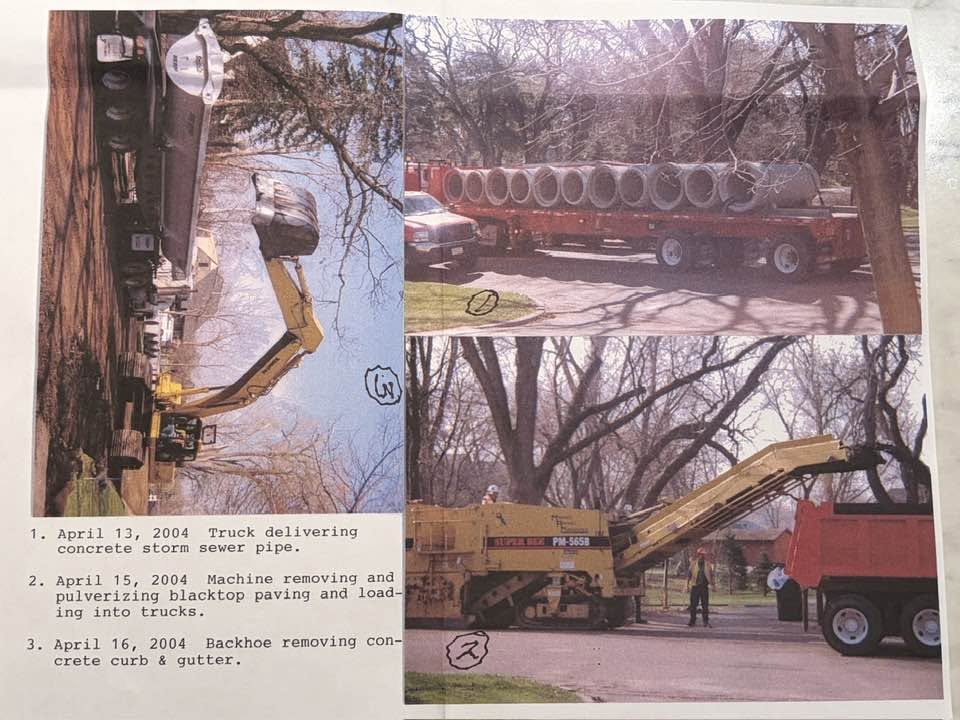
Recently, our cousin-in-law Kerri, whom I mentioned in my 9/9/26 post, sent another letter from her and my cousin Russ’s home-archeology dig. The missive from 2004 was from my father to our California cousins (Kerri, Russ, and Russ’s mother and uncle). He was 82 and well into his retirement, filled as it was, with all the demands and distractions of his sundry interests and pre-occupations. He’d parted the waters long enough to sit down and hammer out a lengthy epistle; an update on my parents’ activities. Accompanying the letter were two pages of photos he’d taken with his 1980s Canon AE-1 SLR and figured out how to copy on his early 2000s combination copier/printer.
For all his refinement and imagination, Dad could be excruciatingly detailed in his descriptions of the banal. The letter was replete with, “Went here; did this; saw that,” down to the minutest detail. But humor in his writing was never too distant from substance, and you missed out on laugh-inducing material if you skimmed too fast. One example, embedded in the “health report” section of the letter: “We both have dental checkups every six months, which we’ve done for many years now. So we are still able to chew our food before we swallow it.”
The bulk of the letter, however, was devoted to a detailed description of the Big Dig—the laying of new sewer and water lines through the neighborhood. This infrastructural upgrade required tearing up the street in front of my parents’ house and excavating an enormous trench. The heavy equipment involved gave the normally quiet leafy street the look and sound of a mechanized Jurassic Park. Given his interest in engineering, Dad staked out an observation post—a lawn chair—in the yard a few yards from the edge of the abyss. For long stretches of time, Mother joined him, though her engineering background was aeronautical, not geological.
The project lasted much of the season, and during our Saturday visits, Mother and Dad would provide a full update on progress. They talked like a couple of nerdy kids describing how not-so-nerdy kids on the playground at recess were coming along with hand-digging a hole to China.
One critical element, I remember, was placement and continual re-placement of the big steel shoring device that a heavy crane lowered into the trench to prevent cave-ins where workers had to position themselves. The clumsy apparatus consisted of two giant steel plates separated by huge steel cylinders about five feet long with ends firmly attached to the plates. Since Mother and Dad were steeped in Greek and Roman art and architecture (including the distinctions among Doric, Ionic, and Corinthian capitals atop temple columns), they both referred to the clunky cave-in prevention equipment as the “Roman forum” (a temple turned on its side) and marked its every move up and down the construction site.
Beth and I were amused that the Big Dig amused my parents. In time, they themselves found humor not only in something as down to earth as a local municipal water and sewer project but in their self-awareness. Amidst their joint report over a lunch of Mother’s (predictable) bean soup and half-ham sandwiches, my parents would laugh at themselves for having found something so silly to laugh about as the positioning of the “Roman forum.”
Now I find myself in their shoes . . . er, lawn chairs . . . excavating amusement from the myriad works of the world around me.
Except, being some distance from the big “Eight-O[h!]” I’m not exactly whiling away the day in a lawn chair. I’m still practicing law—when it suits me—and wouldn’t you know, but the issue of the day today was a sanitary sewer line easement running under a building that a bank client of mine is prospectively taking as collateral for a loan. The problem is that the applicable easement agreement (ostensibly as ancient as a Roman scroll) provides that if, in an emergency, the city has to fire up a steam shovel and drop its Jurassic jaws through the building to gain access to the portion of the sewer pipe than runs underneath, the city has no obligation to compensate the property owner (or mortgagee) for any damages. When I pointed this out to the banker, it was as though something very unsanitary had been flushed down the “sanitary” sewer.
After discussing the matter with the banker, he went off to his prospective borrower with a list of questions. In my work—business law—I’m always an advocate of problem solving, not contention, and often solutions—after you’ve disrupted people’s plans by pointing out the problem—can be addressed best once you’ve gathered all material pertinent information to answer three basic questions: 1. What is the problem, exactly? 2. What’s the monetary range of its potential consequences? and 3. What is the probability of the consequences materializing? Once you’ve addressed these questions, you can figure out how to mitigate the problem (or shift the risk) down to an acceptable “solution.”
While awaiting responses to the questions, I found amusement in recalling my childhood puzzlement over the words “sanitary sewer” written in raised lettering on the forged grate over a street drain in our neighborhood. I wasn’t yet acquainted with the term, “oxymoron,” but I certainly understood the concept as it appeared in “sanitary sewer.” In my limited world view at the time, a sewer was, well, a sewer, and a sewer was anything but “sanitary,” the exact opposite of the word my sister used to describe my dirty paws when one summer day she caught me digging cookies out of a package on the kitchen counter.
Such a mundane thing—a “sanitary sewer”—but think how unpleasant urban life would be without it. Or how challenging life would be without a whole lot of other infrastructure we take for granted.
In the simple act of writing this post, I understand better how aging works. As you slip out of the fast-paced current running down the center of the river and edge your way toward slower moving waters, you begin to notice more the little pools and eddies along the shore; quieter places that harbor their own attractions—fish, frogs, waterfowl habitats, and aquatic plants. You gain an appreciation for all the stuff that in your earlier years you had neither time, interest nor capacity to observe and contemplate—and in which to find amusement.
Such is life; such is the way of the world on this planet of ours as it spins, one day at a time, day after day, year past year, until the decades add up and you look in the mirror and see . . . an ancient Roman.
Subscribe to this blog and received notifications of new posts by email.
© 2026 by Eric Nilsson

4 Comments
Love the river analogy for life, compare to this:Bertrand Russell
Russell places at the heart of a fulfilling life the dissolution of the personal ego into something larger. Drawing on the longstanding allure of rivers as existential metaphors, he writes:
“Make your interests gradually wider and more impersonal, until bit by bit the walls of the ego recede, and your life becomes increasingly merged in the universal life. An individual human existence should be like a river — small at first, narrowly contained within its banks, and rushing passionately past rocks and over waterfalls. Gradually the river grows wider, the banks recede, the waters flow more quietly, and in the end, without any visible break, they become merged in the sea, and painlessly lose their individual being.”
Thanks much for this, Connie. I love Bertrand Russell’s description.
I loved this one Eric.
Thanks, Vinny; glad that you enjoyed it! I certainly had fun writing it.