SEPTEMBER 19, 2026 – Books in our house grow like weeds. Most of this condition is attributable to my wife’s enterprise of selling used books online. To sell books, she must buy books, and books bought need to be housed. Add to this a lifetime of acquiring books for keeps. Start with college back in the day of syllabi with attached lists of books to be purchased at the campus bookstore. Continue to the era of the large brick-and-mortar bookstores, chain-owned, as well as independent bookshops and second-hand stores such as Lurie’s Used Bookstore in the center of downtown Minneapolis, a popular two-level store where you could lose yourself browsing—and find many-a-lawyer seeking escape, ironically, from all too-much-required reading back at the office. A visit to any bookstore back in the day rarely ended without the acquisition of yet another . . . book.
Not helping matters is my lifelong compulsion to keep every single book I’ve received as a gift or for which I’ve paid good money. Except, it’s not about the money. When I pick up a dusty volume that cost $24.95 25 years ago, I don’t think, Gee, I paid 25 bucks for this; can’t possibly toss it in recycling or hand it off to the local library for its annual fund raiser sale. No. I say, “This was a great book. How could I part with it?” Or more likely, “Hmmm. I vaguely remember having read this, but without consulting the blurb, I couldn’t pass a retention quiz.” Or possibly, I’d say, “I should pull this book out and add it to the ‘to be read again’ stack next to the bed.” Except . . . said stack is leaning precariously, and the old tome in hand easily weighs more than the top three books that will be asked to support the “new” old book.
In nearly every case, the newly uncovered ancient book that I bought a lifetime ago is returned to its box stacked in the closet. Let someone else deal with it—the closet, the box, the book—when that time comes.
If you dare to inspect Beth’s book biz inventory, you’ll gasp. I do every time I descend to the basement and peek around the corner to the right, a former “rec room,” where once sat an inviting sleeper sofa in front of a fireplace. Now the sleeper sofa is a book repository, pressed up against the fireplace, the mantel of which serves handily as a long, sturdy additional bookshelf. Real bookshelves line the walls, and rows and stacks—straight and precarious—of books cover the floor. Not included in her basement inventory are the cartons of my novel, Severance Package, stuffed in the closet at the base of the staircase.
The basement book storage area supplements the “book room” that was built out of extra garage storage space on the other side of the wall to our den. The den itself has morphed into the “book biz” office, which houses at each end, fully loaded floor-to-ceiling bookshelves.
But the books don’t end there. Check out the bedrooms. And at any given day of the week, tubs of new books—yet to be entered in “the system” crowd Beth’s car or the back entryway of our house. Outgoing books, neatly packaged, fill tubs headed for the post office.
Then there are the non-biz books—book club books borrowed from the library and resting on a chair here or countertop there. Plus, we have on hand books purchased from the library. Earlier this week, Beth informed me that our local public library was having its annual fund-raising book sale. “You should go up there,” she said. “There are lots of history books and other non-fiction. You might find something interesting.”
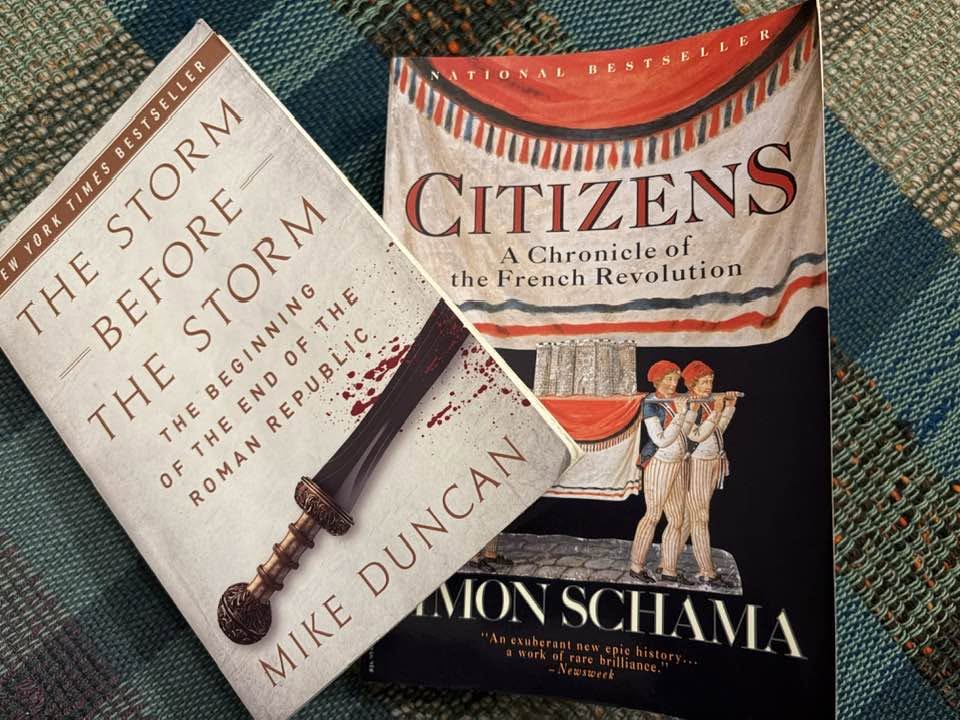
And so I did and so she was correct and so, for just a buck a piece, I walked away with two more books for our home collection: Citizen – A Chronicle of the French Revolution by Simon Schama, and The Storm Before the Storm – The Beginning of the End of the Roman Republic by Mike Duncan, known for his ever-popular podcast, Empire.
Duncan’s book is relatively short in length—just 305 pages; the Schuma book, however, qualifies as a “tome”—with 906 pages and weighing as much as a patio paver. Quite apart from the number of pages, however, is the density of the subject matter of each of these books. Neither is an “easy read,” any more than sailing across the Great Australian Bight is an easy passage. On the other hand, “no pain, no gain,” and I’m sorely in need of a deeper understanding of both the fall of the Roman Republic, as well as the dynamics of the French Revolution.
Who knew there was so much to wonder about on our tiny planet in the grand scheme of the sky? Which is why we have . . . books.
All of which triggers an amusing book-memory from my childhood . . . (Cont.)
Subscribe to this blog and received notifications of new posts by email.
© 2026 by Eric Nilsson

1 Comment
Can’t wait to hear about your kids’ thoughts on this. “Heirlooms are just peer pressure from the dead.”
On a side note, I might have some books to give to your wife…