FEBRUARY 15, 2026 – My wife has a much more detailed memory of our sons’ childhood than I do, probably because she attended to far more of the details of parenting than I did. This is not to say I don’t have vivid memories of those years or that I didn’t enjoy parenting, however deficient I was at it. I have distinct memories of saying to myself during each year leading up to the teenage years, “Now this is the best age,” until more time passed, and I’d say, “No, this is the best age.”
Now that we’re visiting our younger son’s family—involving a newborn and a two-and-a-half year old—I’m in awe of how our son and daughter-in-law juggle life, kids, careers, and family and friendships on each side of the Atlantic.
Today we drove up to West Hartford to visit over brunch with close friends of our son and daughter-in-law and the parents of J from two hours away in upstate New York. It was a wonderful gathering for all involved, especially considering the gourmet tastes of the two younger couples, palates developed and refined in France, where the very word gourmet was invented. (F and Mylène grew up in France; J and Byron each lived there long enough to become well acculturated in the words and ways of France. F and Mylène met by chance several years ago in a coffee shop in West Hartford; the husbands met soon afterward and also found they had much in common. The two couples have since become steadfast friends.)
On the way back to Chester, I rode with Mylène, who’d driven up to West Hartford separately so she could attend an earlier pilates class close to home. Free of parental demands and duties for 40 minutes, our ride together gave Mylène a rare chance to reflect out loud about parenting. I told her that as far as I could observe, she and Byron were doing a fantastic job. “I wouldn’t change a thing about how you two are parenting,” I said, though admittedly with dubious authority.
“Really?” she said with surprise in her tone.
“Each of you two seems to have achieved an excellent balance in how you manage everything. I’m really quite astonished how you do it.”
She then expressed how it often “doesn’t feel that way,” but I suppose that’s how most young parents feel. Back in my parents’ day, nearly every middle-way home had a copy of Dr. Spock’s child-rearing guide on hand. By the time my generation assumed the role of parenting, a proliferation of parent-help books had hit the market. Today? Good grief: Judging by strict protocols that now seem to be in vogue among our kids’ generation, it’s a wonder that any of us grandparents trying our best to comply with the new “rules” weren’t arrested for child abuse when we ourselves were parents.
In any era, though, let’s face it: rearing kids is one of life’s toughest challenges; in the thick of it, often impossible. “Yet,” I said to Mylène, “somehow humanity has been managing for thousands of years.” I then likened it to marathons. Tens of thousands of people have run them, start to finish, but knowing that doesn’t reduce by one iota, the challenge that any one individual faces in re-enacting the first “marathon,” run by Pheidippides in 490 B.C.E.[1] Likewise, my telling Mylène what great parents she and Byron are was analogous to spectators yelling out to their relative- /friend-runners on the marathon course, “You’re looking GREAT!” when in fact the runners are suppressing the urge to QUIT, given how god-awful they feel at the 17th mile mark. Yet, the vast majority of runners who’ve put 17 miles in the rearview mirror finish whether they like or not—just as a super-majority of parents who’ve made it through their kids’ teenage years will see the project to the finish line.
Upon arriving back at the house in the heights above Chester, we regrouped, then set out by foot (plus two strollers) for the center of town below. One splendid feature of New England, is that with a few notable exceptions, this corner of the country is . . . well, more “country” than urban. I always marvel that in this hilly little town on the western shore of the lower Connecticut River, just 129 miles to Boston Common to the northeast and 109 miles to Grand Central Station to the southwest, is surrounded by bucolic countryside—as are countless other small towns in New England.
On most weekends, Chester is a destination for people from miles around looking for an upscale dining experience, craft beer, the best ice cream in the world, a fine sandwich or latté at Simon’s, specialty gifts at the three or four boutiques, or a wide array of original art at the two or three galleries, including “Leif Nilsson Spring Street Studio and Gallery.” (no relation).
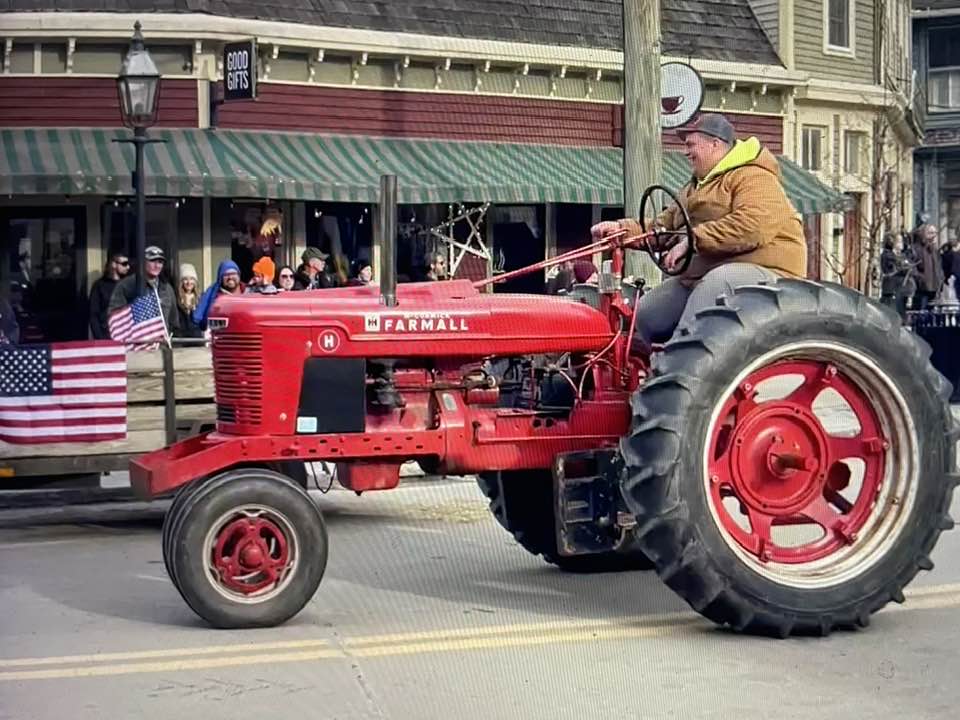
But on this weekend, the big attraction in “downtown” Chester was the annual farm tractor parade. The event drew a crowd of many hundreds, not only from Chester proper but from other small towns in the area and the countryside in between. Lined up tires-to-tires in several rows on Main Street were several dozen tractors, mostly vintage models, representing all the big name brands—Ford, Deere, Farmall, McCormack, International Harvester, Kubota, and Minneapolis Moline. They were nothing but a hoot to ogle, and as one could readily anticipate, for two or three minutes in a tractor seat, every kid under the age of 12 was all smiles for their parents’ and grandparents’ photographs. The crowd was definitely rural and was interchangeable, I figured, with their non-corporate farm counterparts from one end of America to the other. Our little guy, who’s in the trucks and construction equipment phase of his childhood, was in seventh heaven. So were his pappa and grandfather.
But I was fascinated by something else, as well. While the others devoured their ice cream, I settled my eyes on the three-story façade of the old frame building next to the ice cream shop. I figured it was at least 150 years old, but it was well-built and very well maintained. As my sight followed the crenelated trim, the fluted pilasters, and other architectural features, I mentioned to Byron how amazed I am generally by such design and old construction. “Just think,” I said, as I pointed out the more distinctive features, “that all of those were done with hand tools by highly skilled craftsmen.” This reminded me of a road sign south of Essex, the second river town below Chester, that dates the first settlement of this area by the English back to 1635. “Imagine, Byron,” I said, “that the Europeans began settling in this area just 15 years after the Pilgrims landed on the shores of Cape Cod, without enough wherewithal to survive their first year without the essential aid of the indigenous population.”
After more than an hour on the ground inspecting the tractors and waiting in line for ice cream before scarfing it down, we decided to head out on the 45-minute stroller expedition back “up the mountain” to the house. As our caravan approached the roadblock at the intersection of Main and Route 148, suddenly the tractors started firing up. Small puffs of diesel fumes blew forth from vertical exhaust pipes as a vast chorus of loud guttural wheezing hesitant tractor engines cleared their fuel lines and found their voices. A few moments later the local police removed the street barriers and signaled that the tractor assemblage was free to go.
If the start-up had been amusing enough, once the gears were engaged, all hell broke loose. By all appearances, the occasion wasn’t the first rodeo of any of the tractor participants. Yet, at the same time, the affair resembled more than anything else, a rowdy rodeo, in which each driver was riding a bucking bronco and desperately holding onto the saddle horn. I laughed heartily at the gratifying scene. “What a country!” I said aloud. And indeed it is. I snapped lots of photos and short videos in an attempt to capture the mood, the flavor, the atmosphere created by these New England cowboys and their unruly mounts.
In a most beautifully entertaining maneuver, at the intersection of Main and 148, the crazy rush of old growling farm tractors shook off their age and shot off in all three directions—north on 148, south on 148 and to the west on the road on the other side of 148. It was a wonder that none of the tractors crashed or, what seemed more likely to me, acquiring a mind of its own to match newfound vitality and purpose, and taking its owner/driver for a proverbial “ride.” I imagined a herd of mustangs, corralled far too long, forced to walk at a snail’s pace most of their working hours but now on show, free to gallop all out, giving their masters the rides of their lives.
The cacophony had long faded by the time Byron and Mylène departed for a dinner party in Middletown up the pike 20 minutes or so from Chester. Grandma and Grandpa then settled in to discharge their grandparenting duties. Apart from one minor head bump and 30 seconds of tears by our grandson and two 10- to 15-minute crying spells on the part of our granddaughter, all went well. No one got hurt and nothing got broken. But it was hard to go too far off the tracks. We were closely monitored—all in a supportive manner—by texts and calls from Byron.
My favorite moment came after it was my turn to read stories up in our grandson’s bedroom. “Okay,” I said. “Time to go to bed.” He offered no resistance but dutifully walked from the reading chair over to his crib. There he stood, gazing into it through the side bars. “Now,” I said, how do you propose to find your way into the crib? I don’t see a crane or a ladder.” He looked up at me with a perplexed look. “Oh! Wait a sec!” I said, as if inside my noggin a light switch had been flipped. “I get it! I’m supposed to turn into a crane and lift you into the crib. Alright, kid, you can call me Grandpa Crane.” With that I lifted him high above the side and gently lowered him into the inside of his nighttime cage.
I then remembered the instruction involving his special blanket, which I’d left downstairs. By the time I returned with it, the precious little rapscallion was sound asleep.
Tomorrow, I’m told, we’re going hunting for a new “big boy” bed. Something tells me it’s going to put Grandpa Crane out to pasture—perhaps with all those vintage tractors that brought so much delight to our lives today. I’m fine with that.
Subscribe to this blog and receive notifications of new posts by email.
© 2026 by Eric Nilsson
[1] From the battlefield at Marathon to Athens to announce the Greeks’ victory over the Persians. After having run from Sparta to Marathon, after the pivotal battle at Marathon, Pheidippides ran the roughly 26 miles to Athens. Upon his arrival, he shouted, “Victory is ours!” then collapsed and died. As I recall, the modern marathon was extended an additional 385 yards so that at the 1908 London Olympics, the course could run from Windsor Castle to the Royal viewing box at the finish in the White City—a total distance of 26 miles, 385 yards.

1 Comment
👏🏻👏🏻👏🏻👏🏻👏🏻🤗