FEBRUARY 16, 2026 – Today the household—our hosts, their infant and toddler, and my wife and I—launched an expedition to Jordan’s and Ikea in New Haven in search of a “big boy bed” for the toddler. The floor models were killing me. For under fifty bucks at Home Depot, I could bring home real lumber, plenty of fasteners, primer and finish paint. In a couple of hours plus drying time for the primer and paint, I’d have a finished “big boy bed” to present to the family’s little “big boy.” But on the spectrum of practical probability, my DIY project was confined to the realm of theoretical possibility—until a “big boy bed” was purchased at Ikea, in which case both probability and possibility of my DIY project dropped to zero.
On the way out of the store, I rationalized that the time and effort required for the DIY “big boy bed,” could be diverted to writing this post.
The trip to Jordan’s was a bit like visiting the façade department of an old Hollywood production lot. If I squinted, the room set-ups appeared real enough, but upon closer inspection little was “real” and much was “faux”—the latter being far less expensive. Not all of the goods came from China: I noticed a tag on one “big boy bunkbed” that said, “Made in Ashley, WI.” I had to look that up and found that it’s an unincorporated rural community in Marathon County, close to the geographic center of Wisconsin.
Upon concluding our scouting mission—with no purchase decision—we wandered into It, an enormous kid-scaled zip-line entertainment center owned and managed by and accessible directly from the gargantuan Jordan furniture store itself. In addition to a maze of zip lines and related features, an elaborate set of fountains combined with an intricate repeating light show captured our attention. In the background we heard a recording of “Nimrod” from Edward Elgar’s Enigma Variations. It was an unadulterated version, not some poorly arranged jazzed up adaptation. Moreover, the volume was perfect—pleasantly audible; not blasted onto our eardrums. I can’t remember the last time I heard Elgar’s “Nimrod” played in a public space (other than a concert hall), and I’m sure the reason I can’t remember is that today was the very first occasion on which I’ve ever encountered that hauntingly beautiful music in public.
When asked if he’d like to try the small kids’ zip line, our grandson said “Yeah.” The not insignificant ticket price was paid (I chalked up the premium to the upscale music) and the little guy and his dad walked to the zip line gate. When the staff member tried to talk our grandson into the safety harness, however, the latter changed his mind. My wife asked for and received a refund, which would nearly cover lunch at nearby Ikea, our next destination.
Given Ikea’s international market share in the arena of furniture and household wares—and Swedish meatballs—I don’t have to introduce my readers to this highly successful privately owned company founded by a Swede from Agunnaryd, Småland, not more than a half-day bike ride from our family’s ancestral home in Småland. Today’s visit, however, was only my second time inside an Ikea complex; hard to believe, I know, but entirely true.
With everything labeled in Swedish, and “Hej!” (“Hi!”) written on the back of every employee shirt, I soon felt right at home, but I was also quickly reminded that this worldwide chain store has developed a winning business model. Again, just as occurred inside Jordan’s, when I saw the “big boy beds,” I wanted to make a dash to the nearest lumberyard, but this time around, I got over the DIY impulse much more easily. The Ikea inventory boasted a few more flourishes—minor, in the scheme of things, but not easily replicated in my DIY settings, given my lack of lathes and routers. Moreover, the prices undercut my minimum (self-paying) wage.
Once Byron and Mylène found what they were looking for in the way of a “big boy bed” and Beth had purchased a fine collection of vehicles from the “Lillabo” set[1], we found our way to the cafeteria. Against all the head-spinning changes in the world since my only previous patronage of an Ikea cafeteria (back in Minnesota near the Mega Mall) seven years ago, I was greatly reassured by a point of constancy: featured on the menu was exactly the same “special” in which I’d indulged back then—Swedish meatballs, fresh bright green peas, mashed potatoes and gravy and . . . drum roll, drum roll . . . lingonberries. And every morsel tasted just as fresh and delightful as had the same fare so long ago. Plus, each plate filled with this meal of generous portions cost under 10 bucks. Beth and Byron ordered the same; Mylène, being of Portuguese parentage, opted for the cod, the national fish of Portugal (but popular in Norway and Sweden, as well). Our grandson feasted on the macaroni part of mac and cheese—unadulterated by the cheese—plus green peas from each of the grown-up plates but only the peas that hadn’t been contaminated by contact with other grown-up food.
Only the checkout system at an Aldi grocery store can rival the efficiency of the food queue at Ikea. But efficiency didn’t compromise the cheerfulness of the servers. I wouldn’t have guessed how being called, “dear” and “honey” repeatedly by the servers, whose faces lit up when I complimented them on their cheerfulness, would make my day.
As we snaked our way through the store to the warehoused furniture (to pick up the unassembled “big boy bed”), thence to the checkout, I knew full well the intent of the layout: to funnel customers through the entire store for the purpose of increasing sales. But I’m just as frugal as Ingvar Kamprad, the founder of Ikea, was notoriously frugal; the only difference being that he died a billionaire, whereas I . . . I am still living. I resisted any and all temptations to buy, buy, buy (anything more than the “big boy bed” and Lillabo vehicle set for our grandson, plus the meal of cod, Swedish meatballs and mac without the cheese).
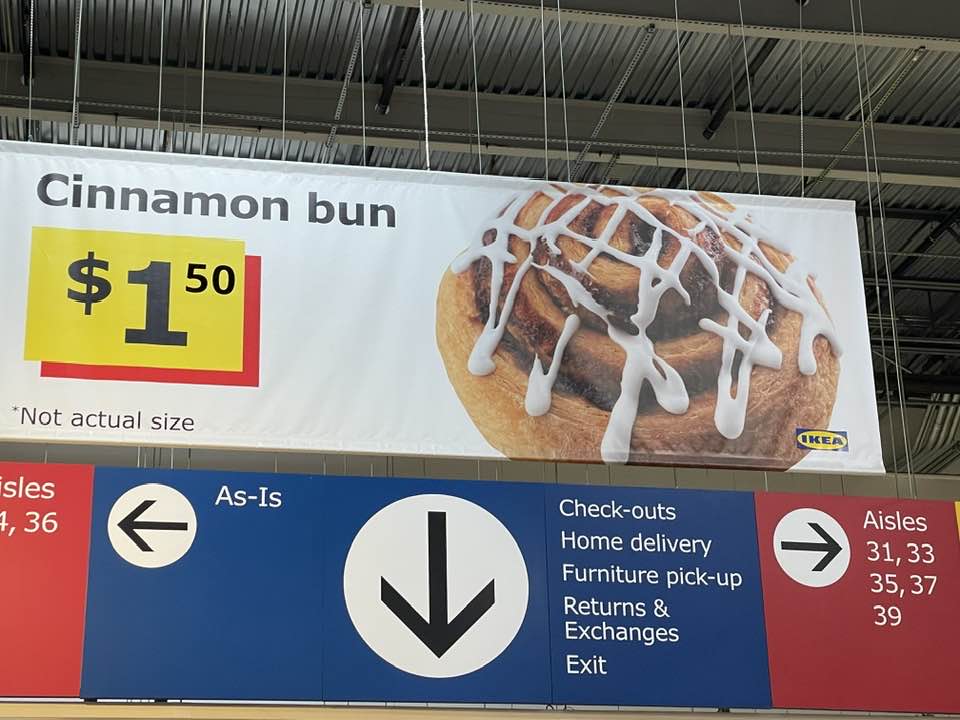
But the Ikea business model wasn’t yet done with me, the self-styled transplanted “Småläning,” who’s so frugal he “dilutes his water.” Above the checkout lanes was a large banner advertising cinnamon buns for just $1.50 a piece. Occupying the right half of the sign was the image of a mouth-watering bun, with (image) dimensions of about two feet by three feet. In the lower left-hand corner of the banner was an asterisk and the words, “Not actual size.” I appreciated the sense of humor—and promptly fell prey to the temptation. There was no way I’d be walking out of Ikea without a cinnamon bun, especially now that I’d been reminded of the ones our Swedish grandmother made by the dozens.
Yet even after we’d checked out, Ikea wasn’t done with us. Besides the cinnamon buns, more irresistible food offerings awaited. How in a Swedish based store, where I’d already been fed numerous additions to my Swedish vocabulary, albeit all relating to household goods, could I pass up a large box of Swedish-style ginger snaps?
All kidding aside, I did engage a number of store employees in conversation. How long had they worked there? How did they like their jobs, the company? Were there opportunities for advancement? Et cetera. I could judge as well by their spontaneity as by the substance of their responses. As a result of my unscientific poll, I’d give Ikea an A+. Show me an enterprise that does right by its employees, and I’ll show you a business that does right by its customers—in that order.
Now to put that “big boy bed” together. Byron has scheduled us for the task this Friday, his “home office” workday, while the little “big boy” is off at school. It would be splendid if the assembly directions are in Swedish, but I’ll settle for English. Besides, the work is likely to progress more swiftly in English than in Swedish.
Subscribe to this blog and receive notifications of new posts by email.
© 2026 by Eric Nilsson
[1] An Ikea brand name for toy trucks, cars, parking ramps, other features of urban living; in literal terms, “little” (“lilla”) + “place” or “live/reside” (“bo”)).
