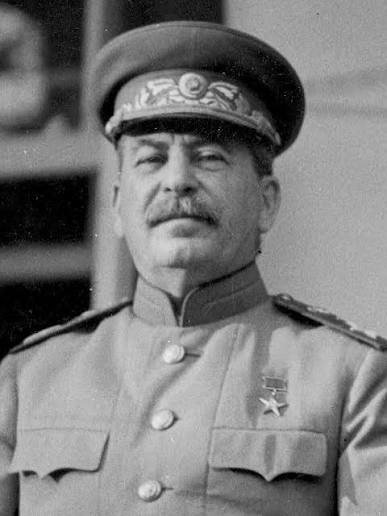
NOVEMBER 27, 2026 – Today’s edition of the Times included an article about Putin’s suppression of memorials dedicated to the victims of Stalin’s reign of terror throughout the last two decades of his rule over the Soviet Union. The downgrading and removal of these memorials, say critics of the regime, is to rehabilitate Stalin and use his example as a basis for demanding loyalty in the fight against Ukraine—a war that that at its outset nearly five years ago, Putin thought would be over within two weeks but to date has killed between 490,000 and 720,000 Russians in uniform and another 900,000[1] with no end in sight. To keep his subjects in line, Russia’s 21st century Tsar needs to leverage the example of “Tsar Joseph the Terrible” of the 20th century.
To put all this in perspective, the gob-smacking Russian casualties are drawn from a population of 143 million—less than half the current U.S. population (342 million). On a percentage basis, that makes Russia’s population less than 42% of our population. Or, to bring the perspective into sharper focus, the American equivalent of Russian war deaths would be between 844,000 and 1.67 million. I don’t have to tell you what happened when America sacrificed 58,000 lives—over a period of 21 years (1954 to 1975)[2]. What readers might not know or remember, however, is that the Soviet Union suffered 50,000 deaths in its war in Afghanistan after a nine-year slog. Many experts assign major blame on that debacle for the unraveling of the Soviet empire.[3]
As “Koba” (Stalin’s nickname) himself infamously said, “One death is a tragedy; a million deaths are a statistic.” Putin seems to have attended the same School of Inhumanity and Statistics as Stalin. To justify his own cruel megalomania, Putin is repressing the memory of Stalin’s brutal excesses and resurrecting the Soviet ruler’s fight against the Nazi invaders. Twenty million Soviet citizens—mostly Russian and Ukrainian—died in the war against fascism, among them, soldiers who’d committed the unforgivable crime of having been captured by German forces (and released by the losers upon their retreat out of the country). For years starting with the thaw orchestrated by Khrushchev after Stalin’s death in 1953, Stalin’s reputation took a big hit when his murderous ways were brought (mostly) to light. As many as 18 million to 20 million had suffered in the gulags, and the scars of Stalin’s terror ran deep across Soviet society.
But now Putin is desperate to keep his subjects in line with his wishes and out of the line of protest. He needs to remind Russians of the “glorious victory” over fascism—not simply that victory came at last but that it was achieved by brute force and, frankly, brutish means. Just as the nation had rallied around its strongman then, Russia must rally around Putin now. Moreover, the righteous cause today is the same fight it was during the Great Patriotic War (what Russians call WW II)—crushing the fascist enemy: “Nazi” Ukraine is the immoral equivalent of Nazi Germany.
We might ask how can Putin force ordinary Russians to stay with the war wagon. The answer is as simple as it is twisted, cruel and brutal: repress all memory of Stalin’s brutality but bring back the memory of his strongman approach to fighting the enemy. And for good measure, round up political opponents on trumped up charges and toss them in prison.
If Trump, who considers Putin his “friend,” would relish the “freedom” to incarcerate all of us who voted blue, hell would likely freeze over—as it did for ICE in the Twin Cities last winter—before he could get far with such a move. Even lame duck Republicans in Congress would acquire a measure of spine and indignation in protest. But Russians are the heirs of quite a different history from ours. If “freedom” is our rallying cry (if only “equality” were too!), a long tradition of repression and suffering is what allows Russians to “do what needs to be done.”
Before my travels to Russia, I’d read about much about its bloody past, but my armchair introduction omitted salient effects of that history. I remember my shock when I boarded a city bus in Irkutsk at the foot of Lake Baikal in Siberia. After boarding, I took an empty aisle seat and looked toward the front of the bus. There attached to the interior just above the windshield was a portrait of . . . drum roll, drum roll . . . the despised Stalin; except, I realized with naïve surprise that given the prominent public display of “Uncle Joe’s” mug, apparently he wasn’t universally disparaged.
A little over a decade later, after the break-up of the Soviet Union, Beth and I attended a neighbor’s welcoming party for a delegation of visiting Russians. Among them was a woman in her 60s, who would have been a child during the Purges and the Great Patriotic War. Having lived during those times—as well as glasnost, meaning “openness” and “transparency”, which preceded and precipitated dissolution of the Soviet Union—the woman had to harbor, I figured, strong ill-will for the horrific crimes of the erstwhile Soviet dictator.
But no! When I asked her about Stalin, she was an unabashed enthusiast. “He made us strong,” she said. “His leadership is how we defeated the Nazis.”
“Hmmm. Okay,” I said. Under the social circumstances and given the certitude in her tone, there was no point in arguing with her. But in my silence I connected her comment to the portrait of Stalin at the front of that bus in Irkutsk.
The Times article provides a litany of how memorials to Stalin’s victims are now being treated by Putin. The piece weaves in the legacy of what Alexander Solzhenitsyn called the labor camps—the Gulag Archipelago. It concludes with the view of a Russian historian who is a Stalin apologist. He claims that to develop the Soviet Union (apart from winning the war against fascism), Stalin had to deploy prison labor—at whatever the human cost might be. “Why focus on the fact that slaves built the pyramids?” he says. “How are the pyramids perceived by us today? As the Seventh Wonder of the World.”
And the man is an historian.
One man’s voice is an opinion; but millions of voices from the land in which such an opinion is cultivated by a leader who dictates what part of history is to be remembered and what part is to be forgotten form the statistic that gives effect to Putin’s campaign to bury the past.
Subscribe to this blog and receive notifications of new posts by email.
© 2026 by Eric Nilsson
[1] The lower figure is based on leaked analyses from Rosstat, the official Russian state statistics agency, and covers the period through September 2026. The higher figure includes estimates from independent sources taking into account reporting delays and missing in action statistics. The number of wounded Russians in the war against Ukraine is a shot in the dark, but Ukraine’s military General Staff puts the total figure—killed and wounded—at around 1.65 million as of late November. If the high-end of the 490k – 720k range of deaths is taken into account, the total number of wounded to date is over 900,000.
[2] Out of a total population (1975) of 216 million. In a strictly apples-to-apples comparison, the ratio of (a) American deaths (all causes) in the Vietnam War TO (b) the total U.S. population average between 1954 (162 million) and 1975 (216 million)(average = 189 million) translates to 0.03% of the total U.S. population. The Russian war deaths so far in Ukraine work out to 10 to 16 times that percentage.
[3] While traveling extensively in Russia in the fall of 1981—less than two years before the USSR invasion of Afghanistan—I asked dozens of people I encountered over two weeks on the Trans-Siberian Railway about their reactions to their country’s involvement in Afghanistan. The “party line” regarding every foreign incursion by the Soviet Union between 1945 and 1979 was a predictable regurgitation of Kremlin propaganda. When it came to Afghanistan, however, my train comrades parted abruptly with that party line. “CWA [U.S.A.],” I’d be told, “VEET-NAM; CCCP [USSR]—OFFGHANEESTAN.” The Kremlin’s rationale for Afghanistan seemed not to have many takers—if any—among ordinary Russians.
