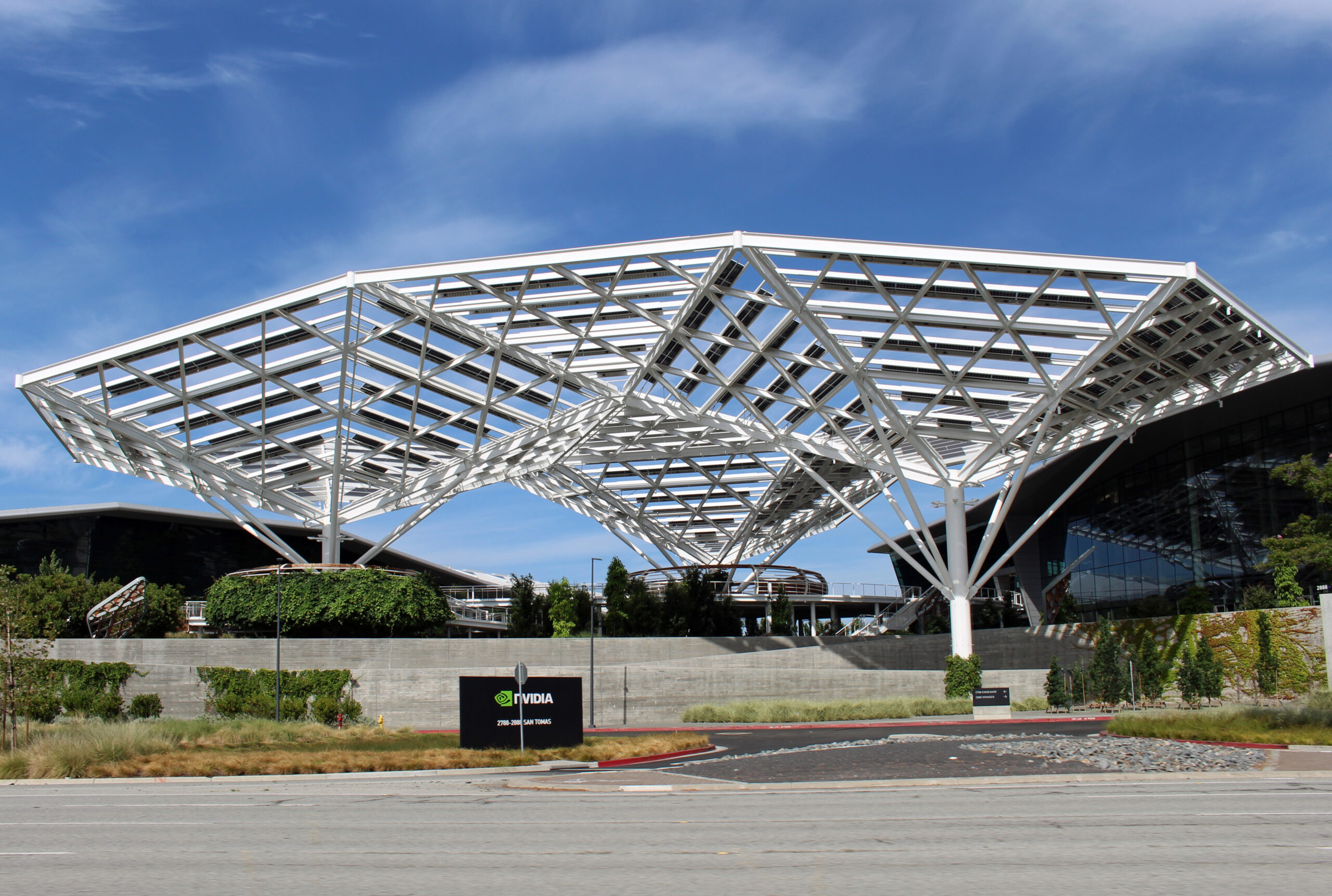
NOVEMBER 12, 2026 – The news of the day is the downfall of Jensen Hwang, head of NVIDIA, the world’s biggest chip maker, with a current market cap of over $4 trillion, even after a 30% plunge in its share price since its all-time high last month (not surprisingly, it’s now rated a “buy”). If you pry under the surface of the scandal-ridden story, however, you see the rest of the iceberg. That is, you see how corruption on an Olympian scale has infiltrated the infrastructure of American capitalism—and politics.
Let’s review the recent figurative “video tape”.
Cleverly, but in the end, unsuccessfully, ever since Trump took office again in January 2025, the Party of Sycophancy tried to equate all political opposition as “communist,” “socialist” and (therefore) radical, extreme and anti-American. In susceptible minds, the repetition of false equivalents worked. FoxNews, NewsMax and other propaganda sources (as opposed to opinion platforms) embedded these terms into anchor scripts and show-host themes. The entire act was nothing more than a disingenuous rerun of an historically ragged play: fear of the Reds. In remarkable irony, of course, the “anti-red” party has long accepted its own red coloration, allowing Democrats to imbue themselves with the spirit of “true blue” Americans.
But all shin-kicking aside, use of anti-communist/socialist rhetoric diverted Republicans in Congress not only from their Constitutional duty—oversight of the executive branch—but from the Trump family’s unrelenting attack on all that’s good and right about American capitalism. What’s baffling to me is how so many rightwing pundits, commentators and yes, academics, could pile on the Trump bandwagon of supreme corruption with such blind disregard for their own stated principles.
The NVIDIA spy case reveals the level of graft and corruption connecting an all-powerful corporate interest and the Trump crime family. The now disgraced oligarch Mr. Hwang had contributed $25 million toward Trump’s Playroom. If you think that chunk of dough had absolutely no strings attached, you’re fair game for the latest “IRS” phone call scam threatening a levy on your bank account if you don’t “pay up” by noon today. And that $25 mil chump change, of course, was but a surface scratch in the damage done to the American way of life—id est, the business of America, which is business . . . as President Calvin Coolidge pointed out so succinctly and unapologetically a century ago—before all things business went to hell in a hand-basket.
The other name emblematic of corruption in the Trump Era is, of course, Elon Musk. The future will ultimately judge the net benefit of his technologically visionary and innovative way of thinking and doing, but in the present, the verdict is in: Along with his co-conspirators in the White House and Republican Congress, he is liable for supreme damage wreaked upon American capitalism, government and democracy.
Apart from Trump Era corruption, American big-corporate capitalism gives the objective observer lots to complain about, from the generation of greed to the generation of pollution—in a word, to the creation of “excess.”[1] But on the constructive side, the same level of objectivity must recognize how the core elements of capitalism—competition, the profit incentive and the “invisible hand” of the marketplace—work to produce a cornucopia of goods and services larger and more varied than any other economic system yet devised.
For that system to thrive, however, without ultimately consuming itself or destroying the human race, requires two essential ingredients: 1. Freedom from corruption; and 2. Regulation. To function (across a spectrum from “adequately” to “optimally”), every business enterprise from the mom-and-pop hotdog stand to the Fortune 50 international conglomerate must attract investors and customers. As regards corruption and regulation . . . A hungry “me” at the beach must be confident that the hot dog I buy from “mom-and-pop” isn’t poisoned dog food in a bun. Moreover, I must know that the inspection permit slapped on the side of the mobile hot-dog stand isn’t fake or the manifestation of a bribe versus an actual legitimate science-based inspection. If I’m the banker issuing a $1,000 loan to “mom-and-pop” to stock up on inventory for future sales, I need to know that the Mob isn’t skimming 20% of the hotdog revenues off the top, jeopardizing loan repayment prospects. Likewise, if I’m buying a car from GM, I need to know that the company didn’t pay for the vacation of a Supreme Court justice so as to influence the outcome of a case on the constitutionality of a critical safety regulation. And if I’m an investment banker evaluating an IPO, I need to be certain the company books haven’t been cooked by accountants after the company’s top executives have contributed millions to political campaign PACs with the expectation of warding off SEC scrutiny.
To the extent neither customers nor investors can depend on corruption-free environment, the effect will be a drag on the economy; a hidden tax on capitalism, if you will.
Likewise, regulation. In the Libertarian hay-day—well, kinda, sorta, if you ignore all the corruption—running up to the recent election, government regulation of nearly every sort was unabashedly (and ignorantly) conflated with “communist,” “socialist,” “radical” and “extreme,” all of which, of course, were overtly ascribed to “Democratic.” This simplistic propaganda harbored the ultimate false equivalent—that American capitalism was an “either-or” proposition; that either it had to operate free of all government regulation or you’d have yourself a bunch of Bolsheviks ruling the economy and sending it and you—stripped of your worldly possession and precious freedom—to the Gulag.
But the choice isn’t between laissez-faire capitalism and the Gulag. It’s between “anything goes” and some degree of regulation of capitalism’s tendency toward excess. Or under closer examination, the tendencies of human nature—myopic thinking and actions; strict adherence to self-interest in conflict with the self-interest of others or, of collective interests, which, in the strategic long-haul are aligned with everyone’s self-interest.
I remember well a conversation a neighbor and I had one day during the Great Recession, on our morning bus commute into downtown Minneapolis. It was barely a 20-minute ride, but our exchange made a lasting impression. He was a Republican by disposition; an engineer by training and very analytical, which suited him well in his vocational transformation into a money guy working for Merrill Lynch (at the time). He was, of course, steeped in the multi-faceted regulatory framework governing his industry. Some of that regulatory scheme was eye-rolling—I knew firsthand from my own exposure to securities laws—but I remember distinctly him saying, “The system has to be regulated. If it weren’t, we’d be drowning in a sea of greed.”
At the time I had had my own confrontations with unchecked greed. I knew firsthand from what I’d seen of it in my law practice, that unregulated, some human beings will simply snatch and run with all that they can grab. None of us should want to live in such a world, especially if we hold dear basic values that undergird a civil and productive society that bends toward justice and equitable behavior and outcomes.
Legitimate debate should be encouraged with respect to “regulation,” but the emphasis should be on what’s rational and reasonable, fact-based and realistic, necessary and appropriate, not simplistically between “more” or “less.” In cases such as the high-speed rail fiasco in California, conflicting layers of local, state, regional, and national environmental regulation need to be reformed into a rational and far more efficient system. In other cases, regulation devised mainly to serve one powerful interest over another, without any net benefit to the broader economy, must be scrutinized and where appropriate, eliminated. This latter mission, however, runs smack into the effect of Citizens United and the corruptive effect of money in politics, though Musk’s colossal failure in Texas may signal a critical turning point in efforts to outlaw such “legal” corruption.
All of which leads back to NVIDIA, the notorious corruption of the Trump family along with its supporters/enablers, and the magnitude of the Blue Wave . . .
Given the anti-Trump mandate of the mid-term voters, Democrats face a sobering responsibility: to organize, strategize, and in all ways operate, responsively. This includes focus on accountability, which ultimately overlaps with economic concerns; with bolstering American capitalism by attacking corruption and restoring what Trump and Musk tore asunder and Congressional Republicans sycophantically permitted. Investigations should ensue, explicitly not in the name of retribution but expressly in the democratic and (capitalistic) economic necessity of accountability.
I for one remain cautiously hopeful that the size of the Blue Wave will give the country fresh motivation to confront constructively the damage to American capitalism; wreckage we’ve allowed for much too long.
Subscribe to this blog and receive notifications of new posts by email.
© 2026 by Eric Nilsson
[1] The word “pollution,” in fact, derives from the Greek word, πολύς, meaning, “many,” “great,” “much.”
