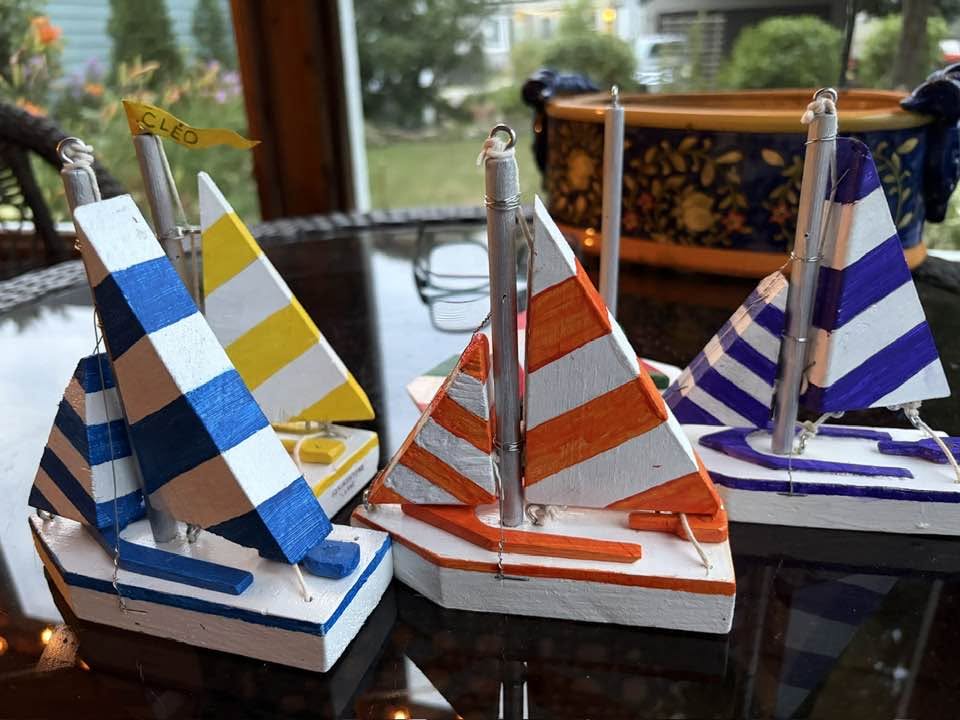
JULY 30, 2026 – Early this morning I stepped outside the back door of the old cabin and strolled around to the front for a view of the lake. Sunbeams filtered through the trees to the east, signaling positive prospects for the day ahead. The air was already warm and a bit hazy but not yet uncomfortably humid. A steady breeze out of the southwest was a sailor’s delight. For a few moments I imagined myself tacking to the center of the lake, then aiming for the islands before reaching back to port for breakfast. That was the course I’d take years ago whenever conditions such these occurred. In the moments of recall this morning, I smiled without regret. On many occasions I’d seized the day—not only for what was then the present but for future satisfaction, such as I felt today.
With my various work-related chess boards now waiting for other players to make their moves, I was under no pressure to plunge into “work.” Most of the morning would be my own. With inside and outside conditions being in perfect equilibrium, I ate breakfast at the table on the back porch. The sun was angled perfectly to highlight my current reading material, Our Declaration by Danielle Allen. Soon I’ll give a more substantive reaction to Professor Allen’s detailed analysis of the Declaration of Independence. For now, I can best describe her 2015 book as a perfect text for a multi-disciplinary undergraduate course in philosophy (logic and epistemology), political philosophy, political science, religion, Latin, English, history and even a touch of straight up math and astronomical science. (That in a nutshell ought to be praise enough for both the book and its subject matter.)
When my coffee cup ran dry, however, it was time to get on with the main business at hand: finishing the rigging of the first five vessels of “the fleet.” To anyone not engaged in such a project, it’s probably all a big yawner, but for the do-er, this sort of work soon leads to a state of zen.
I was intentional in fostering and embracing such conditions—open windows to let in fresh air and the sound of the breeze at play in the trees; no other humans about (Beth and her guests are still holding down the Red Cabin); phone silenced and no music playing. There I sat, tying (and occasionally untying) miniature knots in the main halyard; threading the 28-gauge “stay” wires through the near-microscopic holes I’d drilled free-hand in the masts, pulling the wires taut with pincer pliers, then twisting the “stays” into place.
Every bit of this was a delicate operation, and more than twice, I’d wanted to swear out loud. What stilled my tongue, however, was my imaginary company. And the longer I imagined them, the less imaginary they seemed to be, but as real as the stir in the air and the susurration of the trees.
My sisters and I have vivid memories of lunches out on that porch, at least on warm sunny summer days. We kids would sit on the wooden built-in storage bench that ran the length of the north outside wall. With our backs to the tall open casement windows, we’d face Dad on the other side of the table.[1] Our grandmother (“Ga”) sat at the end of the table near the refrigerator, and grandpa sat at the opposing end right beside the back door, which, with the casement windows next to it, would always be open. Grandpa positioned his chair at a slight angle so he could see out the doorway.
In her early years in this country, Ga had worked on the domestic culinary staff of one of the “fancy families” of Minneapolis. I think she had naturally refined sensibilities, despite a typical rural upbringing in Sweden. But in working for the upper crust in a land “paved with gold,” she learned much about sophisticated style and taste. Meals at the “fancy homes” were formal affairs, especially when the guests were every bit as “fancy” as the hosts. Ga adapted easily to “fancy” environments and to the elaborate culinary productions within. Decades later she perpetuated her refinements for our edification, even at the cabin—and even during the years when her cooking apparatus was a wood-burning stove.
Cabin breakfasts were multi-course affairs, and dinners involved preparations that invariably commenced long before the dinner bell rang. Lunches were less formal, but no less abundant, it seemed. In addition to bearing soup and sandwiches, the table was graced with Swedish knäckebröd (crispbread), “Noon Hour” brand sil (pickled herring) and King Oscar brand sardines—along with jams, jellies, and other tidbits of one kind or another, followed by Ga’s canned pears and homemade “ice box” cookies.
Those times at the lunch table cemented some of my happiest memories of the cabin. Dad and our grandparents were always in a cheerful mood, as they talked about current cabin projects, told stories, and exchanged ideas about one subject and another. And when a chipmunk appeared at the top of the stone steps right outside the doorway, all talk stopped as Grandpa clicked his tongue, communicating, “Hey little fella! When I’ve finished my lunch, I’ll get the bag of peanuts and come out and feed you.” And for our amusement, he’d do just that, while we watched a chipmunk—or two or three—fill their fat cheeks with a peanut in the shell . . . or two or three.
Today, those scenes of yore filled my thoughts as I worked at that same table—laden not with lunch dishes but with all the tools, parts and materials of my model sailboat shipyard. As I imagined going back to those years, I wondered what Dad and my grandparents would think if they could see me at work. What questions would they ask? What answers would I give? As the air moved, brushing across my face, I very much felt the presence of those three people, who’d made such a deep impression on my sisters and me. I realized how unusual it was for anyone to have spent so much time over seven-plus decades in the exact place—at the same table, no less—that had given rise to such formative and positive memories.
The recipients of the vessels in my growing fleet won’t know the full connection between what will soon be their sailboats and the “shipyard” of our old family cabin. But their knowing or not knowing isn’t important. What matters is that our lives interconnect like threads in an endless tapestry. A place is only that—a place; coordinates on a map. It’s the people of one place or another who give our lives meaning, however much the courses we chart diverge.
Subscribe to this blog and received notifications of new posts by email.
© 2026 by Eric Nilsson
[1] I don’t remember Mother being at the cabin much in those years. I also don’t remember all four of us kids being at the cabin at the same time. The sleeping arrangements weren’t crowded, but at the same time, they weren’t sufficient to accommodate all six of our family plus our grandparents. I suspect that the grownups reached an easy consensus that we kids would visit two at a time—with Dad, while Mother stayed at home with the other two of us.
