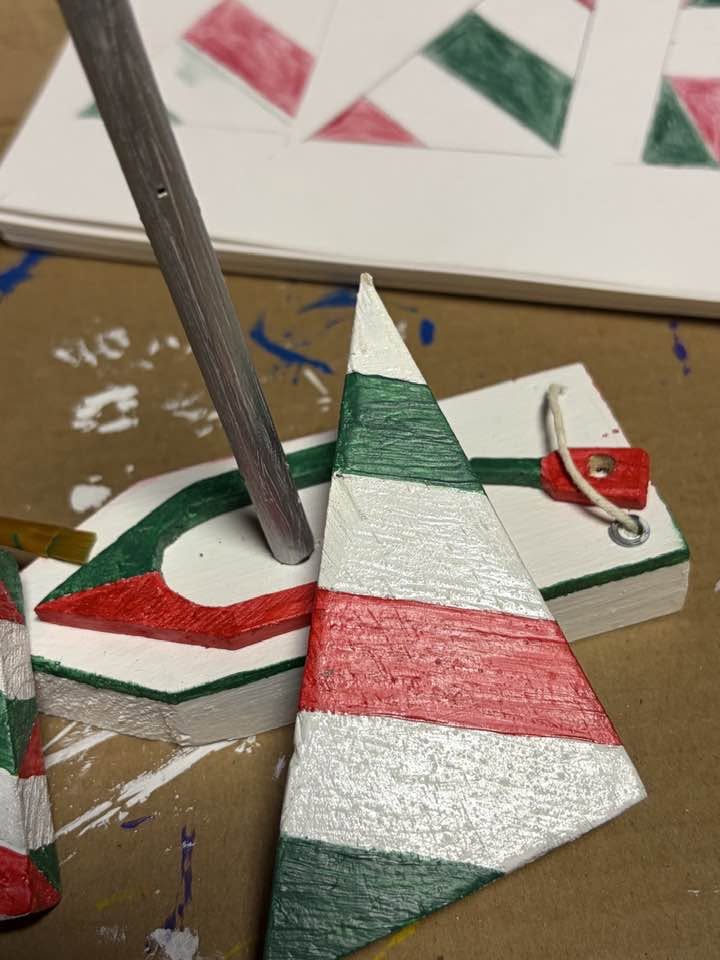
JULY 28, 2026 – Today the waters parted long enough to allow for painting the “sails,” tiller, splashboard and hull trim of another vessel of my model sailboat-from-wood-scraps fleet. This one was particularly tricky—it’s dual colored (for a husband-and-wife crew among the guests we’ll be hosting at the Red Cabin in August) and required an angled brush in an especially steady hand.
As I noted in an earlier post about this project, I’ve experimented with various aids for painting inside the lines—tape, a straight-edge, et cetera, but nothing works as well as free-hand. It’s a nerve-wracking task, however. Along certain lines I feel as if I’m walking a tightrope without a safety net. When painting other sections, I imagine I’m playing a scale on my violin while standing in front of an oscillator tuned to a 440 A. The machine doesn’t lie or accept excuses. In yet other places that need to be painted inside the lines, I go with a skiing metaphor, mindful of two critical factors: speed and visual focus—the former provides momentum for balance and turning; the latter allows my eyes to lead my hand, and just as in skiing, I look way ahead of my skis, not at my skis.
As I strive for perfection—and mostly fall short—in this whimsical endeavor of no consequence for the earth’s tilt or rotation, I’m struck by the irony of my standard. “Perfection”? In a world defined by its imperfections? Have I lost all perspective and sense of proportion? Perhaps not; maybe I’m simply acknowledging the elusiveness of perfection, even in the narrowest of circumstances, where I have near total control of the outcome, right down to holding my breath in synchrony with the slow, steady advance of the ultra-fine paintbrush in my (steady) hand.
While trying my best to paint inside the lines, I thought about the multiple phone calls and emails I’d received earlier in the day; each one communicating someone else’s troubles, anxieties, heavy burdens. As members of humanity, I thought, what we share first and foremost, is imperfection, in its infinite manifestations. Yet, in many contexts we hold others—and often ourselves—to expectations of perfection. And miraculously, in a wide range of settings, we do achieve near perfection. A prime example would be commercial aviation, long operating at a massive scale with a safety record matching that of the chairs around our dining room table. Another arena comprises various surgical procedures, wherein risk-mitigation is modeled after that discipline in aviation.
Many people look to AI to solve our “imperfection” problems. That’s fine. Subject to appropriate regulation, I’m all for developing AI to aid the human condition. But I also share the reservation expressed by analysts who warn, “Not so fast.” My reticence isn’t based solely on the “dark side” of AI’s potential, but rather, on its focus on perfection.
You see, despite my goal of perfection, I don’t favor it straight across the board. Take my hand-painted model sailboats, for example. Even in the absence of advanced AI, a machine could “paint inside the lines” far better and far more reliably than I ever will. But when a tourist enters a gift shop in Olde Mistick, Connecticut, what will seal the sale is not a perfectly machined model powerboat (batteries included) but a handsomely hand-painted model sailboat, with below-the-waterline elements (keel and rudder) left to the beholder’s imagination.
I had a similar thought several years ago when I attended a performance of the Brahms Violin Concerto by the world-renowned violinist, Steven Copes of the Saint Paul Chamber Orchestra. By current world and historical recording standards, Steve “knocked the ball out of the park.” But by “AI-perfect” standards, I thought, his rendition wasn’t “perfect.” Why? Because by definition, a machine-perfect version of that piece wouldn’t flow from a human heart or mind; it wouldn’t have any of the expressive, interpretive, or other sound elements that are unique to a human being, and in the concert at hand, a human being of extraordinary skill and talent. If a person really wants to connect with this masterpiece of Brahms, I thought, the person must hear a non-AI-perfect version performed live by . . . a human being of Steve Copes’s caliber, and in truth, 10 times over by 10 different world class violinists. At that juncture of my thoughts, I realized another salient facet to Steve’s performance: the concert was being recorded, of course, but the live version would occur only once. No matter how many times Steve Copes (or any other violinist) plays that concerto live, no two renditions will be exactly the same; not true of an “AI-perfect” version. In the uniqueness of the human performance lies its superiority, not its “perfection.”
While painting inside the lines with green, today, I thought of the trees that surrounded my outdoor “studio.” I then realized why I’m so enamored of the white pine in these environs. Not only were they the dominant indigenous species, long before white people invaded and saw the cash value of white pine lumber. In these parts, the pinus strobus was also the tallest, the largest, the oldest of all the trees. Young survivors of the clear-cutting 125 years ago are now in their prime, and their signature feature isn’t only size; it’s their wildly asymmetrical profile that transforms them into arboreal royalty.
Yesterday evening while out on the pontoon far from shore, I surveyed the entire silhouetted tree line around Grindstone Lake. Half a century ago—even half that time ago—only a few rugged, jagged, rakish white pine with sprawling crowns reaching for the clouds stood guard on Grindstone. Today the giants are beyond count. As I tried for perfection, tried to paint green inside the lines, I reflected on all those royal pine. And I realized then what makes them so special: their asymmetry, the randomness of their branches and outreach; in a word . . . their imperfections.
By way of these three examples—trying to paint inside the lines and in so doing endowing my model sailboats with “human-hand authenticity”; a highly gifted human being giving a unique performance of a musical masterpiece—recordable, but impossible to play twice exactly the same; and the wild and wooly white pine, so perfectly imperfect in their asymmetry—I decided that the significance of “perfection” versus “imperfection” is contextual. In many cases, what’s really going on runs much deeper than superficial perfection; often it’s as deep as the fathomless human soul and as wondrous as nature’s design.
Subscribe to this blog and received notifications of new posts by email.
© 2026 by Eric Nilsson
