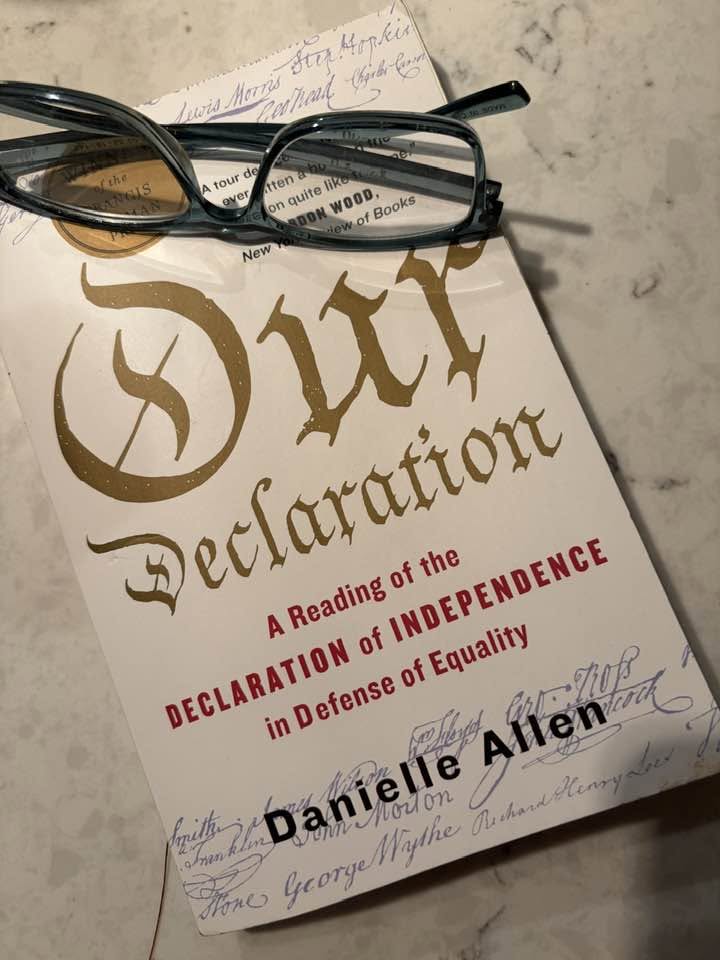
AUGUST 3, 2026 – (Cont.) Professor argues that the Declaration lays down five aspects of “equality” among peoples:
First is the equality of people from domination of one by another. This finds expression in the first sentence, “for one people [. . .] to assume among the powers of the earth, the separate and equal station to which the Laws of Nature and of Nature’s God, entitle them [. . . ]” (emphasis added) This pertained to the notion that as a people, the Americans were entitled to equal standing with other countries—not in wealth or size or military power—but as a people. Equal standing or “station” with other countries went hand in with freedom from domination;
The second aspect of equality concerned equal access to the political vehicle unique to humanity: government, the purpose and indeed, the necessity of which, as presented by the Declaration, is to preserve equality and “unalienable” rights, including “life, liberty, and the pursuit of happiness.” Other species have social orders, but none has what Allen calls, the “tool of government,” which is highlighted in the second and transcendent sentence of the Declaration:
We hold these truths to be self-evident, that all men are created equal, that they are endowed by their Creator with certain unalienable rights, that among these are Life, Liberty and the Pursuit of Happiness, —That to secure these rights, Governments are instituted among Men, deriving their just powers from the consent of the governed, — (emphasis added)[1].
The third aspect of equality addressed by the Declaration is what Allen describes as “egalitarian approaches to the development of collective intelligence.” Experts, she argues, perform best when they work with a well-educated public providing useful input to policy-making and implementation. She points to the example of grievances described in the Declaration and how they were developed through an extensive communication network among the colonies, by which information regarding specific offenses by the British overlords was collected and synthesized into the 27 generalized statements.
Fourth among the facets of equality addressed by the Declaration is what Allen calls “egalitarian practices of reciprocity,” that is, drawing benefits from fellow citizens and owing benefits in return. This notion of reciprocity—or rather, the lack of it in their relationship with the British—is what fueled many of the grievances.
The fifth element of equality implicit in the Declaration is to be found in shared participation in and responsibility for public life. This is what was being exhibited by the Signers—a bold public action the support for which they “mutually pledged to each other, [their] Lives, [their] Fortunes, and [their] sacred Honor.”
Our Declaration faces directly the apparent contradiction between genocide of the indigenous population and the institution of slavery, on the one hand, and on the other, the clause, “We hold these truths to be self-evident, that all men were created equal.” She acknowledges Jefferson’s personal conflict and includes the paragraph he drafted condemning slavery—before showing what the Continental Congress did with it: wholesale deletion. Also, she grapples with “men” (vs. “women”) but by reference to “men” in draft language accusing the King of sending “men” to the slave market, when everyone know, women and children were sent to the slave market as well, she argues that in contemporary usage, “men” meant “humanity.” But overall, she gives white men of the late 18th century a rather large pass since they lived in . . . the 18th century . . . and despite the influences of the Enlightenment and liberal political philosophies of Hobbes, Locke, and Rousseau, the drafters and signers of the Declaration were also captive to the habits and mores of their times.
As I said in yesterday’s installment, Allen presents a picture of the Declaration that is overly optimistic. She conveniently avoids mention of pecuniary interests—as opposed to ideas and ideals—that drove many colonists to rebel or, for that matter not to rebel, depending on their livelihoods and locations. Revisionist historians, I’m sure, would take serious issue with Professor Allen’s love and respect for the Declaration of Independence as a statement of our foundational principles. Libertarians, whom Allen singles out as espousing a political philosophy at odds with the political philosophy expressed in the Declaration, would likewise challenge her position that government, somehow, can be a good and necessary force in our lives. With my diminishing faith in the past now disturbing my view of our prospects, perhaps a strong dose of Professor Allen’s enthusiasm for the Declaration of Independence is not such a bad thing.
On balance, Professor Allen does her fellow citizens a huge service by her scholarship and writing on the Declaration of Independence. If you’re searching for something positive about our American heritage, this book will bolster your confidence in our origins. Also, I agree with her political philosophy that since “we’re all in this together,” everything that secures what we hold dear—particularly our “unalienable rights”—requires equality (as distinguished from “sameness”). Equality, in turn, necessitates government with consent of the governed and with equal access, and then and only then, can we enjoy freedom from tyranny and domination.
Subscribe to this blog and received notifications of new posts by email.
© 2026 by Eric Nilsson
[1] One of the most interesting historical aspects of the Declaration pertains to the different versions that developed after approval of the “official” text. Most critical was the unilateral decision by one of the printers to insert a period after “Life, Liberty, and the Pursuit of Happiness.” This punctuation, which Allen asserts fundamentally altered the meaning of the original version by interrupting what was intended as a single sentence, thereby decoupling “equality” and “freedom.” The punctuation change was perpetuated and is what now appears in most copies of the Declaration, including what appears on the National Archives website. Moreover, the Signers believed that to secure “Life, Liberty, and the Pursuit of Happiness” required government with the consent of the governed but with the attendant right to replace it if that “Government becomes destructive of these ends [securing the unalienable rights].” By breaking up the sentence with the period, the thrust of the document changes, underscoring “freedom” at the expense of “equality,” leading to a logical dead end, in Allen’s analysis, since without equality, freedom is endangered.
