AUGUST 23, 2026 – As a daily blogger of a site featuring “[o]riginal anecdotes, commentary, rumination, and occasional pontification,” I’m always on the lookout for subject matter, but sometimes the subject matter finds me. Today was one of those occasions—inside a Walmart store, no less.
At a little past three this afternoon, it was announced that an expedition would be mounted to Hayward, the nearest town from Grindstone Lake, to do laundry, make a stop at Tremblay’s candy shop, and buy some groceries. When asked if I would be joining the group, I threw in my hat. Watching our three-year-old grandson in a classic candy shop would be well worth the price of admission.
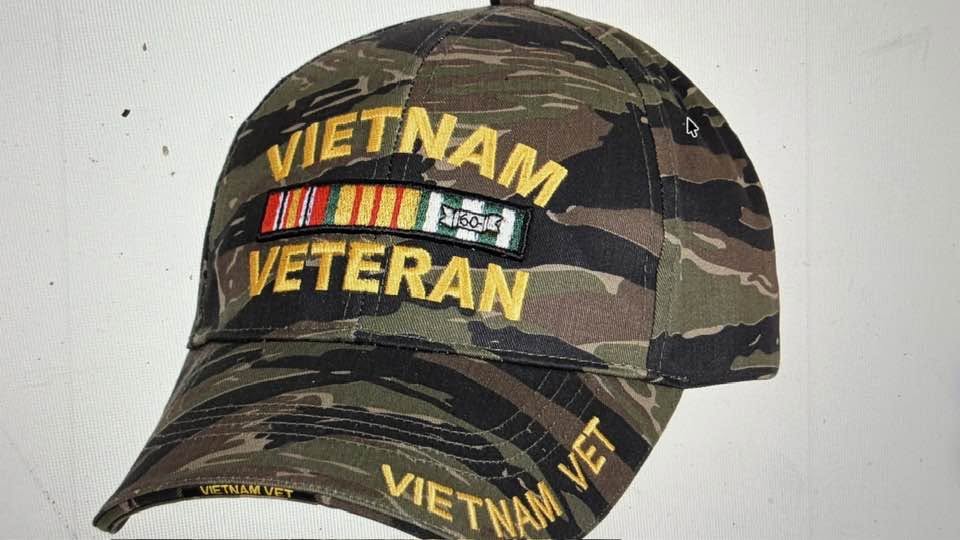
Ninety minutes later, after clearing out of the laundromat and an unhurried stop at Tremblay’s, we headed for the Walmart on the edge of town to grab some groceries on our way back to the Red Cabin. Inside a nearly deserted Walmart, I split off from the group to hunt down a container of Ovaltine. My search proved futile, and I was now looking for my people, when at the end of an aisle, I encountered a large man wearing a T-shirt and a camouflage “Vietnam War Vet” cap, seated in an electric conveyance equipped with a large wire basket in front. He looked every year of his age, which I figured was late 70s.
The man looked at me and cried out, “What a sight for sore eyes!”
I didn’t know whether to feel flattered or cornered by someone who’d lost his marbles. When he extended his arm inviting a handshake, I leaned toward the probability of lost marbles. But his veterans cap suggested that he’d been through hell or high water or both in his youth, and that possibility gained my respect—lost marbles or not. I shook his hand, but when I looked into his face, I didn’t see the picture of health. On the other hand, I didn’t detect lost marbles, either.
“I know it’s been years,” he said. “Bob Stromquist [not his real name].” The name didn’t ring a bell, as I conducted a quick review of my mental Rolodex. “And that’s my wife Donna over there. He pointed toward a woman nearby, about his age, pushing a grocery cart. She turned to me and out of awkward politeness, we shook hands.
“And do you know who I am?” I asked.
“I’m bad with names,” said the man. “And it’s been years, I know, since we’ve seen each other.”
I introduced myself and it was clear that no bells were ringing inside the vet’s head either. “What’s our connection?” I asked him. I doubted that any existed but thought I should ask.
“The [Chippewa] Flowage,” he said.
His response confirmed what I’d now concluded: a case of mistaken identity. “No, I’m sorry, you’ve got the wrong person. I’m on Grindstone. I’ve been to the Flowage only once in my life, and that was 30 years ago.”
“I see,” he said. “Well, I must say, you’ve got a twin out there.”
I knew that if I didn’t appear at the checkout soon, Beth would soon be texting or phoning me. The grocery list was short. And given that my exchange with the self-identified Vietnam Vet had been over his mistaking me for “my twin,” I had no further reason to enter into a conversation.
But my curiosity got the better of me. Surely this guy had colors in his past, and his outgoing personality told me it wouldn’t take much to open the lid to the paint can for a brief peek inside.
“Where were you in Vietnam?” I asked.
“I was based in Danang,” he said, “but I traveled up and down all the rivers around there.” He named three or four, but none of them registered. The only river in Vietnam I knew about was the Mekong.
“What was your assignment?”
“I was a courier, a special messenger carrying highly classified information back and forth between fighting units. I drove a Boston whaler. It had an 85-horsepower engine on it, and believe me, I knew how to drive that thing as fast as it could possibly go.”
With that, I knew I was “off to the races.” While his wife ambled on down the aisle and I awaited the inevitable text or call, I asked Bob Stromquist a gazillion questions. He was quite willing to engage, and little by little I was able to extract his story.
“The funny thing was,” he said, “I was in the Navy but never saw a ship. I was part of what they called the ‘brown water Navy. For the entire 18 months I was in Vietnam, I was driving a Boston Whaler.”
“How big was your crew?”
“Crew?” he said, as if I’d asked a dumb question. “I had no crew. I was it.” This disclosure came after he’d told me how wherever they were along his river routes, the enemy would shoot at the boat and shoot at him. For self-defense, he carried a shotgun and an M-16.
“The crazy thing was that I could never see the people I was shooting back at. They’d shoot at me, and I’d shoot at them. I should’ve died many times over,” he said, “but I managed to survive. But there were many times when I was so scared, I was like this . . .” whereupon he arched his bulk over the handlebars of his cart, “not knowing if I’d live or die.”
He had many buddies who did die in Vietnam, and he said “that’s something you never get over.”
When he was preparing to return home, Stromquist said his C.O. asked him to stay another six months. “There was no way I was doing that,” he said. “My C.O. was upset, but it was my life.”
“What kind of work did you get into after the war?” I asked.
“I was a police officer. Went to school for that for six months but didn’t learn a thing I didn’t already know. Once in a while someone shoots at a police officer, but driving that Boston Whaler—I was getting shot at every single time I went up or down a river.”
Finally, I did get a call—from Byron. The rest of our crew had already headed back to the Red Cabin. He was waiting for me in the parking lot.
I told Mr. Stromquist that I was being summoned. He was quick to laugh at my predicament. I told him how very much I appreciated his taking the time to talk with me and thanked him for being so open. Before dashing off, however, I asked if he’d ever been interviewed about his experiences in Vietnam.
“No,” he said with a tone that suggested that it was an odd question. “I gave some talks years ago . . .” his voice trailed off.
“Do you realize,” I said, “that the U.S. left Vietnam 51 years ago? Yet, JFK was assassinated only 18 years after the end of World War II.”
“Huh. I’d never thought of it in those terms,” he said. “Interesting.”
We shook hands firmly. I think he enjoyed talking with me as much as I had with him.
As soon as I joined Byron in the car, I told him all about the conversation. “The thing of it was,” I said, “when I asked him what his perspective was on the Vietnam War today, now that so much time has passed, he said, ‘Oh we had to do what we did there.’ But then a second or two later he questioned his own statement. ‘But maybe we didn’t,’ he said.
“I found it strange that he’d say the second part right on the heels of his first statement—as if he’d never before reflected on a war in which he’d been directly involved.”
But Byron wisely observed that I’d been talking with someone who’d been fighting the war, not a politician or commentator. “Given the guy’s experience,” said Byron, “and the fact that he had friends who’d been killed there, it’s easy to see how he’d want to find a justification for it—and stick with that for the rest of his life.”
Byron’s insight revealed my own naivete. Though a Boomer, I was just young enough not to have to up-end my life in response to our country’s misguided policy in Vietnam. I didn’t know anyone personally who’d died there or come back broken into a million pieces. The closest I got was the two Vietnamese my parents sponsored—one a refugee and former South Vietnamese Naval officer; the other, his younger brother, a college student in the U.S. subsidized entirely by the South Vietnamese government when things collapsed in April 1975, leaving him high and dry and “a man without a country” or tenable status.
Upon returning to the lake, I pondered the contrast between my charmed life back here in the U.S. vs. Stromquist’s daily journeys through hell and high water a world away. He and so many others had paid a high personal price—over 50,000 Americans had paid the ultimate price—for our nation’s folly. I’d skated past. In parting ways at Walmart, I’d not said, “And thank you for your service.” I knew that was the cliché we’ve been acculturated into saying in such circumstances, but “thank you” strikes me as so inappropriate. I simply couldn’t bring myself to say, in effect, “Thank you for putting your life in danger not to advance the interests of humanity but in support of the misguided cause of domestic politicians.” People such as Stromquist have my deep respect, admiration, empathy and sympathy but not my gratitude.
Subscribe to this blog and received notifications of new posts by email.
© 2026 by Eric Nilsson
