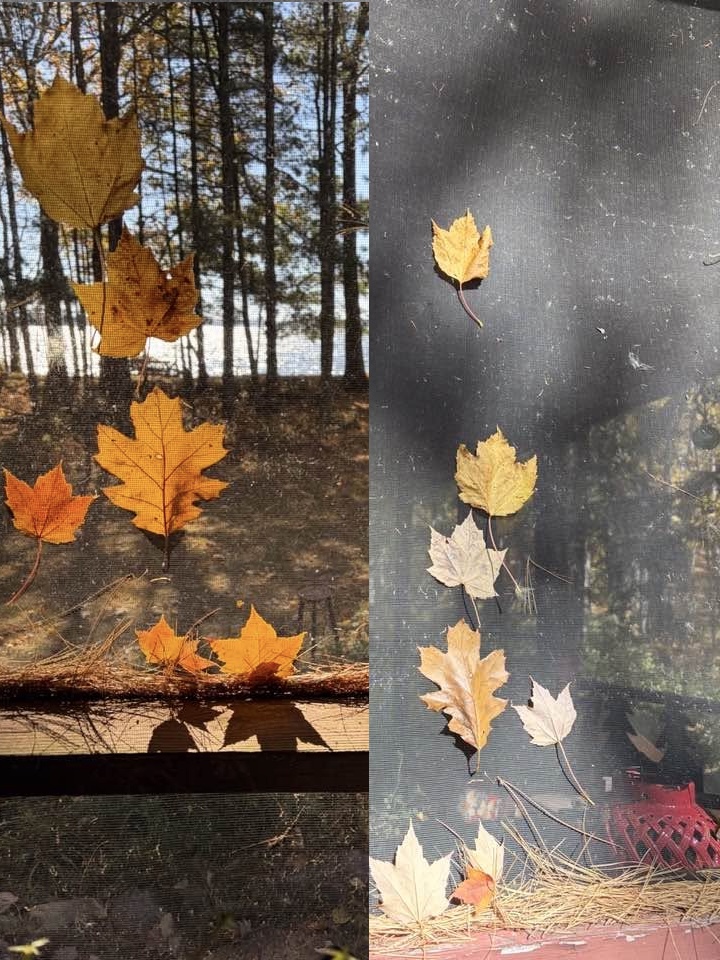
OCTOBER 10, 2026 – In our neck of the woods on the shores of Grindstone Lake, fall colors are at their peak. At a little past eight a.m., the sun already shines at a lofty angle, lighting thousands of red, orange and yellow flames among earthbound arbors. The breeze is up as sunrays warm the cool overnight air. The lake is already a sea of whitecaps as the trees sing and wave in the wind.
I’m bundled well in several layers, which will soon be shed once I plunge into the work and play of the day. Right now, however, I’m pretending to be comfortably situated on the deck of an old steamship; a passenger aboard a vessel plying deep waters through some magical archipelago in a place familiar yet full of surprises. The wonderful thing about this setting is that I can enjoy the voyage without a hint of seasickness: everything is on the perfect level.
A perennial feature of this place at this time of year is the leaf-art that forms on the south-facing end of the porch. Oak and maple leaves from the trees guarding the shore 75 feet away fly in the breeze and pin themselves against the screen, frozen in motion as if playing their own form of “Duck, duck, gray duck.”[1] Among my portfolio of 25,000 photographs, I must have hundreds, at least, of fall leaves pressed flat against the screen, some illuminated by backlight with every vein captured as if by an x-ray, while others appear as sun-catchers, their portraits taken with the sun behind the camera.
I’m no less inclined than the next person to snap a gazillion pictures of fall foliage. The impulse flares from our desire to snatch and preserve the fleeting, the ephemeral, the intangible. And of course, the Smartphone camera is the equivalent of a potent steroid, giving limitless license to that impulse. How many photos have I seen of the blazing crown of a maple tree against the deep blue October sky? (In the northern hemisphere, anyway.) And how many such pictures have I myself taken and buried in my unorganized photo archives, never again to see the light of day just as squirrels at this time of year bury uncountable acorns but with no chance of remembering where until little oak seedlings push their green heads above the earth!
. . .
Now I am at the other end of the day. I’m again seated on the deck of the old steamship but with no need for an extra sweatshirt, down vest and blanket. The breeze that continues unabated is warm and delicious. I’m clad in shorts and a single sweatshirt. Beth occupies the deck chair opposite me, plunging further into her book club book. Earlier today she sat reading (and napping) on the dock, every loose item weighted down to prevent the wind from whisking it away.
Today in my project zone a few yards back from the dock, I worked on Hemlock Cage No. 2. Having learned much from construction of Hemlock Cage No. 1 ten days ago, this time around the desired result was achieved much more swiftly . . . and smoothly. When installing the cage over Hemlock No. 2, I applied a few innovations to mitigate the risk of harm to the very tree I was trying to protect, as well as to myself. When I sent pictures to Byron, he rewarded me with a prompt, “Wow!” and “You’re really going to town there.” But this project isn’t about me “going to town.” It’s about the brave hemlocks—30 of ‘em—that are flourishing, though No. 1 and No. 2 have developed a huge lead over all the others. As with real estate values, the success of any given tree is first and foremost all about three things: “Location, location, and location.” As it turns out, I’d managed to plant these two trees in the perfect location inside the tree garden.
This afternoon as I assembled Cage No. 2, I was surrounded by a generous display of classic fall splendor. The colors were accompanied by the symphony of unceasing wind through the trees. By chance I looked skyward just in time to see a bald eagle soaring 100 feet or so above. I watched with wonder as it adjusted the angle its wings but never flapped them and soon floated gracefully out of sight.
What amazes me about these woods, which I’ve come to know so well, is that I’m always seeing and learning more; things in front of my nose for decades that only now have gained my notice. Today’s revelation was that blueberry plants’ autumn “blush.” Yes—their leaves turn a handsome red, lending added beauty to the woodland floor. And given my efforts to protect pruned young pine from deer rutting, I’ve begun to notice how many trees bear the scars—some quite old—of rutting deer.
But mostly what I’ve noticed in the autumn of my life is that I can’t get enough of this golden season. If my high school English teacher expected bigger words, I find the best for nature’s beauty are simply “always” and “everywhere.” The magnificence of it is this: All one must do to “own” such splendor is to notice it.
Subscribe to this blog and receive notifications of new posts by email.
© 2026 by Eric Nilsson
[1] A bit of trivia with which I was entirely unfamiliar until drafting this post: “Duck, duck, gray duck” (or “Duck, duck, goose,” a game we played frequently as kids, always in our spacious yard filled with oak trees, was peculiar to Minnesota. Its origins, apparently, were Swedish, (“Anka, anka, grå anka” or “Anka, anka, gås”), which figured, given the then predominance of us descendants of Swedish immigrants.
