SEPTEMBER 8, 2026 –
Today our 10- almost 11-year-old granddaughter attended her first day of fifth grade. Beth and I were eager to hear Illiana’s report but also anxious about it. What if she didn’t want to talk about it? Or worse, what if she did talk about it, but it was negative?
Over our morning coffee, Beth reminisced about her fifth grade experience, and I silently recalled the highlights of mine. For each of us, fifth grade was a watershed year, mainly because of our teachers. Beth’s was Miss Marsten. Mine was Mrs. Hilliard. Both have long passed from the earth.
Beth remembers Miss Marsten for teaching the points of the compass. Symbolically, as well as figuratively, this was a critical lesson and one that I added last year to my own daily prescription whenever I dropped Illiana off at school: “Remember, smile, be kind, pay attention and know where you’re going.” That fourth imperative requires at a minimum, a good sense of direction; command of the compass. Miss Marsten apparently saw to it that her students wouldn’t leave fifth grade without knowing “where they were going.” Beth still has an old photo of her fifth grade class, with the stolid Miss Marsten standing on the side. She looked of the sort that took no prisoners.
Beth’s other takeaway from fifth grade was Miss Marsten’s earnest use of the very highest available technology of that day: the chalkboard. When Illiana asked Beth if there was a smart TV in the room, Grandma replied, “No, the highest form of technology we had was a second chalkboard.”
In any case, however, apparently Miss Marsten was an expert at squeezing letters onto the board. Her method was to get down on her knees, the hem of her brown dress falling over her calves and the heavy heels of her dark brown shoes aimed at her students. In that position she’d crowd the daily reading assignment or math problem onto the chalkboard.
I’m sure Beth had other, substantive “takeaways” from Miss Marsten’s fifth grade class, but no doubt they were so numerous and interrelated as to lose their individual identity in long-term memory. In melded form they turned into a concrete foundation, not hangings in an art gallery.
I remember many things about Mrs. Hilliard. She’d been my oldest sister’s fifth grade teacher, and since my oldest sister was almost as smart as our parents, I figured that to qualify as Nina’s teacher, Mrs. Hilliard had to be smarter than Nina. In fact, I was pretty sure that she was smarter than all the other teachers and even smarter than the principal. But Mrs. Hilliard was also kind toward everyone, and I noticed that her shifts from “appropriate serious” to appropriate smiling” were effortless. In age she was somewhere between my mother and my grandmothers and gave her students every reason to call her their favorite teacher at Franklin Elementary. She was a widow of one of the named partners of the upscale clothier in town, and his name had meant enough to be retained on store signage long after he’d passed away. Mrs. Hilliard lived in a well-kempt, colonial-style house on the next street up, just two blocks away. Often in class she mentioned her son and his family in far off Philadelphia, which added to her respectability.
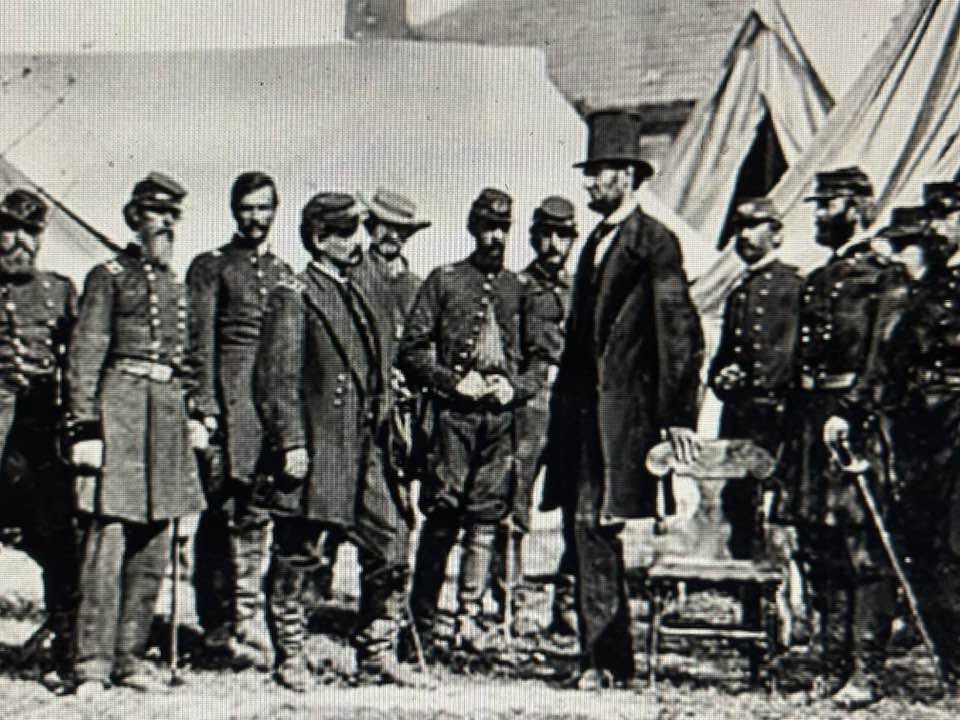
Many highlights of that year stand out in my memory, but one incident in particular, since it involved memory, or more precisely, memorization. One day halfway through the school year, Mrs. Hilliard announced that for extra credit students could memorize a poem or piece of prose of modest length and recite it to the class. I chose the Gettysburg Address, since as an extra-curricular activity, I was at the time, deep into Civil War history. I practiced the speech umpteen times in front of my dad, who was himself, quite a student of that conflict and a big fan of Abraham Lincoln. Eventually he said, “You’re wearing me out. I don’t think you need to practice anymore.”
When “extra credit day” arrived shortly thereafter, I was more than ready. I was flat out excited. The problem was, in all my practice sessions, I’d imagined Dad as Mrs. Hilliard. I’d even close my eyes and picture her standing off to the side, listening intently to my recitation. Her approval of it would mean everything to me. What I hadn’t countenanced was what my fellow students might think of me standing up there reciting the Gettysburg Address—until, that is, Mrs. Hilliard called on me, and I found myself facing my classmates seated in five rows of desks, each row six desks deep.
Suddenly, I wasn’t performing for Mrs. Hilliard’s approval. I was trying not to embarrass myself in front of everyone in the room. Not having enough experience at public speaking to draw a deep breath before plunging into “Four score and seven years ago . . .” I soon found myself hyper-ventilating. To prevent what I feared might be a fainting spell (I’d never fainted in my life, so I didn’t know what fainting felt like exactly), I decided the best tactic would be to feign a memory slip; a brief one, just a second or two but long enough for me to catch my breath and reach, “. . . that government of the people, by the people, for the people, shall not perish from the earth.”[1] But two seconds didn’t seem sufficient. I decided to go for more, whereupon Mrs. Hilliard, thinking I was stumbling over a memory slip, threw me a line: “We are met on a great battlefield . . .” In its own way, this gave me a second more to achieve composure, but I was terribly disappointed in myself for having led Mrs. Hilliard to believe that I hadn’t mastered the Gettysburg Address. Yet in its own way, my disappointment distracted me from my nervousness over facing the class. I got back on the horse, as it were, and galloped to the end.
But the horse I’m currently riding—this post—has digressed. Back to Illiana. Early this afternoon her dad called me to say she’d told him at the top of the day that she wanted him to pick her up. As Cory’s schedule worked out, however, he wouldn’t be able to get away in time to pick her up. I gladly agreed to be the chauffeur.
When she climbed into the car, I explained the change of plans. I then told her that I wouldn’t ask any questions about her day; that she had total control over what she wanted to say about it and when. I then issued a general and innocuous comment about the weather. A second or two later . . .
“Great!” issued forth from the back seat. “Today was great,” she repeated. “And math was easy.”
I couldn’t wait to tell Beth . . . or better yet, to hear Illiana herself tell Beth. “My teacher is really nice,” she continued. “He’s really good at teaching.” I realized that it was a gusher. She continued, describing all the things she liked about the day, about learning at the feet of a Miss Marsten and a Mrs. Hilliard conjoined and reincarnated as “Mr. K”—a former Peace Corps volunteer (Ecuador) and Spanish immersion teacher, whose focus in his long teaching career has been reading, with the smarts and experience to know what works and what doesn’t[2].
By the time we reached our house, Beth had returned from her day’s myriad stops and was seated on the back porch. Before she could pose any questions, Beth received Illiana’s account, with details added to the report she’d given me. We were astounded by how much substantive ground was covered on the very first day of fifth grade.
“Do the fourth graders seem little to you?” Beth asked at one point.
“Well, no,” said Illiana, “but the third graders—they’re so tiny!” A beat or two later she said, “You know, by fifth grade, we’re now at the top of the food chain.”
Beth and I laughed in amusement—as did Illiana. But then Beth forewarned her that once Illiana graduated to middle school, she’d be back at the bottom of the food chain. And again when she started college. This drew more laughter.
“Was there any crisis today?” Beth asked.
“Well,” said Illiana, “Marcel farted and it smelled.”
“Goodness. What happened next?” Beth asked.
“Kids started laughing. I went like this . . .” Illiana said, covering her nose and mouth with both hands.
“What did Mr. K do?”
“He told everyone to return to their seats. He didn’t get mad, but he was serious.”
“Uh huh. He had to,” said Beth, a former special education teacher. “He had to get control before things got out of control.”
“Yeah,” said Illiana.
I then told her a fart story dating back to my undergraduate days. A sizable group of us were taking a closed-book essay exam in a classroom in old Massachusetts Hall. After having launched the exam, the course professor disappeared for the most part, returning only sporadically to check on us. With heads bent over our desks, we were scratching away feverishly in our blue books, when out of nowhere (while the professor was out of the room) there sounded a fart of the high-squeak variety; no whole note on a tuba but something on the order of a high C sixteenth note on a trumpet, and not forte, either; not even mezzo-forte, but mezzo-piano—just loud enough to be audible in an otherwise silent room. A moment or two passed before someone allowed a slight giggle. The giggle triggered another by someone in the next row. Next came a close-mouth laugh another row over, followed by full open-mouth laughter sprinkle across the room. This burst open the floodgates, and soon every single person in the room was laughing uncontrollably.
The story didn’t send Illiana (or Beth) into hysterics, but given her instinctive social grace, Illiana awarded me a chuckle, at least.
For the next two hours, Beth and I delighted in wide-ranging conversation with this observant fifth grader so full of personality. As I observed her earnest and expressive face, I no longer saw a “tiny” third-grader or a fourth grader in the middle of the “food chain.” I saw a full-fledged fifth grader, eager to learn and be her own person. The future will be in good hands.
Subscribe to this blog and received notifications of new posts by email.
© 2026 by Eric Nilsson
[1] During my practice sessions in front of Dad, I learned from him that contrary to popular assumption (and practice) , Lincoln emphasized each annunciation of “people” not the prepositions “of,” “by,” and “for.” His source was the account of a witness present at Gettysburg when Lincoln delivered his famous speech.
[2] Last week after “Back to School Night,” Beth had asked Illiana to describe her teacher. She used one word: “Sunshine.”
