OCTOBER 3, 2026 – Back in the day, my oldest sister Kristina, who was well on her way to reading every book in print, gave me her copy of The Last Strange Voyage of Donald Crowhurst. She raved about it, and knowing of my nautical exploits on Grindstone Lake, she told me I had to read the book. I went straight to work on it and found her enthusiastic recommendation fully warranted. Not only the sailor’s surname but his eccentric character were the stuff of fiction—as was one of the two logs that he maintained as a contestant in the Sunday Times Golden Globe Race—a single-handed, non-stop yacht race round the world in 1968-69. An electronics engineer and businessman (albeit in financial straits), Crowhurst was also a weekend English sailor, whose approach to the sea was a classic case of Dunning-Kruger Effect[1]. Some would say he lacked the requisite experience as an open-ocean sailor to have any business in a solo “round the capes” race (Cape of Good Hope; Cape Leeuwin (western Australia); Cape Horn) over such tumultuous seas as occur across the Great Australian Bight, the southern Pacific Ocean and most dangerous, the Drake Passage south of Tierra del Fuego, where winds reaching 100-miles-an-hour, rogue waves and icebergs are common. He sorely needed the prize money, however, and midway down the Atlantic, he realized that he wasn’t going to win—or maybe he never intended to try to win, at least fair and square. Thus began his great deceit, his faked locations as he sailed up and down a remote part of the ocean. His boat was ultimately found adrift—abandoned by its skipper without a trace, with no sign of harm to the vessel or indication of irregularity. The mystery of Crowhurst’s disappearance was never solved.
Now comes our age of mind-bending advances in nautical, navigational, and meteorological technologies, all in tandem with the explosion of social media. Non-sailors would be astonished not only by how many solo-sailors are constantly crisscrossing the world’s oceans but by how they and their land-based back-up are posting highly polished and edited daily video reports of progress, mishaps and close calls.
Among the crowded field of modern adventurers at sea is one Oliver Widger from Clackamas, Oregon. Hardly an old salt, the 29-year-old had never sailed a boat until two years ago. After he was diagnosed with Klippel-Feil syndrome (abnormal fusion of the vertebrae in his neck), he quit his job at a tire company, liquidated his 401(k), and bought a 30-foot boat. After learning to sail it, he logged passage from Oregon to Hawaii. His route was relatively easy as open ocean sailing goes, plying mostly friendly seas. One big mistake was that of an amateur—a poorly mounted auto-pilot system broke loose. Oliver managed to regain control of his boat after it went into a pointless spiral. In a second big “Uh-oh!” he accidentally locked himself into the engine compartment. With a wrench and adrenaline, he busted his way out, after which I’m sure he said, “Won’t do that again!”
Although he was still learning the ropes . . . er, lines . . . on his passage to Hawaii, by the time he reached his destination, Oliver must’ve experienced some version of the Dunning-Kruger effect: soon after his arrival he announced plans to circumnavigate the globe—alone, non-stop and without assistance[2], an endeavor accomplished by fewer than 200 human beings. He flew back to Oregon and began plotting his Grand Odyssey.
Having drawn an impressive following, Oliver pursued two efforts with great intensity: (1) Acquisition, refitting, and supplying (with, among everything else, over a million calories of food) of a 40-foot vessel that could withstand the rigors of circumnavigation; and (2) Keeping his followers well informed by his appealing, down-to-earth . . . er, “water”? . . . updates on his impressive preparations. In the background, he connected with world-renowned sailors. Apparently, these consultations have been serious, not casual, and in some measure they cut against the Dunning-Kruger—and Donald Crowhurst—effect(s).
Another sign that Oliver has self-immunized against these potentially fatal effects is that he’s leaving his beloved cat, Phoenix, on dry land. If your rudder breaks (a death knell if you can’t fix or replace it) or when, not if, you’re being cast about in wind and waves bigger than your boat, you can’t be distracted by worries about your (fraidy) cat.
But I worry about the guy: there’s no substitute for actual experience—years of it—as crew or skipper, and Oliver simply lacks challenging open ocean sailing through nature’s worst, not to mention a host of possible mechanical, electronic, and navigational breakdowns, and lest we forget, serious physical and mental maladies.
What’s interesting is the mix of reactions to his venture. Many offshore sailors with big-ocean experience are highly critical of Widger and dismissive of his chances of success. Their skepticism is captured best by the axiom, “Sailors with superior experience avoid situations in which survival depends on superior experience of experience.” These naysayers are far outnumbered by the Oliver’s vast cheering section—people inspired by the motivation behind his compulsion: “Because one day the opportunity disappears. One day we get too old, too comfortable, too afraid, too busy, or simply run out of days.”
Other people worry that all the publicity generated by the project will put enormous pressure on Oliver “not to fail,” thereby driving him to take undue risks. Perhaps, but I think his posts to date reveal someone who’s secure enough with himself to trust his own compass in navigating risk assessments and not be thrown off course by what people other than his most trustworthy advisers might think or say.
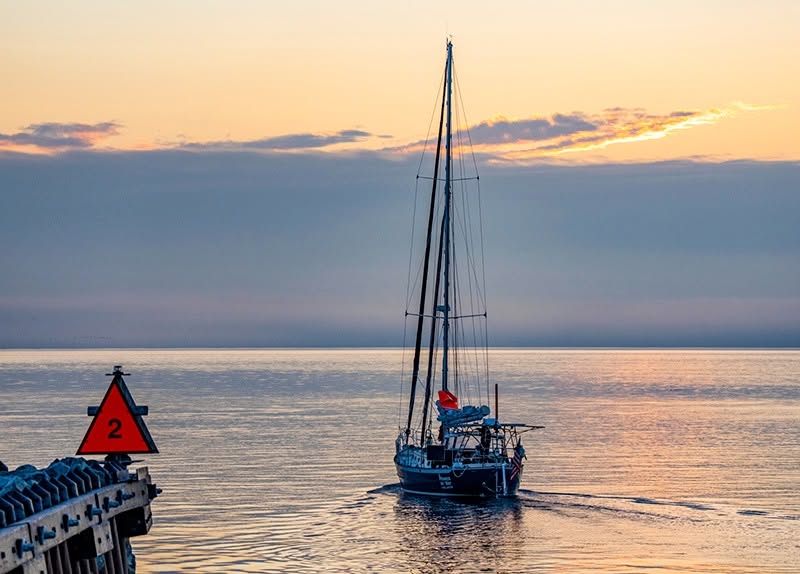
Yesterday at dawn and to fanfare provided by family and friends, Oliver the Sailor Man motored out of Port Townsend, Washington, heading through the Strait of Juan de Fuca for the open Pacific. Somewhat ominously, however, he reported that the sky was red. The implication was obvious to any sailor: “Red in the morning, sailor take warning . . .” Upon facing the ocean out of Neah Bay, Oliver said in a second video, he’ll point his bow for Cape Horn. With fingers crossed, I’ll be joining the rest of his followers on our vicarious voyage around the world, a/k/a “Sailing with Phoenix.” Wish us—but especially him—“Fair winds and following seas.”
Subscribe to this blog and received notifications of new posts by email.
© 2026 by Eric Nilsson
[1] The psychological profile of one who gains just enough experience at something to develop an unrealistic assessment of one’s ability.
[2] According to rules promulgated by the World Sailing Speed Record Council, “solo” means just that—no one is allowed to board the vessel except the (solo) skipper; “unassisted” means no physical assistance from other boats, taking on supplies, or engine propulsion. (NOTE: Though he motored out of Port Townsend, Washington and through the Strait of Juan de Fuca to Neah Bay, the actual starting point of his voyage. Neah Bay sits on the extreme northwest point of the continental United States); “non-stop” means no port entry, though anchoring is permitted for repairs, but only with on-board tools and materials; “circumnavigation” means sailing the great circle route of at least 21,600 nautical miles, crossing the equator (twice), and rounding the capes—Cape Horn, Cape of Good Hope, and Cape Leeuwin.
