NOVEMBER 22, 2026 – Because it was January in Minnesota, the usual hospitality of my good friend Linda Lovas Hoeschler seemed unusually warm and welcoming. Perhaps it was the hot delectable soup she served, though lunch and the interesting conversation that accompanied it were not the purpose of my visit. She had extended an invitation to browse through the extensive library of her late husband, my equally good friend, Jack Hoeschler, a man of many interests that overlapped with my own.
Among these was history, and over the decades, Jack had assembled an impressive inventory of books covering the stories of humanity far and wide. My own collection of histories was far more modest, and though it was organized by country and region—England, Poland, Russia, Sweden, Europe, Ancient Mediterranean (no African, no Asian, no Latin America, no “other”), and . . . drum roll, drum roll . . . these United States of Amerigo Vespucci, none of these subsets was labelled. Jack’s history books, on the other hand, were far more numerous, squeezed onto wall-wide shelves in his floor-to-ceiling library equipped with a comely wooden movable ladder. Moreover, the books weren’t merely organized by country, region and era: the shelves were neatly labeled.
“Take all you want,” said Linda. She had her own wide collection to contend with in anticipation of moving to new quarters with her new husband—one of Jack’s best friends from their rowing days at Georgetown, Peter Blyberg, who’d lost his long-time spouse (and a good friend of Linda’s) a while before Jack had died.
I faced several physical limits to “take all you want.” FIRST was the available space in my Sonata—trunk and car interior—assuming a single trip. SECOND was the fact that my wife is an online seller of used books, and accordingly, already has thousands of books on hand inside our abode, including “add-on” space commandeered from our garage, a basement converted into a warehouse, and “spillage” into a sitting room adjoining the former-den-now-book-office. That doesn’t take into account the temporary stacks of books surrounding Beth’s easy chair in the living room as she enters titles and prices on Amazon while she catches up on a Netflix series.[1] THIRD, the boxes I’d brought and the bags Linda had on hand could accommodate only so many books.
After I’d packed what I could into the car, I re-entered the house to fetch the last cache of books and to say good-bye. On hand by this time were Jay Hoeschler, Jack’s younger brother, and his wife Judy. They’d dropped by and in characteristic fashion, enlivened the space with their good humor and cheerful presence. When Jay was informed of my mission, he joined me in the library, where I showed him a sample of my selections.
He then pulled from a shelf a paperback three inches thick and handed it to me. “Here’s a fantastic book,” he said. “You’ve got to read it. Really, it’s an amazing book. Take it and read it. You’ll be glad you did.”
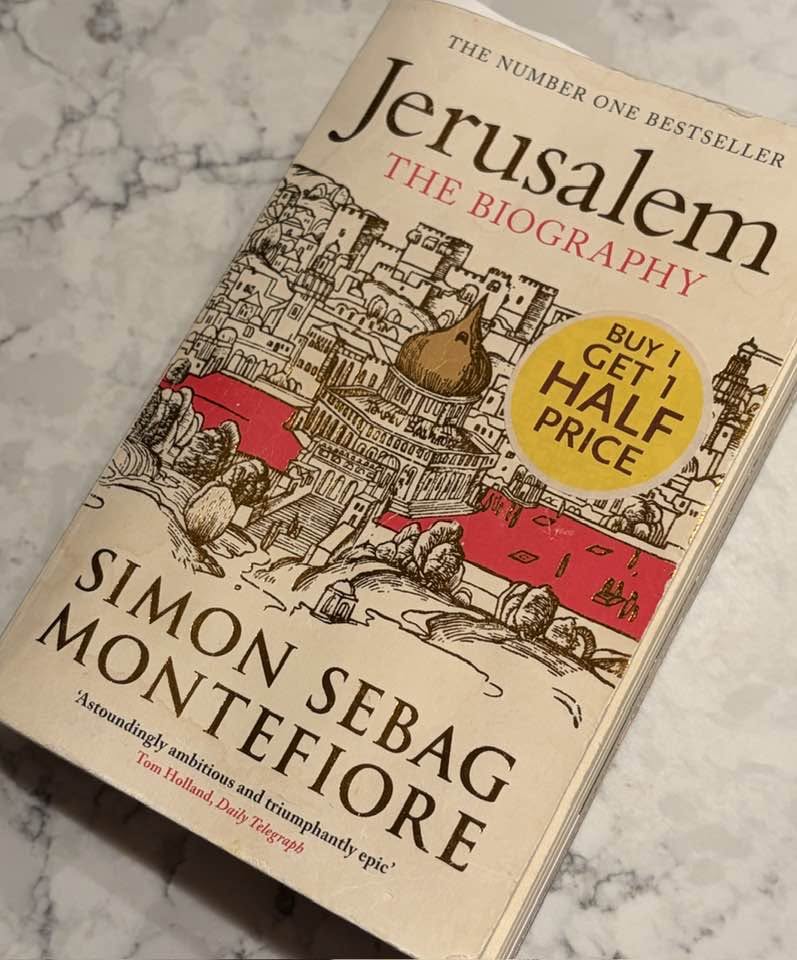
Upon this recommendation, I took the book and place it on top of a fully loaded bag. The title was Jerusalem – The Biography by the British historian Simon Sebag Montefiore. I carried the bag extra carefully to prevent the addition from sliding off into the snow. The subject matter was troubled enough without my creating hardship for its book form.
Jay’s enthusiasm for life is infectious; a family trait shared by his late brother Jack. Not only had his spontaneous book review stirred me to add the 628-page[2] Jerusalem to such tomes as The Crimean War: The Last Crusade by Orlando Figes, The Man Who Loved China by Simon Winchester and Mao: The Unknown Story by Jung Chang and Jon Halliday (all of which turned out to be interesting “reads”), but I was further motivated to start reading Jay’s recommended history ahead of the others.
His leading endorsement was warranted. From the very start of the introduction, I was hooked.
But soon thereafter, the book disappeared. More accurately, I misplaced it. Between trips to the Red Cabin, New York and Connecticut, somehow I’d manage to lose all sight of Jerusalem. “It’s got to turn up,” I consoled myself, after extensive, repetitive searches failed. I’d already turned to other books from Jack’s collection, and wound up traveling far and wide, though coincidentally, The Crimean War started, in all places, in . . . Jerusalem.
Almost two years have passed since that day in Jack Hoeschler’s library when Jay Hoeschler had handed me Montefiore’s magnum opus. Yesterday, as I was searching under the writing desk in the scriptorium inside the Red Cabin, I discovered a small cloth tote bag containing several books—a travel journal, two sketchbooks and . . . Jerusalem. My instant joy was coupled with supreme gratitude. The lost had been found. I removed the book and placed it in the basket of sundry items for the return trip home later in the day.
On the drive, I relished the thought of plunging back into Jerusalem. I also thought about Jay and Judy Hoeschler and felt bad that I hadn’t made an effort to follow up with them, especially given that they have a lake place not far from Grindstone Lake. They are the kind of people who give me faith in humanity; people who bring sunshine to life in a world too often shaded by humankind’s not so kind dysfunctionality.
Yesterday evening we joined our good friends Ann and Ravi for Italian cuisine at Caffe Biaggio in St Paul. After a delectable meal and scintillating conversation, we asked for the bill. While waiting for our server to return with the slip, we re-assembled ourselves for the short drive back to our house for a few rounds of Rummikub. I also checked my texts in response to the earlier hunting horn haptic that had announced a text’s arrival a while before. “Hi Eric,” it read. “Jay Hoeschler here . . .” It went on to say that he and Judy wanted to get together for “good conversation and some food.”
A coincidence, to be sure, but coincidences are what spin the world—at least the one in which I love to live and interact with fellow travelers.
Subscribe to this blog and receive notifications of new posts by email.
© 2026 by Eric Nilsson
[1] On advantage to Beth’s sprawling inventory is that it’s made her a stickler for keeping the rest of our “public space” ship shape.
[2] Plus 10 pages of maps, 7 pages of dynastic charts, and a 30-page bibliography. Unfortunately, the end notes appear only in the hardcover edition of the book.
