JUNE 20, 2026 – With two small royal children taken on a road trip goes a regular camel caravan of supporting supplies and equipment—the Pack N Play; toys; strollers; stroller fans in case the weather is too hot; stroller blankets in case the weather is too cold; ample food supplies; cloth bags stuffed with diapers, powders, and ointments; suitcases filled with clothing outfits; more suitcases loaded with clothing outfits and accessories for the older Cousin-Princess of the small royal children, the King and Queen, and the King and Queen Emeriti. In contemporary terms, the royal cavalcade travels by two motor vehicles that double as U-Hauls.
As King Emeritus, I rode with the King and the Cousin-Princess at the head of the caravan from Chester to Boston—a town that figures prominently in life of the royal family. For four years the King himself attended college in Boston. The Queen Dowager of a close branch of the family pursued her masters degree at New England Conservatory, where she studied with Max Hobart, concertmaster of the Boston Pops and assistant concertmaster of the BSO (when Joseph Silverstein was concertmaster) and played with the NEC Orchestra under the baton of Gunther Schuller—before switching tracks and adding a law degree to her formal education credentials before adding another by winning admission into a special LLM program at Harvard—joined by other royal legal scholars—to develop a new approach to law school instruction. Before getting too deep into that, however, she had the good sense to stick with music—embarking on a 40-year career in Boston, which route included the Boston Pops and Pro Arte Chamber Orchestra.[1] She lived all over town—on Beacon Street near the Public Garden; then in Jamaica Plain a short walk from the sprawling park around Jamaica Pond; near Cleveland Circle and the Chestnut Hill Reservoir; on Gibbs Street in Brookline; and finally, on Ridgeway Terrace in Newton Highlands.
During my freshman year of college up on Maine, I made weekly treks to Beantown for violin lessons with my oldest sister’s teacher at NEC; on school breaks, my sister’s digs became my home away from home. I spent many hours walking the town; often hiking all the way from her house in Jamaica Plain to Copley Square and back. Many more hours were spent inside the Boston Public Library, where I researched and wrote papers for college classes.
Two years after college, I ran (and finished) my first of five Boston Marathons, each time experiencing the heartbreak of Heartbreak Hill. But still, it was my favorite marathon, largely because of the people who lined the course—the best sports fans in the world.
But upon entering the outskirts to Boston yesterday, King Byron and I were a million miles away from the Boston Marathon. We both noticed the same three reminders of the late Royal Dean of the family: a billboard advertising Bentley University, a business school in Waltham; a small public transit vehicle dubbed, “The Ride,” for transport of the physically challenged; and in the distance, the John Hancock Building in the Back Bay section of the city. The King expressly linked the three: “All reminders of Dean,” he said.
As a young man, “The Dean” had moved from his home in New York to Boston to study clarinet at New England Conservatory. He was the boyfriend of one of Kristina’s housemates in Jamaica Plain, another violinist at NEC. It was there at the house where I first met Dean and his best friend, Bill Wiley, a percussionist at NEC. The two were a royal comedic duo, playing off each other’s one-liners—when Dean wasn’t entertaining everyone in the household with his impressive repertoire of unrivaled prestidigitator skills. Just as I commuted from Maine to Boston, Dean, Bill and my sister commuted from Boston to Maine to perform with the Portland Symphony.
Dean and my sister married the year after I graduated from college. They had two daughters who are at the chronological head of the next generation of the now far-flung royal clan. With the advent of family life, Dean switched careers in reverse alphabetical sequence: C(larinet), B(entley University), and A(ccounting). In later years, when King Byron matriculated at Babson College, a 10-minute drive from Dean and Nina’s home in Newton Highlands, Dean would make fun of Bentley, which he considered a much inferior school to Babson. But Bentley had given Dean a new lease on his vocational life—and a stellar career in tax accounting. He sat for and aced his CPA exam and joined a small firm. After a series of acquisitions, Dean wound up as a partner in E&Y—with an office affording a bird’s eye view of Boston from the heights of the John Hancock Tower.
As Dean’s reputation as an accountant rose, however, his ability to stand up unassisted became compromised. The culprit was MS—in a form that progressed relentlessly. Dean never caught a break from it, and eventually he was unable to get himself to work and back. That’s where “the Ride” came into play. But as symptoms worsened, Dean was forced to take early retirement.
Any other person unlucky enough to become completely disabled by MS, yet lucky enough to have a normal psychological profile would’ve fallen into a state of despair and depression. Not Dean. Not once did anyone hear him complain or express anger or frustration over his predicament. Once a natural stand-up comedian, Dean adapted to MS and made us laugh just as hard when he became a sit-down comedian.
Then there was his book project: reading the top 100 books of all time, including all the plays of Shakespeare, which he tackled under the scholarly guidance of a Shakespeare expert recruited by my sister.
During his college years, King Byron was a frequent visitor at 11 Ridgeway Terrace. He’d grill steaks for Dean, talk business over drinks and dinner, and best of all, became a Scrabble marvel, learning to play up to the championship level of his aunt and uncle and participating in their annual Scrabble tournaments. Nothing could’ve given Dean and Nina greater pleasure than Byron’s presence, good cheer, and expertise at the Scrabble board.
Dean has been gone now for all too long, and Nina no longer lives in Boston. On this trip to Boston, the objective was to introduce the next generation to the cradle of the American Revolution—to a travel adventure that would stimulate curiosity and provide exposure to something different. In anticipation of our annual trip to Connecticut and New York City, Illiana had asked if we could see “another big city.” What better place than Boston?
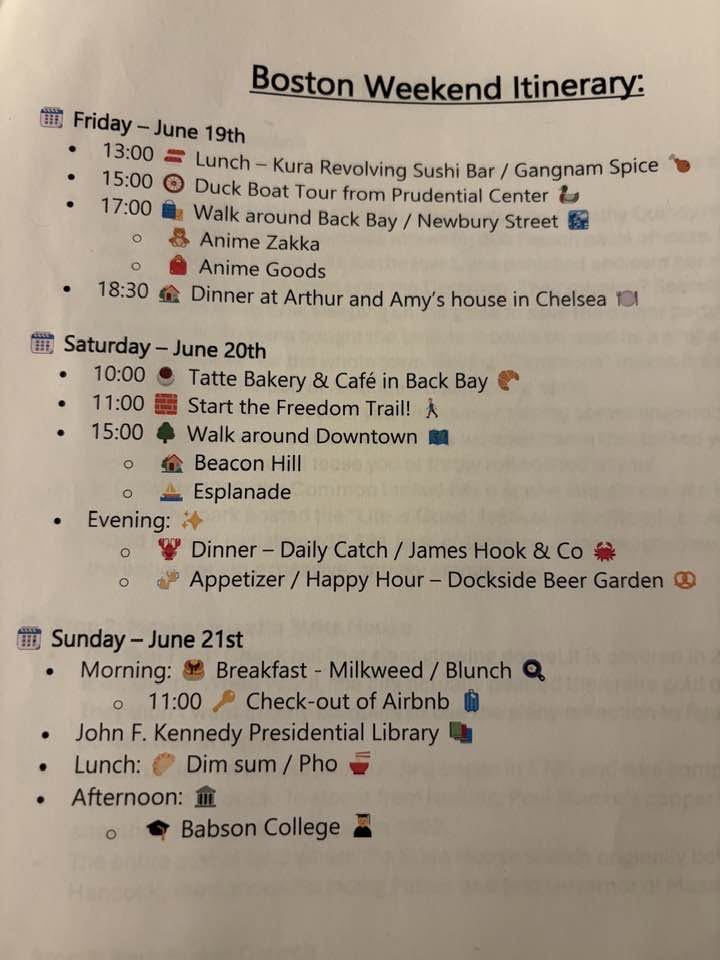
So in his typical organized yet fun-loving fashion, Byron assembled a three-day itinerary; reserved two nights in the lap of luxury at an AirBNB and led us on a magnificent trip to Beantown, which, for Byron and me, at least, will always be remembered as “Deantown.” Every aspect of our weekend travels has been reminiscent of the wonderful joint Euro-trips that Byron and Mylène skippered for us throughout France, Iberia, and northern Italy. (Cont.)
Subscribe to this blog and received notifications of new posts by email.
© 2026 by Eric Nilsson
[1] In 1988—or was it 1989?—the Queen Dowager’s two sisters and brother performed Vivaldi’s Concerto for Four Violins with Pro Arte for a packed-house audience at Harvard’s Sanders Theater. The crowd was so impressed by the QD and her sisters that on the same program, the three sisters played a Bach concerto for three violins.
