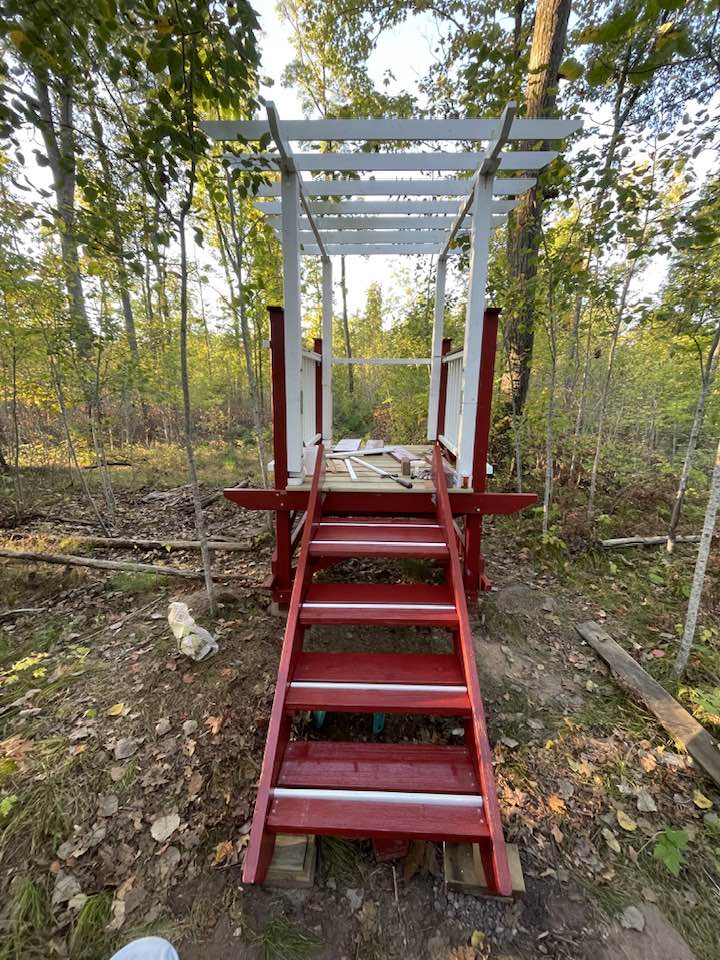
SEPTEMBER 28, 2025 – (Cont.) At the outset of my Pergola-on-a-Platform project, I’d scoped out a site inside the 20-acre (give or take) tree garden behind the lake frontage. I sought the intersection of three geographic features.
The first was one of the trails that crisscross the garden. I imagined that the pergola platform would straddle one of them, so that hikers wouldn’t have to step off the path to experience the pergola; straight along the trail they’d walk up the steps to the viewing platform under the (raised) pergola, then continue down the steps on the other side and continue along the same trail.
The second feature I sought was the high point of the garden, which turns out to be the highest point around the entire near-perimeter of the lake. In high summer, the lake isn’t visible from ground level at this point, but when the foliage begins to fall and you have the advantage of stilts, you can see the sparkling waters of Grindstone Lake.
Finally, I needed an area that was level, free of large trees, and large enough to accommodate a structure fifteen feet long and five feet wide.
Serendipitously, I found the place where these three parameters lined up perfectly, and with a minimum of disturbance, I sited the Pergola-on-a-Platform.
The only catch was a white pine tree where the front steps were to land—right under the anticipated placement of the second step, to be exact. This tree was remarkable not for its size (it was only two feet high) or species (the white pine in the garden are prolix) or purebred appearance (it was just the opposite—Dr. Seussian in its eccentricities); no, what it lacked in physical beauty it more than compensated in character. Its foliage was robust, and after having struggled for a couple of years, it added decent growth this season. It seemed to say, “Look at me! I’m here for the long haul. I’m not giving up or giving in. Let it rain, sleet, and snow; let the cold winds blow, but one day I’ll tower over the surrounding trees. Fisherfolk way out on the lake will use me as a reference point for locating the best place in the world to catch record muskies. Just mark my words.”
I’m paraphrasing, of course, but I’ve captured the essence of what that tree called out to me every time I lugged another load of materials to the building site. In short, this little tree exuded character, and I knew eventually I’d need to address the tree’s fate against the backdrop of that tree’s plucky personality.
Before this weekend, every visitor to the building site has inquired about the tree and made suggestions about it. “You’ll have to cut that tree down,” people would say when I gestured where the stairs would go. But then they’d quickly add, “Or you could transplant it.” Or, half joking, people would say, “You’ll have to re-route your stairs, maybe.”
The easiest response was to defer a decision. At my slow rate of progress, I could kick the log a very long way down the hill.
Yesterday, however, I made major strides with assembly of what I call, the “Grand Staircase” to the deck of the pergola platform. By late morning, I was already anticipating completion of the steps by early afternoon, affording me time to start work on the railings—and the embellishments that I have in mind for them. Except . . . there was the tree—standing so bright and cheerful smack dab where the second step would go. The log that I’d been kicking downhill since June had now rolled to a decision point.
All sorts of parallels coursed through my thoughts. First was Évora, Portugal, a place my wife and I visited several years ago. We stayed at a recently renovated Air BnB in the old town center. We learned from the owner that the bones of the tidy abode were ancient, and that to obtain the necessary permits and approvals had been a costly undertaking. In fact, just about every location in the old part of Évora sits on several layers of archeological history. The city is a UNESCO World Heritage Site thanks to a Roman temple and many other architectural gems from various ancient epochs, which date back 5,000 years!
Anyway, with stringers in place and all the tread supports screwed in, I looked at the Dr. Seuss tree and thought of Évora. I was the guy trying to improve things; trying to build a Pergola-on-a-Platform, but right smack dab in the middle of things, the authorities slapped an injunction on any further work until the inevitable archeological artifacts on my site had been properly addressed . . .
Before I knew it, however, I imagined being in Beijing—and based on a documentary I saw years ago, witnessing China’s broad-brush sweep of a whole district of old, traditional housing to make way for the site of the 2008 Olympics. An elderly woman was out-loud cranky over the prospect of losing her home, which had been in her family for several generations, through one era of hell followed by another of high water. She was a determined hold-out until she wasn’t—finally swept away by government fiat. Her defiance was a minor speed bump, but it was a speed bump, nonetheless. I began to think of the white pine as a speed bump. To remove it, I’d have to march back down to the cabin and retrieve a pair of pruning shears.
With the moment of reckoning now upon me—and the tree—I settled on a third image: displacement of Indigenous Americans from their lands from time immemorial to the desolate reservations carved out of arid, inhospitable regions of the West in the late 19th century. It occurred to no one in white society back then to call it quits on our Manifest Destiny. No. No way would we call it all a big mistake, apologize to the survivors and give cattle country back to the original inhabitants so they could hunt whatever buffalo remained. No, America was no more likely to do that than I was to abandon my pergola project and with the wave of a stick, return the tree garden to early 2016 before the loggers began their once in a century harvest of . . . trees.
But unlike Custer and kind, I experienced a bout of guilt-ridden discomfort at the thought of killing that little white pine. If it had been a poplar—no problem, since a poplar or aspen “tree” is simply one of a million sprouts of a single “plant.” In that case, I’d be giving the much larger organism a haircut—as in cutting a single hair. But this was different. This was a white pine, a free-standing tree, just like a person, a child, no less. And if the Seventh Cavalry was okay with shooting women and children in cold blood in the name of “white progress,” no less, I would have none of it.
The “kinder, gentler” government policy was to herd the “savages” onto reservations and transplant the children off to Indian Agency boarding schools that would wipe the slate clean of Indian culture, customs, life and language. “At least,” I rationalized, “by transplanting the little white pine, I wouldn’t be cutting (and killing) it with pruning shears.
But where to transplant it? In my (white guy) impatience, I now saw the white pine as a nuisance, an impediment to my pergola progress, just as the last of the Plains tribes blocked a complete takeover of resources by the invading whites. I searched the immediate vicinity—the most convenient—but soon discovered that this was an area where I’d planted lots of white spruce seedlings last spring. Because of drought conditions back then, I’d lugged many gallons of water up the trail to enhance the prospects of the white spruce. Nearly all had made it, and like members of a chorus in protest, they seemed to cry out, “No! Don’t’ transplant the pine to our home! We don’t want the competition!”
I was forced to expand my search to grounds farther away—just as the Cherokees in the Southeast were driven along the Trail of Tears a thousand miles and a world away from home.
By the time I’d settled on a suitable relocation spot for the white pine, my impatience had run its course. As I sauntered back down to the cabin for a large pail, a small shovel and plenty of water, I was laughing at myself. “Wow,” I said nearly aloud. “Here you are, Mr. Trees, in fact, Mr. White Pine Trees, to use your full name, and you’re all upset with the little delay involved in resettlement of that precious little white pine tree with the huge character, that’s been talking to you all summer; reaching out to you; appealing to your sense of arboreal justice. And now you’ve become all huff-n-puff? Really? For crying out loud, it’s a tree garden. That’s what you call it. A tree garden. And over the past eight years you’ve devoted hundreds of hours to the cultivation, nourishment, TLC of . . . trees, especially the white pine. In fact, sir, it might help to remind you that for several years running, you bud-capped that very tree to protect it from browsing deer!
“So, anyway, take a deep breath. Enjoy the glorious weather, this paradisical setting, this wondrous place that has accepted you as a friend of the arbors. Wallow in the Zen of your pergola project, but breathe deep the pine-scented air and express to that little white pine your gratitude for having led you to . . . nirvana.”
Subscribe to this blog and receive notifications of new posts by email.
© 2025 by Eric Nilsson
