SEPTEMBER 27, 2025 – Fifty years from now, historians studying our era will try to tease out the underlying ingredients and catalysts and analyze their interactions. I say 50 years, because as the great German historian, Leopold von Ranke (1795 – 1886) purportedly advocated, no history worth reading can be written without the perspective of at least half a century. Meanwhile, we who must live in the present need to grapple with extraordinary disruptions and bear the psychological strain that accompanies a relentless string of outrages. Mentally exhausted, we become accustomed to each shocking action, edict and pronouncement upstaging the one that proceeded it, until we slip into despair and depression.
To avoid the psychological abyss, I seek—and invariably achieve—refuge in . . . Zen and nature.
As my readers well know, Zen for me resides in my Pergola-on-a-Platform project up at the lake. Nature, of course, surrounds us, but in my little world, nirvana exists in the combination of that project and nature—as it prevails in the tree garden and lacustrine environs of Björnholm. Today’s perfectly delicious weather took nirvana to a whole new level.
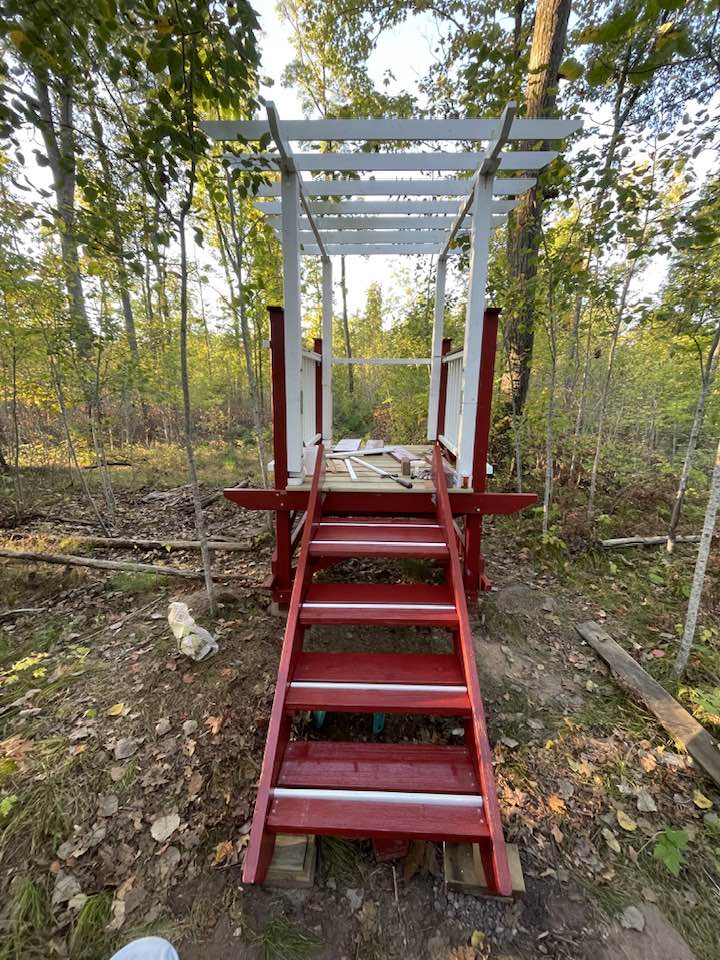
Today’s job was to attach tread supports to the front set of stringers and assemble the treads to what I’ve been calling lightheartedly, the “grand staircase” to the pergola platform. It’s a four-step (between ground and deck of the pergola platform) wooden structure made mostly out of repurposed cedar. I’ve spent the past month designing, cutting, and painting the wood, which, after a rigorous cleaning with a scrub brush and hose, came to life as if it had arrived fresh from the lumber mill.
The whole staircase sub-project (a second “grand staircase” is planned for the opposite side of the pergola platform) has been challenging in both design and construction. The basic engineering is an adaptation of staircases my dad built for access to the dock at Björnholm. His work has held up exceedingly well for over 60 years, thanks to his use of treated lumber and extra wide planks for treads and stringers. His goal was strictly utilitarian, however, and he applied no embellishment. As I studied his work, I developed considerable respect for Dad’s undertaking. I don’t remember thinking much of it at the time (I would’ve been only 10 or 11); it was simply another of Dad’s many home and cabin projects, but he must’ve invested much thought and time in designing and building the steps that would stand the test of many decades of exposure to harsh elements.
I’m sure Dad never consciously identified his cabin projects with any version of Zen, but I know that he experienced that meditative state of consciousness every time he worked on a serious project. Today I felt his presence at every turn and imagined consulting him about all sorts of things—the best approach to one phase or another of the project; how to overcome an unforeseen obstacle or the most sensible way to correct a mistake. For all his craftsmanship and perfectionism, which I observed with great curiosity when I was a kid, he never took over while assisting me on my own cabin projects many years later. He’d offer helpful suggestions and encouragement, but he never took tools out of my hands and said, “Here, let me do it.” He was very gracious and stuck to the role of experienced assistant. As a result, we worked together very well, and today it was easy and enjoyable for me to imagine him helping.
A central part of achieving “Zen” mode in a project is setting time aside—after having set aside lots of time. Today I had vague hope of accomplishing far more than I did, but by taking my grand old time with each stage of the effort, I found the gateway to Zen. The time-consuming tasks were due in large part to my design features: my plans call for treads consisting of two red 2 xs of different widths, separated by a white 1 x 2. Ahead of laying down the treads, however, I had to attach the supports to each of the stringers. This whole operation was tedious—I had to keep everything square and level from side-to-side and front-to-back. Moreover, the thin white piece contrasts with the deep red of the other two members of each step. The slightest deviation from square and level in any of multiple directions would be readily noticed. By the time the sun began to recline on my efforts, I’d made considerable progress, but only the stringers, the tread supports and one step are in place permanently.
Builders, I know, are often frustrated with what they consider the “whims” and “unrealistic” demands of the architect. Today I gained considerable appreciation for the builder’s perspective. “Who in the world came up with this for a design?” I’d imagine joking to Dad. “Oh yeah,” I’d answer: “I did.” Then I’d laugh and so would Dad. (Cont.)
Subscribe to this blog and receive notifications of new posts by email.
© 2025 by Eric Nilsson
