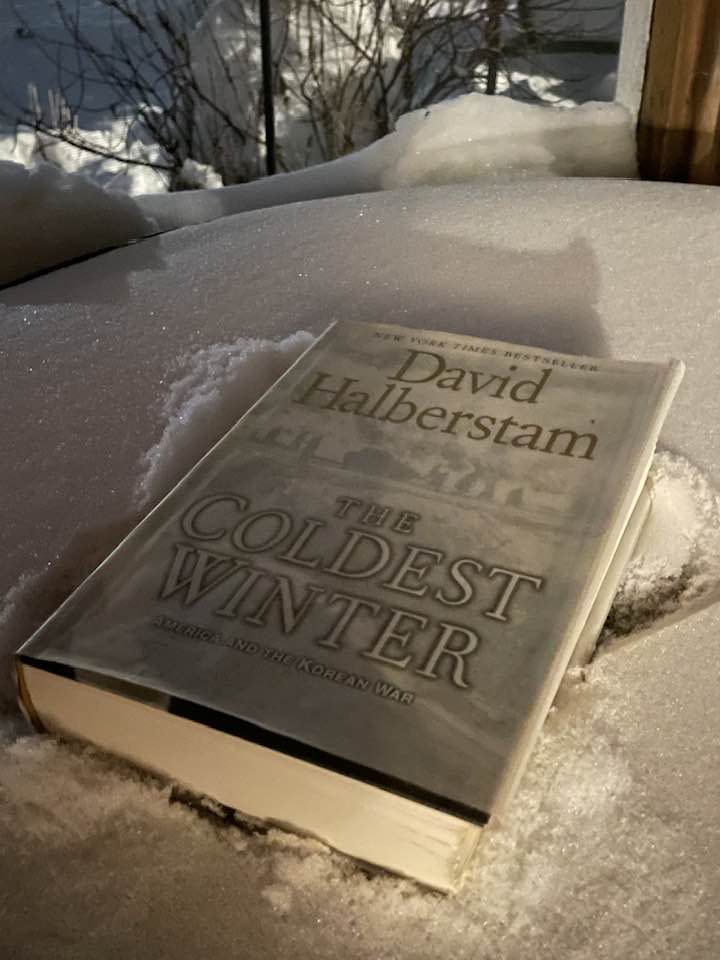
DECEMBER 14, 2025 – When the most recent wintry fusion of deep freeze, cold wave, cold snap, polar vortex, and Alberta Clipper descended upon this region of the world, I thought I’d supplement my other reading by strapping on a pair of snowshoes and venturing into David Halberstam’s highly acclaimed, New York Times bestseller, The Coldest Winter: America and the Korean War—what Halberstam himself, author of no fewer than fifteen bestsellers, called his best work.
I’ve read quite a lot about the Korean War—enough, at least, for exposure to the historical backdrop to the conflict and the combination of megalomania (Kim Il Sung), cynicism (Soviet and Chinese) and misperceptions (American) that precipitated the war. With two Korean-born sons and now their children, along with a Korean-born niece, I’ve long been interested in Korean history, though with the exception of bibimbap, chap chae, and bulgogi, I have yet to acquire much of a palate for Korean cuisine.
But my interest in Korea pre-dates the arrival of the oldest Korean-born family, who was folded into the clan in early 1982. Before my niece arrived, my focus was on Poland, throughout which I’d traveled the year before in the midst of the Solidarność (“Solidarity”) Revolution, and to which I’d return under martial law in June, 1982. During those intense, “under the surface” trips, I gained a crash course in Polish history, which in a nutshell, is the story of a resilient people crushed between two and sometimes three and four superpowers—Prussia/Germany; Russia/Soviet Union; Sweden[1]; and the Austro-Hungarian Empire. When I broadened my geographic curiosity to the Far East—mostly by way of a two-way trip on the Trans-Siberian Railroad in 1981—and learned a bit about Korea’s history, I saw parallels between Poland and Korea, the latter also being a prisoner of geography, sandwiched principally between China and Japan, but also bordered by Russia/Soviet Union and profoundly influenced by the United States, first via late 19th century missionaries and trade envoys and later in the immediate aftermath of World War II, when America emerged as a world superpower.
In 2000, our immediate family traveled together to ROK (Republic of Korea – “South Korea”). Our itinerary included the DMZ 60 miles north of Seoul, birthplace of our two sons. At several lookout posts, we peered directly into the DPRK (Democratic Peoples Republic of Korea – “North Korea”), and through a “spyglass,” we were afforded a good view of the Soviet style monolithic architecture of Kaesong just five miles north of the DMZ. The artificial barrier between the two Koreas reminded me of the Berlin Wall, a monument to man’s inhumanity toward man.[2] [3]
Two lessons surface in my compulsive study of history. First is that with depth comes greater breadth. The second lesson is that the first involves a dual paradox.
“Depth,” it turns out, has no floor. “Gnosis”—Greek for “knowledge”—has a beginning but no end; the deeper the plunge the deeper it takes you, a condition which prompts the inevitable question, “How much “gnosis” is ‘enough’?” but more fundamentally, “What’s the context? What’s the purpose? To satisfy one’s casual curiosity? To improve one’s understanding of the world? To guide one’s electoral choices? To support an academician’s study—and publishing agenda? To frame a State Department specialist’s (are any left?) formulation of policy? But what policy, exactly? Advancement of the common good? Improvement of national security? National economic interests? Regional defensive and diplomatic strategies? And so on.
The other half of the paradox is that “depth” pushes “breadth” in full circle round the globe. The deeper your dive into say, Korean history, the broader your horizons must expand—toward Japan to the east, China and Russia to the north and west, and the U.S., a ubiquitous power since World War II but now retrenching. To divine the direction of Korea, you soon realize, you must grapple in circular fashion with the interactive futures of Japan, China, Russia, and the U.S. In short order it all becomes a very tall order. By the end of the weekend, you put Halberstam’s book aside, just as you’d have to do with War and Peace and face the immediate demands of life as you’re living it.
I can’t tell you precisely why I keep jumping back into the fathomless ocean of historiography. On one level perhaps, it’s no different from my friends consuming only (good) fiction. Both pursuits—fiction and non-fiction, or in my case, history—further the reader’s insight into the human condition. As my history professor, the inimitable Professor Stavrou, emphasized, “Read great literature. [Great] novelists are the best psychologists.” Implicit in his maxim was the notion that the study of history and literature, is really the study of psychology. Margaret Mead would’ve taken it step further and lobbied for the study of cultural anthropology.
The bottom line here, I think, is that the more history, literature, psychology, and anthropology we digest, the better we can understand and cope with the chronic tension that governs current times. What the aforesaid disciplines grant us is the perspective to see “chronic tension” as just that—chronic. It’s an inescapable aspect of the human condition, and as much as we must seek cures and palliatives for our troubles, so must we develop understanding and exercise patience.
We can always do better.
Subscribe to this blog and receive notifications of new posts by email.
© 2025 by Eric Nilsson
[1]Yes, for one stretch of time, Sweden was an imperial power, pushing the megalomanic dreams of its kings well beyond its strictly Nordic origins.
[2]I’m no anthropologist, but I note how much of the history of humankind is the history of wreckage wrought by men, not women. Surely the pattern is undeniable.
[3] For me, the salient feature of that “monument” wasn’t the barbed wire, the guard towers, or even the East German soldiers ready to shoot people trying to escape from East to West (the deterrent effect was nearly total). It was the arbitrary placement of the physical wall straight across a once busy brick thoroughfare—over curbs, streetcar rails and all.
