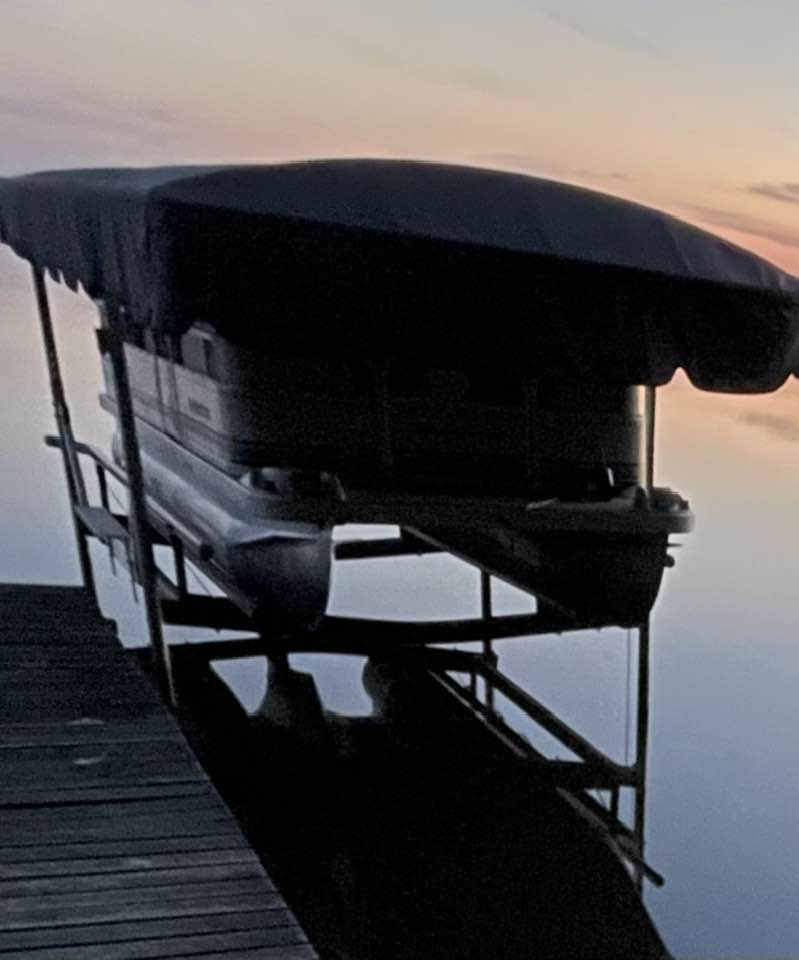
OCTOBER 3, 2025 – This season the water level of Grindstone Lake has taken a hit. Although rainfall has been slack, and additional problem has been DNR control of a small dam way downstream from our spring-fed lake, which forms the headwaters. The condition triggered a major local political re-action, which prompted the town board to reverse its earlier support of the DNR decision to open the damn dam. This favorable development, however, will take time and additional process to ripple through the system. Absent abnormally high rain- and snowfall over the months ahead, water level controlled by the dam won’t be restored until next season.
Meanwhile, many boat owners around the lake are experiencing difficulty launching their boats off their boat lifts. I’m among these frustrated lakeside captains. Next Wednesday our boat is scheduled to be taken away for winter storage, but I must ferry it across the lake myself, and to do that requires getting the boat off the lift. As of this time yesterday, I was unable to accomplish this task.
Because of unusually shallow waters, I hadn’t run the boat in over a month—the last time I was able to remove Northern Comfort from its perch on the solar-powered lift. With no rain in sight, how would I manage this critical operation next Wednesday?
One idea I had was to twist an extra dock pipe with an auger tip as deep as possible into the lake bed about 15 feet out from the stern of the pontoon. I’d then attach a winch to the pipe and the winch cable to the tow bars on the very ends of the pontoons. Next I’d crank the winch to drag the boat off the lift bunks. But I worried—as I cranked the winch would the weight of the boat pull the pipe right out of the lake bed? Or worse, would the cable snap, turning the large cast iron hook on the end of the line into a lethal projectile? Over the years I’d used the winch on many dock and lift removal operations, but what was the comparative weight of the pontoon?
All I could think of in regard to cable (and hook) strength was the story told about Jay Scoggin, brother of good friend and piano collaborator of yore, Sally. Jay was hard at work razing a big old shed at their families’ shared cabin on Long Lake, not too far south of Grindstone. He finally decided on the short-cut of hooking one end of a cable to a beam of the shed and the other end of the cable to a garden tractor. What the reader can imagine might happen—happened. As Jay stepped on the gas and pulled the cable taut, then tight, then really tight . . . the hook was yanked loose from the beam and sailed through the air in a line drive, zipping right past Jay’s ear before digging into the dirt yards ahead of the tractor. An inch or two difference . . . and Jay would’ve been a casualty, and the lives of many people radically altered.
Upon reflection over Jay’s close call, I decided against using the winch to pull our boat off the lift.
I then turned to the all-knowing internet and crafted a simple search: “How do I remove my boat from the boat lift in shallow water?” In less than a minute I discovered a YouTube video demonstrating how a marine operator on Minnesota’s Mille Lacs removed five boats last season from recalcitrant lifts in serious drought conditions. His method was simple: place a sheet of plywood on top of a sturdy inner tube (or tube used for pulling a person behind a boat); position the tube-with-plywood directly under the tilted-up lower unit of the motor; down-tilt the engine until the skag strikes the plywood; down-tilt more by small increments until the stern of the boat pushes up off the lift bunks; with reduced friction now holding the boat to the bunks, go to the bow and push/wriggle the boat until she’s free.
Serendipitously, this afternoon our good friends and weekend guests, Bonnie and Jim, arrived (along with Beth, as a hitchhiker and conversationalist). An architect by education, training and experience, and thus knowledgeable in “things structural,” Jim was immediately conscripted into “Project Float my Boat!” He’d made substantial design and engineering contributions to my “Grand Gateway to the Tree Garden” project a year ago, and several years before that had assisted me in my DYI “Sliding Door to Porch” project.
Today we coordinated application of the idea I’d borrowed from the YouTube video—what I dubbed, the “Float my Boat” project. Since I didn’t have a sheet of three-quarter-inch plywood lying around, I scared up two 4 x 4s and a stray 31-inch piece of 2 x 12—an example of why I never discard a piece of re-usable lumber.
I positioned my jerry-rigged device—2 x 12 lying on top of the 4 x 4s, which I’d laid across the inflated tube—under the raised motor and shouted commands to Jim, who manned the tilt control on the throttle and raised and lowered the lift until everything was exactly where it should be. I then yelled, “Okay, tilt down!” As the skag dug into the 2 x 12, I realized I should’ve rotated the tube so that the skag was perpendicular to the grain of the wood. The way things were going, the wood was in danger of splitting in half. But the wood held, as did the tube, which looked as though it would burst (most likely with a mighty BANG!) as the weight of the pontoon and engine bore down on the makeshift contraption.
To my mild amazement despite having witnessed the success captured by the YouTube video, the system worked. As the tilted-down motor pressed against the flotation device, the force lifted three-quarters of the length of the boat off the lift bunks. With relatively little additional effort I was able to move the bow back and forth as I pushed until the entire boat was free of the lift. Nautique fantastique!
After a long pleasant easy-going cruise with everyone aboard, Jim and I repositioned the boat back on the lift, but this time taking care to pull the boat onto the bunks only just past the tipping point. I reasoned that to whatever point on the bunks I can manually pull the boat (vs. motoring on), I should be able to manually push back off. Jim concurred. With some minor adjustments, we found the sweet spot—secure enough from the “Big Blow” (20 mph sustained winds) forecast for Sunday, yet easy for me to drag (or motor?) off next Wednesday.
All in a day’s play at the Red Cabin.
Subscribe to this blog and receive notifications of new posts by email.
© 2025 by Eric Nilsson
