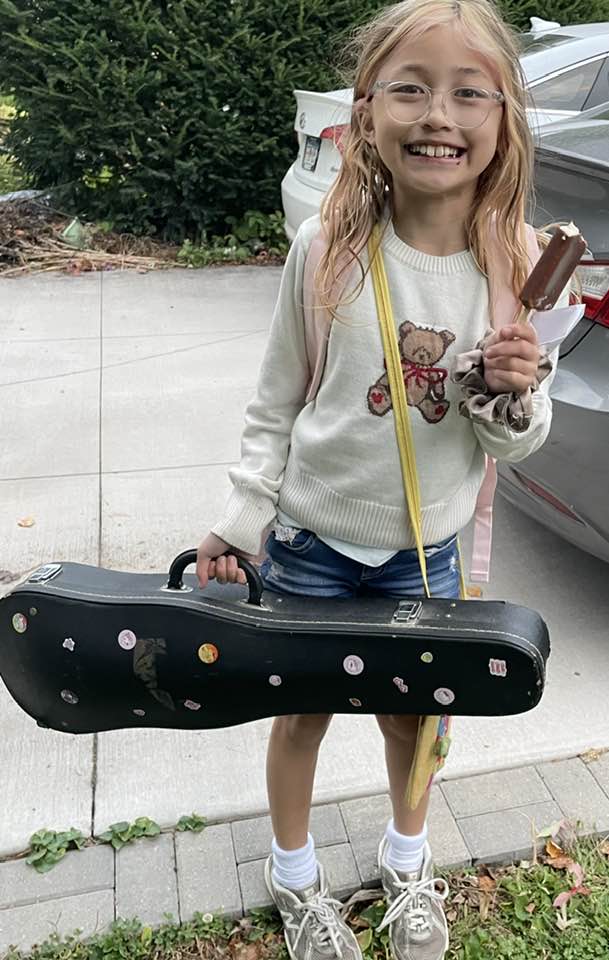
OCTOBER 6, 2025 – Today in accordance with our Monday routine, our fourth grader granddaughter came to our house after school for her weekly online (Zoom) drawing class, followed by a simple supper before her dad picked her up on his way home from work. She’s always such delightful company.
As we enjoyed our meal together, my wife and I asked Illiana about the status of “orchestra” at school. Apparently, she’s been given some instruction, but what we learned this evening is that she needs to acquire a violin and bow of her own. Well, well, well. Wouldn’t you know, but stored in a closet upstairs, her good ol’ grandpa has a regular violin shop going on, but one that’s been closed ever since the fourth grader’s father played violin in the Mounds Park Academy Royal Philharmonic. Surely, I thought, there must be a student fiddle up there—with a serviceable bow and secure case.
Back in the day I naively assumed that our sons would learn to play the violin at age four and by 10 would be performing demanding repertoire in stellar fashion. Of course, that would require more than the standard daily minimum of 30 minutes under the Suzuki method. But Suzuki would be only the launching pad. Once they gained a modicum of proficiency, I thought, Cory and Byron would be placed under the pedagogic influence of a recent Eastern European émigré, preferably an alumna/us of the Leningrad Conservatory, who would instill in our kids the highest of technical standards. I’d then drag them to weekly concerts, surround them with recordings by the world’s greatest violinists and, well, we’d then see how far they’d develop musically, as well as technically.
I didn’t account for many conflicting and competing factors, however, such as . . . sports, for example; Game Boy, for another, and well, the simple reality that unless a kid shows a keen interest in pursuing some endeavor, which interest is accompanied by extraordinary discipline and proclivity, it’s folly bordering on abuse for a parent to impose his or her regrets on the kid. I realized this axiom just in time. Because I myself had lacked the discipline, the obsession to become a great violinist by age . . . 10 . . . (from age 15 to 18, I did seriously flirt with the idea that if I worked my butt off, I could become a decent violinist) it was simply wrong for me to live the lost dream through my innocent sons.
Personally, I think many kids are made miserable by parents who want to relive their chances to be sports and musical heroes. Just because you’ve now realized at age 40 that you “coulda been” an all-star Big Ten wide receiver doesn’t mean you should force your kid to strive for that goal—as unrealistic for the kid as it was—and still is—for you. Ditto for the piano, violin or clarinet.
In the case of Illiana, I’ve been totally laid back. If I think of it when she’s around, I’ll pull up classical music on my laptop, select something off YouTube and have it play in the background. While it’s playing, I touch three bases: 1. Confirm that it’s “registering” with her—that is, that she’s noticing it, 2. I’ll announce what it is—e.g. “This is Mendelssohn’s Italian Symphony, which he wrote nearly 200 years ago,” and 3. Express simply what a positive effect the music has on me—nothing about her having to like it too. That’s it. No “you should,” or “I’d really like it if you played the violin/piano/bassoon.”
After finishing our supper, I led Illiana upstairs to the “violin shop” to dust off the cases that I thought might hold a violin her size. She exhibited ample enthusiasm for joining me. To my pleasant surprise, one case came close with a ¾ Suzuki fiddle in fine shape—along with a (barely) serviceable ¾ bow. This equipment is a bit oversized for her still, but as she held the violin up to her chin and grasped the neck, she said, “I think I’m growing, Grandpa. I’ve felt growing pains, so maybe soon the violin will fit.” I agreed. Since she wasn’t grabbing fiddle or bow by the fist but with a more delicate yet adequately firm grasp, I felt no compulsion to instruct. Her bow grip wasn’t half bad, and she remarked about how the teacher had instructed the novice violinists on this critical step in gaining proficiency on the hardest instrument to master. “Good!” is all I allowed myself. I was pleased with her undistracted interest in the whole enterprise, which took a good 20 minutes, including tuning the instrument for the first time in years.
To her credit, she asked me how to carry the case. I showed her the difference between top and bottom and told her to carry it always with top side out. “But the most secure way,” I said, “is to tuck it up against your side and wrap your arm around it. And treat it like your toothbrush—don’t let other kids hold it and never leave it outside of its case just lying around.” I had her test the case latches to make sure they’re secure. She was very good about listening and following my directions. Her reward, as it were, was license to decorate the outside of the case with stickers. Grandma helped her select some and added an inside identification card with Illiana’s name and parents’ phone numbers.
I’ll be curious to follow Illiana’s progress, but I’ve shed all expectations. I’ll wallow in delight if her experience with the instrument—however limited—elevates her appreciation for “the real thing,” for mastery of the instrument by virtuosi. I’ll be thrilled beyond words if by her exposure she seeks out great music—and supports it so that it may not only survive but thrive as a living art form.
P.S. After her art class I presented Illiana with a printout of the “Legacy Letter” I described in my 9/30 post (and included the entire blog post in which the letter was embedded). She read it, top to bottom, and commented on how she understood—the desire to be in two places at once. Upon finishing, she returned the letter to its envelope and slipped it securely into her school backpack. If she only knew what pleasure this brought its author!
Subscribe to this blog and receive notifications of new posts by email.
© 2025 by Eric Nilsson
