AUGUST 20, 2025 – Today “UB” would’ve turned 102. He didn’t do too bad in the longevity column, having lived just 44 days shy of 95. I remember exactly where I was when I received the call—walking down a broad corridor of Schiphol Airport in Amsterdam, awaiting a flight back to the U.S. A hospice nurse from the assisted living facility in Paramus, NJ informed me that UB had expired peacefully about an hour earlier. For years I thought my singularly eccentric Uncle Bruce would never die; or at least that even if I myself made it to the century mark, he’d survive me and celebrate the fact that I’d no longer pose a threat to his unique approach to life. But now he’s been dead and gone for over eight years.
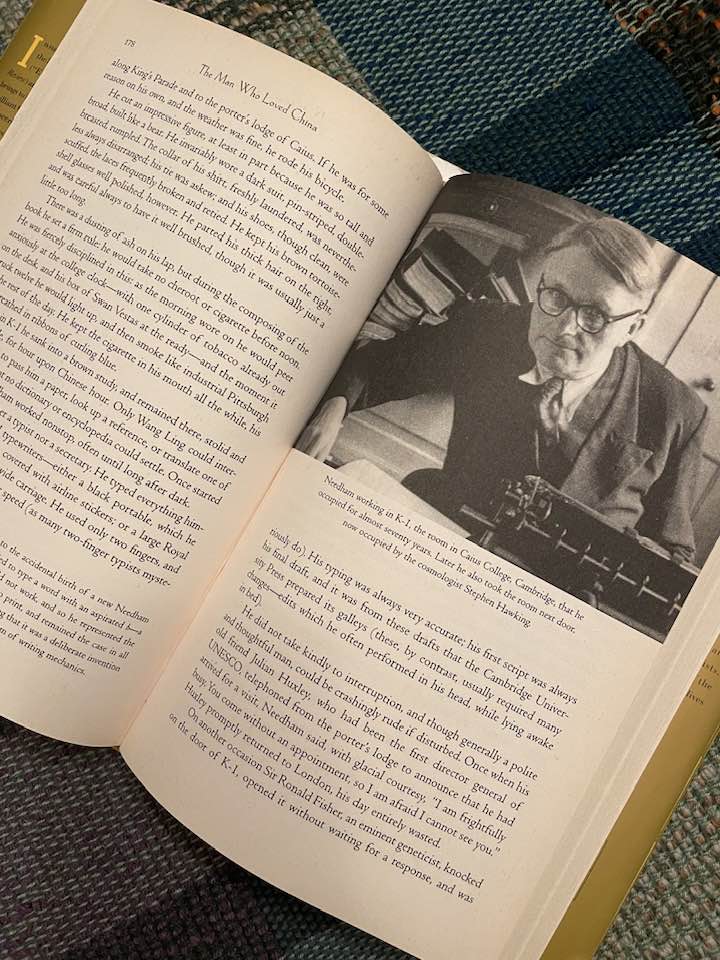
I thought about him today, not only because it’s his birthday, but because I finished reading Simon Winchester’s remarkable book about the inimitable Joseph Needham, The Man Who Loved China—a book that I know UB would’ve thoroughly enjoyed.
It featured UB’s own intense interests in science, history and travel. He was a voracious reader, and in his late 80s one of his favorite haunts was a Barnes & Noble store not more than a 10-minute drive from his home in Rutherford. He treated the bookstore as if it were his private library. Despite his considerable resources, I don’t believe he ever purchased a book at B & N. In fact, that was half the fun of hanging out there for a few hours each day—to read, not to browse and certainly not to buy.
UB made a hobby out of being “cheap,” or as he would call it, “thrifty.” He hadn’t always been so “cheap,” but he loved to “fool the system” without necessarily cheating it. And example would be to invite our friend Cliff to lunch, and when the waitperson appeared with the check, gesturing that it should be given to Cliff, who, being the kind of guy he was, would always pay. Treating a bookstore as a library was simply another variation on a familiar theme.
Anyway, I know UB would’ve been mesmerized by Simon Winchester’s account of the extraordinary academic and extra-curricular achievements of the inimitable Cambridge don and later Master, Noël Joseph Terence Montgomery Needham, who went by “Joseph” Needham. As a young faculty member of Gronville and Caius College in Cambridge, Needham encountered a visiting Chinese researcher three years his junior. Though happily married, Needham was smitten by the young woman, Lu Gwei-djen, and the two would lead a life-long affair that not only played out with his wife Dorothy’s full knowledge but with her active approval! (Needham would marry Gwei-djen two years after Dorothy’s death at 92).
But more critical to the story, it was by way of Gwei-djen that Needham the (highly regarded biochemist) became obsessed with learning Chinese and from there, learning the history of science in China. In conjunction with his official role as head of the Sino-British Scientific Cooperation Office (or “SBSCO” for short) under the British Foreign Ministry, Needham spent years in China gathering source material for what would become his magnum opus, a 24-volume Science and Civilisation in China, organized, written and published over a period of decades following World War II.
The compendium of all extant information about scientific discovery and technological inventions in China reaching back thousands of years embodied Needham’s strident belief that China had beaten the West in nearly every conceivable corner of science and technology until . . . about 1500. Then, everything in China seemed to stop. But why? This became known as the “Neeham Question,” but despite his deep understanding of Chinese history, culture, and science, Needham couldn’t supply a satisfactory answer, perhaps, Winchester speculates, because Needham “was too close to the topic, seeing many trees but not enough forest.” Other scholars have wrestled with the “Needham Question” and provided multiple explanations, but none is definitive.[1] In any event, I can easily imagine a perfectly lucid and extended conversation with UB about all this.
If Needham himself was a rare and colorful genius, much of the allure of studying his life and life’s work flows from all the extraordinary people with whom he interacted in his peripatetic career. He was drawn to people generally, but he attracted geniuses of all kinds, many of them with eccentricities rivaling his own. Winchester does a masterful job of folding these characters into the story. Moreover, by his superb organization of material and excellent writing, Winchester has created an eminently manageable reading experience—one that is only 265 pages, not 2,065 pages long, including a few pages of maps and fascinating photographs. UB, himself a polished and concise writer, would’ve appreciated this.
Needham wasn’t a Communist Party member, but he was an outspoken leftist and socialist. While in China during World War II, he’d befriended Zhou Enlai, and during the Korean War, Zhou would take advantage of this relationship. The Chinese made what most historians believe was a bogus claim that the Americans deployed biological weapons against Chinese and North Korean troops and civilians. The Reds then orchestrated the formation of an international commission to investigate this claim. Given his sterling reputation in the international scientific community, Joseph Needham was manipulated into assuming leadership of the commission. Based on questionable evidence—later determined to be faked—he led the commission to conclude that yes, in fact, the Americans had used biological weapons.
The Americans and British went nuts, as did much of the scientific community outside of the Soviet Union and the PRC. The result nearly upended Needham’s work on Science and Civilisation in China, along with his entire academic career. For a time he was persona non gratis (outside the communist world). When the first volume of his magnus opus came out (the year after the armistice was reached in Korea), however, the sheer magnificence of the work spoke for itself. Moreover, once the madness of the McCarthy Era abated, Needham was cut considerable slack for his leftward leaning politics. In time his standing as one of the world’s most honored scholars was restored. He lived to be nearly exactly as old as UB would live.
One more thing that UB—owner of several Ford Mustang convertibles—would’ve found in common with Joseph Needham: the latter’s affinity for his Armstrong-Siddley sports car, which the “eccentric professor” loved to drive way too fast between his house and office at Cambridge.
Subscribe to this blog and receive notifications of new posts by email.
© 2025 by Eric Nilsson
[1]Winchester summarizes a number of theories but he reduces the conclusions that flow from them to an unsatisfactory “punt”: “China basically stopped trying.” Perhaps—until now
